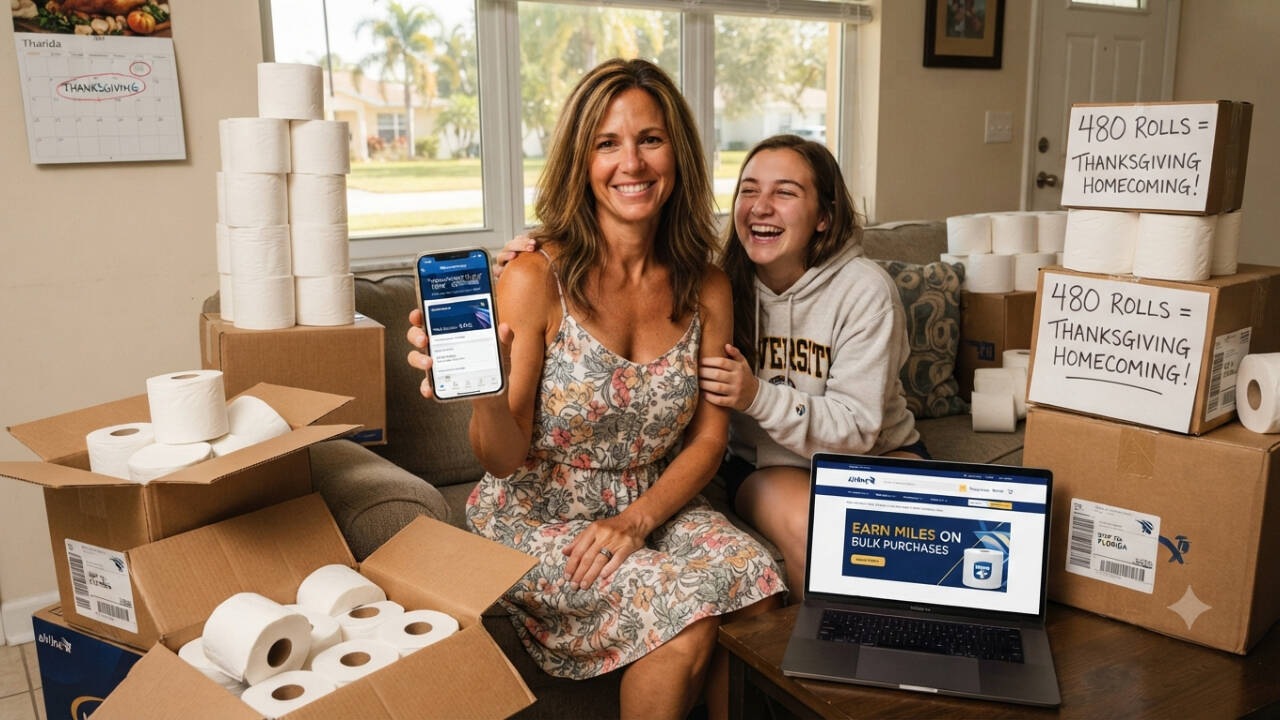
When a Florida mother recently bought 480 rolls of toilet paper to earn enough airline miles for her daughter’s flight home, the internet treated it as a quirky couponing stunt. It wasn't. She simply executed a standard, highly lucrative arbitrage play inside an airline shopping portal. By stacking a bulk household purchase with an elevated promotional bonus rate, she bypassed traditional credit card spending thresholds and acquired commercial airfare for the cost of bulk paper goods she already intended to buy.
Most travelers still believe that airline miles are earned exclusively by sitting in cramped aluminum tubes or swiping a co-branded credit card at the grocery store. That assumption leaves millions of dollars in unredeemed travel value sitting on the table every single year.
The Mechanics of the Portal Arbitrage
To understand how bulk toilet paper translates into a domestic airline ticket, you have to look at the backend economics of customer acquisition. Airlines do not make their primary profits from flying passengers; they make them by selling billions of dollars worth of frequent flyer miles to third-party banks and retail partners.
When you click through an airline's online shopping mall—such as American Airlines AAdvantage eShopping, United MileagePlus Shopping, or Delta SkyMiles Shopping—before making a purchase at a major retailer like Staples, Walmart, or Home Depot, you are triggering an affiliate marketing commission. The retailer pays the airline a percentage of your total cart value for referring the traffic. The airline takes a cut of that cash and uses the remainder to deposit miles directly into your loyalty account.
Normally, these portals offer a modest return of one to three miles per dollar spent. However, during seasonal retail pushes or quarterly promotional blitzes, those payouts spike dramatically. A retailer looking to clear warehouse inventory or hit quarterly sales targets might temporarily offer 10, 15, or even 20 miles per dollar spent.
Consider a hypothetical example of how the math works on a bulk staple purchase. Suppose an office supply chain runs a limited-time promotion through an airline portal offering 15 miles per dollar, alongside a site-wide coupon for bulk janitorial supplies. A consumer spends $400 on wholesale toilet paper, paper towels, and trash bags.
- Portal Payout: $400 multiplied by 15 miles per dollar equals 6,000 bonus miles.
- Credit Card Base Spend: Paying with a standard 2x points travel credit card adds another 800 miles.
- Portal Tier Bonus: Many airline portals run seasonal spend bonuses—such as earning an extra 2,000 miles when you spend $350 within a promotional window.
Suddenly, a single $400 household restock yields 8,800 airline miles. On many domestic carriers, off-peak economy redemptions or short-haul flights start between 7,500 and 10,000 miles. The consumer didn't spend extra money on frivolous luxury items. They shifted their future household budget forward, absorbed the storage space requirement, and extracted a free flight out of routine domestic overhead.
Why Retailers Subsidize Your Vacation
Why would a major box store pay a hefty affiliate commission on low-margin bulk paper products? Customer lifetime value.
Retailers know that acquiring a new online shopper through traditional digital advertising is brutally expensive. Search engine ads and social media placements often cost more than the profit margin of an initial order. By partnering with airline loyalty programs, retailers tap into an audience of high-intent, financially stable buyers who actively hunt for point-earning opportunities.
Data from loyalty industry analysts consistently shows that members of airline frequent flyer programs spend significantly more per transaction than average online shoppers. Retailers are willing to take a short-term loss—or break even—on a massive bulk order of toilet paper because they are betting you will return to their site later for higher-margin items like printer ink, office furniture, or electronics without clicking through a portal.
Furthermore, bulk staples have predictable replenishment cycles. Once a household switches its wholesale purchasing habit to a specific online vendor, inertia takes over. The retailer sacrifices margin today to lock in a repeat buyer tomorrow.
The Hidden Traps of Manufactured Portal Spend
Before you clear out your garage to make room for forty-eight packs of two-ply, you need to understand where this strategy breaks down. Loyalty programs are businesses, not charities, and the fine print is specifically engineered to catch careless shoppers.
Excluded Categories and Bulk Caps
Retailers routinely bury exclusions deep within the terms and conditions of each portal listing. Gift cards are universally excluded, but many merchants also strip out electronics, certain appliance brands, or items purchased using unauthorized coupon codes. If you apply a promo code you found on a random coupon browser extension at checkout, the retailer will frequently void the affiliate commission entirely. The airline never gets paid, which means you never get your miles.
The Tracking Cookie Nightmare
Portal tracking relies entirely on browser cookies. Ad blockers, privacy-focused browsers, VPNs, and intelligent tracking prevention features can sever the digital link between the airline portal and the merchant's checkout page. If the cookie drops, your purchase registers as direct traffic. Recovering missing miles requires submitting receipts, waiting weeks for manual audits, and dealing with customer service agents who often deny claims based on technicalities.
The Storage and Liquidity Penalty
Buying 480 rolls of toilet paper solves a future expense, provided you have a dry basement, a spare closet, or a large garage. If you live in a 700-square-foot apartment, turning your living room into a warehouse is a terrible trade-off. Moreover, prepaying for a year's worth of household supplies ties up liquid cash. If you carry a balance on your credit card to fund a bulk portal purchase, the 24% APR interest charges will instantly obliterate the value of the miles you earned.
How to Execute a Portal Play Without Getting Burned
Veteran points collectors treat shopping portals like financial arbitrage desks. They do not browse casually; they execute with strict operational discipline.
- Use a Dedicated Clean Browser: Never shop through a portal using your daily web browser loaded with ad blockers and coupon extensions. Keep a separate, completely stock browser strictly for portal transactions. Clear the cookies before you start, click directly from the airline portal to the merchant, and complete the purchase in a single uninterrupted session.
- Verify Historical Payout Rates: Never buy at 2 miles per dollar if a merchant routinely jumps to 10 miles per dollar every six weeks. Aggregator sites track historical portal payout rates across all major airlines and cash-back platforms. Checking the payout history takes ten seconds and prevents you from leaving thousands of points on the table.
- Document Every Step: Take screenshots of the portal offer rate, the timestamped click-through confirmation, and your final itemized receipt. If the miles fail to post within fifteen days, this documentation is the only leverage you have to force a manual credit.
- Calculate the Cash Opportunity Cost: Always compare the airline portal rate against pure cash-back portals. If an airline offers 5 miles per dollar (worth roughly 7.5 cents in travel value) while a cash-back competitor offers 12% cash back on the exact same store, take the cash. Loyalty points are subject to sudden, unannounced devaluations by the airlines; cold cash in your checking account never loses its redemption chart.
The Slow Erosion of Loyalty Value
The viral appeal of the Florida toilet paper story lies in its David-versus-Goliath charm—a regular parent outsmarting a multibillion-dollar aviation conglomerate. Yet looking closely at the mechanics reveals a starker reality about modern consumerism.
Airlines have steadily gutted the value of flying itself. Basic economy fares earn virtually nothing. Status thresholds now demand tens of thousands of dollars in annual spend. Dynamic award pricing means a flight that cost 12,500 miles three years ago might cost 38,000 miles next Tuesday.
To survive in this environment, consumers have been forced to turn mundane domestic chores into complex financial optimization exercises. Buying toilet paper isn't about hygiene anymore; it is a strategic asset allocation designed to subsidize basic family travel. Until regulators curb dynamic award inflation or airlines restore genuine loyalty rewards to actual flyers, your smartest move isn't booking a flight—it's checking the portal multiplier before you restock your pantry.