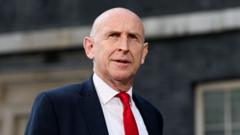
The political churn inside Westminster has hit a breaking point. With a sweeping clearout of former Starmer allies and a new face sitting at the Treasury, the British government is entering a brutal phase of fiscal arithmetic.
Political commentators love focusing on the human drama of cabinet reshuffles. They obsess over who was sidelined, who took a step down, and who managed to survive another week on the front bench. But focusing purely on parliamentary rivalries misses the real story. Discover more on a related issue: this related article.
The immediate dilemma isn't about personality clashes in Downing Street. It's about an inescapable financial reality: Britain's budget deficits, mounting public debt, and the staggering cost of public services leave virtually zero room for error.
The Spending Squeeze Behind Cabinet Shifts
When a new administration or chancellor takes over, the narrative usually centers on fresh starts. Politicians promise clear visions and bold structural shifts. Yet the moment they sit down with senior civil servants at the Treasury, those ambitious visions run straight into a brick wall of balance sheets. Additional reporting by USA Today explores related views on the subject.
The UK's public finances are constrained by severe headwinds:
- Inflationary pressures over recent years have permanently driven up the cost of government procurement and public sector wage demands.
- Debt interest payments consume tens of billions of pounds every year that could otherwise fund frontline services.
- Demographics continue to push health and social care expenditures higher without a matching rise in economic output.
Swapping out cabinet ministers might change the rhetoric, but it doesn't change the numbers. A new chancellor faces the exact same tax receipts and expenditure obligations as their predecessor.
Tax Revenues (Stagnant) - Fixed Liabilities (Rising) = Fiscal Hole
This mathematical dynamic creates an immediate tension between political necessity and fiscal discipline.
Clearing Out Allies Won't Fix Structural Deficits
Political purges are standard practice when a leadership team feels trapped by its own record. Removing factional figures or loyalists associated with past policy stumbles sends a signal of authority. It tells backbenchers and voters that the government is willing to reset its course.
However, political reshuffles are often used as a substitute for policy decisions. Moving ministers around different departments creates a temporary illusion of momentum while fundamental problems remain unaddressed.
Take the Ministry of Defence, the Department of Health and Social Care, or the Home Office. None of these departments can improve outcomes simply through new political leadership. They require long-term capital investment, structural reforms, and clear priorities. When a government refuses to choose between raising taxes or cutting services, shuffling personnel becomes an exercise in optics.
Hard Choices in the Treasury
The Treasury is where ideological promises go to die. Any chancellor stepping into the role faces three brutal levers, each carrying severe political costs:
1. Broad-Based Tax Increases
Raising main rates like Income Tax, National Insurance, or VAT yields substantial revenue. However, doing so breaks major campaign pledges, crushes consumer confidence, and alienates working voters who feel squeezed by living costs.
2. Departmental Spending Cuts
Slashing budgets across un-protected departments—like local government, justice, or transport—causes immediate operational strain. Local councils are already facing severe financial insolvency risks, and public infrastructure continues to crumble from years of deferred maintenance.
3. Higher Borrowing
Increasing government borrowing risks alarming bond markets. Ever since the market turmoil of late 2022, international investors have shown zero tolerance for unbudgeted spending commitments or ambiguous fiscal rules. Higher yields on government bonds mean higher borrowing costs across the entire economy, including mortgage rates for ordinary households.
There are no hidden options. The government must pull one or more of these levers, and every choice creates vocal enemies.
The Mirage of Economic Growth as a Quick Fix
Ministers across the spectrum frequently claim that "unlocking economic growth" will solve these fiscal dilemmas without painful choices. While productivity growth is essential for long-term health, treating it as an immediate solution for current budget shortfalls is unrealistic.
Structural reforms—such as planning system overhauls, energy grid updates, and skills training—take years to show up in official gross domestic product (GDP) figures. Tax receipts won't magically jump next quarter because a government published a new growth strategy document today.
In the short run, fiscal choices are zero-sum. If spending rises in one area, it must be cut elsewhere or financed through higher taxation.
What Needs to Happen Next
To break out of this cycle of political instability and fiscal crisis, the government needs to drop the management tricks and adopt a clear, transparent strategy:
- Conduct an honest public accounting of departmental liabilities instead of relying on accounting gimmicks to meet self-imposed fiscal rules.
- Prioritize long-term infrastructure and capital investment over short-term consumption subsidies, ensuring borrowed funds actually build growth-generating assets.
- Establish clear, multi-year spending frameworks for key departments to allow civil servants and public sector leaders to plan effectively without constant policy shifts.
- Stop using cabinet reshuffles as a distraction from structural tax and spending decisions.
Until the government aligns its political promises with actual economic reality, changing the faces around the Cabinet table will do little to fix the underlying crisis.