You are probably burning out on the same predictable travel destinations. The crowded European alleys, the over-touristed tropical beaches, and the heavily filtered Instagram spots all start to blur together after a while. If you want a destination that genuinely shifts your perspective, you have to look toward places where modern civilization simply fails to leave a footprint.
Deep in southeastern Venezuela lies Canaima National Park, a protected wilderness roughly the size of Belgium. It is a raw, prehistoric expanse spanning 30,000 square kilometers. This isn't your typical manicured nature reserve. It is a place where cellular service dies, roads don't exist, and geological structures date back two billion years.
People usually look up Canaima for one specific reason. They want to see Angel Falls, the tallest waterfall on the planet. But focusing only on the waterfall means missing the broader, mind-bending reality of this ancient ecosystem. This park is an evolutionary time capsule home to apex avian predators that hunt monkeys and isolated mountaintops that function as biological islands.
The Island Ecology of the Ancient Tepuis
When you look across the horizon of Canaima National Park, the flat-topped table mountains dominate the sky. Locally known as tepuis, these vertical sandstone monoliths occupy roughly 65% of the park's territory. They are some of the oldest geological formations on Earth, tracking back to an era when South America and Africa were still fused together as a supercontinent.
The sheer vertical walls of these mountains rise up to 1,000 meters straight out of the lowland rainforests. Because these summits have been completely cut off from the valleys below for millions of years, they operate as biological islands in the sky. Evolution didn't just slow down here; it took an entirely different path.
Scientists studying the tepuis have found that each individual summit possesses its own highly localized ecosystem. The soil on top of these plateaus is incredibly nutrient-poor due to constant heavy rainfall. To survive, the plant life adapted to become carnivorous. You will find massive fields of pitcher plants and sundews that trap and digest insects for sustenance.
The animal life on the summits is equally strange. You won't find large jaguars or pumas roaming the tops of the tepuis. Instead, the high-altitude terrain belongs to micro-endemic species like the tiny Roraima mouse and Tyler's mouse opossum. These creatures live in a cloud-shrouded world of wet stone and moss, completely unaware of the massive predators hunting in the jungles thousands of feet below them.
Living with the Heavyweight Raptors of the Canopy
If the mountaintops belong to the micro-species, the lowland rainforests and vast savanna grasslands belong to the giants. Walk through the dense river valleys and you are entering the hunting grounds of South America's most formidable aerial predator: the harpy eagle.
With a massive wingspan reaching up to two meters, the harpy eagle is an absolute unit of an avian hunter. They don't fly high in the open sky like eagles you see in North America. Instead, they navigate the dense, tangled canopy of the Venezuelan jungle with terrifying agility.
Their primary prey consists of sloths and tree-dwelling monkeys, including red howlers and white-faced sakis. A harpy eagle’s talons are roughly the same size as the claws of a grizzly bear, capable of exerting enough pressure to crush bones instantly. Hearing the sudden, panicked alarm calls of howler monkeys echoing through the canopy usually means one of these apex raptors is hunting nearby.
The presence of these eagles indicates a highly stable, intact ecosystem. They require massive corridors of undisturbed forest to survive and rear their young. Aside from the eagles, the lower levels of the park protect vulnerable populations of giant armadillos, giant river otters, and secretive jaguars.
Standing at the Base of Earth's Highest Waterfall
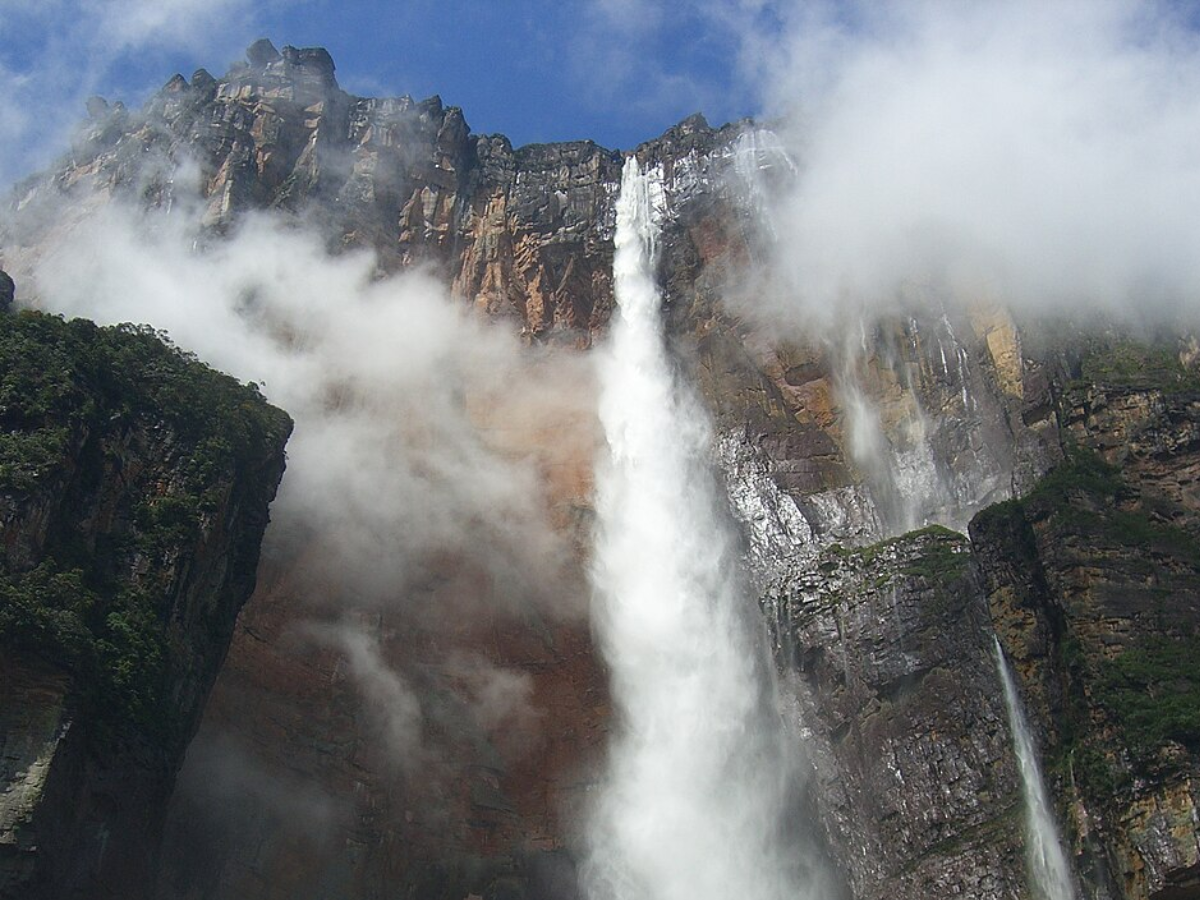
Angel Falls is the undeniable centerpiece of the park, dropping a staggering 979 meters from the plateau of Auyán-tepui. To put that in perspective, it is more than double the height of the Empire State Building and roughly fifteen times taller than Niagara Falls. The water plunges so far that by the time it reaches the lower canyon, much of it has atomized into a massive, blinding mist that blankets the surrounding forest.
The indigenous Pemon people, who have inhabited this region for centuries, call the falls Kerepakupai Merú, which translates to "waterfall of the deepest place." They hold a deep spiritual connection to these formations, viewing the tepuis as the sacred domain of the Mawari spirits.
The modern name comes from Jimmie Angel, an American bush pilot who spotted the falls in 1933 while searching for a mythical river of gold. He returned in 1937 and managed to crash-land his plane on the swampy summit of Auyán-tepui. He and his crew had to hike down the treacherous mountain walls for eleven days just to get back to civilization.
Logistical Realities of Traveling to Canaima
Let's be completely honest about one thing. You cannot simply rent a car, plug Canaima into Google Maps, and drive there. There are no roads leading into the heart of the park. If you want to experience this wilderness, you have to commit to a multi-stage expedition.
The baseline reality of planning an itinerary involves specific steps:
- The Inbound Flight: You must book a light commercial or charter flight from cities like Caracas or Puerto Ordaz to the tiny airstrip at Canaima village.
- The River Journey: Reaching the base of Angel Falls requires boarding a traditional wooden motorized canoe, known as a curiara, operated by expert Pemon captains.
- The Timing: You need to time your visit during the rainy season, which runs from May through November. If you try to go during the peak dry season, river levels drop too low, and canoes cannot navigate the rapids of the Carrao and Churún rivers.
You will sleep in rustic hammock camps along the riverbanks, listening to the roar of the water and the sounds of the jungle. It is a trip devoid of luxury resorts or predictable schedules.
The park currently faces mounting environmental pressures from illegal gold and diamond mining along its outer borders, which introduces mercury pollution into vital waterways. Unregulated fires and shifting climate patterns also threaten the fragile cloud forests of the tepuis. Visiting responsibly means working exclusively with local Pemon guides and established eco-tours that actively fund community conservation efforts.
If you want to experience a corner of the planet that looks exactly as it did thousands of years ago, start looking into flight options to Caracas. Reach out to reputable local operators like Angel-Eco Tours or Osprey Expeditions to check river conditions and secure the necessary park permits. Pack high-quality waterproof gear, leave your expectations of constant connectivity behind, and prepare for an expedition that will redefine how you view the natural world.