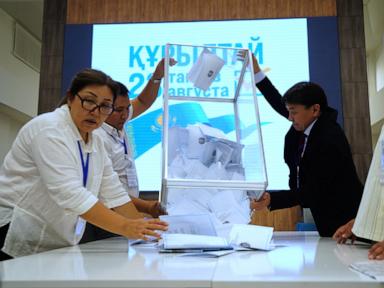
Political consolidation in transitional states rarely happens through abrupt disruption; instead, it unfolds via institutional engineering and legal re-architecting. The recent parliamentary election in Kazakhstan, which resulted in a 71 percent landslide victory for the newly formed, pro-government Adilet party, illustrates how state machinery adapts to macroeconomic pressure and geopolitical volatility. Operating under a newly established single-chamber legislature known as the Kurultai, the political apparatus executed a structural centralization of power designed to insulate the executive branch from external shocks.
Understanding this outcome requires examining the operational variables that dictate political outcomes in Central Asia's largest economy. Rather than viewing the election as an isolated democratic exercise, quantitative observation reveals a calculated alignment of legal frameworks, economic risk management, and executive continuity.
The Constitutional Architecture of Centralization
The legislative landslide did not occur in a vacuum; it served as the tactical culmination of a structural overhaul initiated earlier in the year. By merging a historically bicameral system into the single-chamber Kurultai, the administration reduced friction in the legislative pipeline. In political economy, structural simplification decreases the transaction costs of passing executive-sponsored mandates.
The mechanics of this overhaul rely on three distinct institutional levers:
- Executive Appointment Powers: The revised constitutional framework grants the presidency direct authority over key administrative placements, subject to parliamentary confirmation.
- Term Reset Mechanics: A ruling by the Constitutional Court established that structural amendments reset the statutory clock on presidential terms, creating a legal pathway for an extended mandate past 2029.
- Threshold Management: Electoral laws establishing a 5 percent entry barrier permitted four secondary blocs—including the Auyl Party, Respublica, Aq Jol, and the Nationwide Social Democratic Party—to enter parliament while maintaining absolute dominance for the primary pro-government vehicle.
International monitors from the Organization for Security and Co-operation in Europe noted that the resulting legislature features a uniform ideological alignment, with all seated factions endorsing the core programmatic agenda of incumbent President Kassym-Jomart Tokayev. This elimination of legislative friction ensures that executive directives encounter zero internal opposition during implementation phases.
Macroeconomic Stressors and Risk Mitigation
Political centralization directly correlates with economic volatility. At the time of the election, Kazakhstan faced a domestic inflation rate running at 10.2 percent alongside friction generated by recent tax increases. These financial pressures generate public discontent, heightening the state's sensitivity to social instability.
The administrative memory of the January 2022 fuel price protests—which escalated into widespread unrest—serves as a primary behavioral driver for state planners. In economic risk management, when systemic volatility spikes, decision-making authority concentrates inward to mitigate tail-risk events. The structural expansion of executive control functions as an institutional hedge against civil friction, prioritizing state continuity over pluralistic debate.
Geopolitical Equilibrium and External Dependencies
Operating as a regional pivot between major global powers, Kazakhstan maintains a deliberate diplomatic balancing act. Since the imposition of Western sanctions on Russia following the conflict in Ukraine, the administration has navigated competing economic corridors, energy transit routes, and secondary compliance risks.
This external exposure demands high administrative agility. The official justification provided for the constitutional streamlining centers entirely on the necessity for rapid decision-making within a fragmented global trade environment. When supply chains face continuous disruption and secondary sanctions threaten export revenue, centralized governance models substitute bureaucratic consensus with top-down execution.
Information Control and Opposition Constraints
Political monopolies rely heavily on controlling informational vectors and managing political competition. Ahead of the legislative cycle, state authorities intensified pressure on independent digital publishers and investigative bloggers, opening approximately ten criminal proceedings against media figures.
This enforcement pattern targets the informational infrastructure necessary for coordinated opposition. By restricting independent reporting and maintaining strict oversight over digital discourse, the state raises the operational cost of dissent. Consequently, political competition is channeled exclusively through state-sanctioned channels that do not challenge core executive parameters.
Execute structural enforcement through concentrated executive authority, aligning legislative design with risk mitigation protocols to insulate the state against macroeconomic and geopolitical friction.