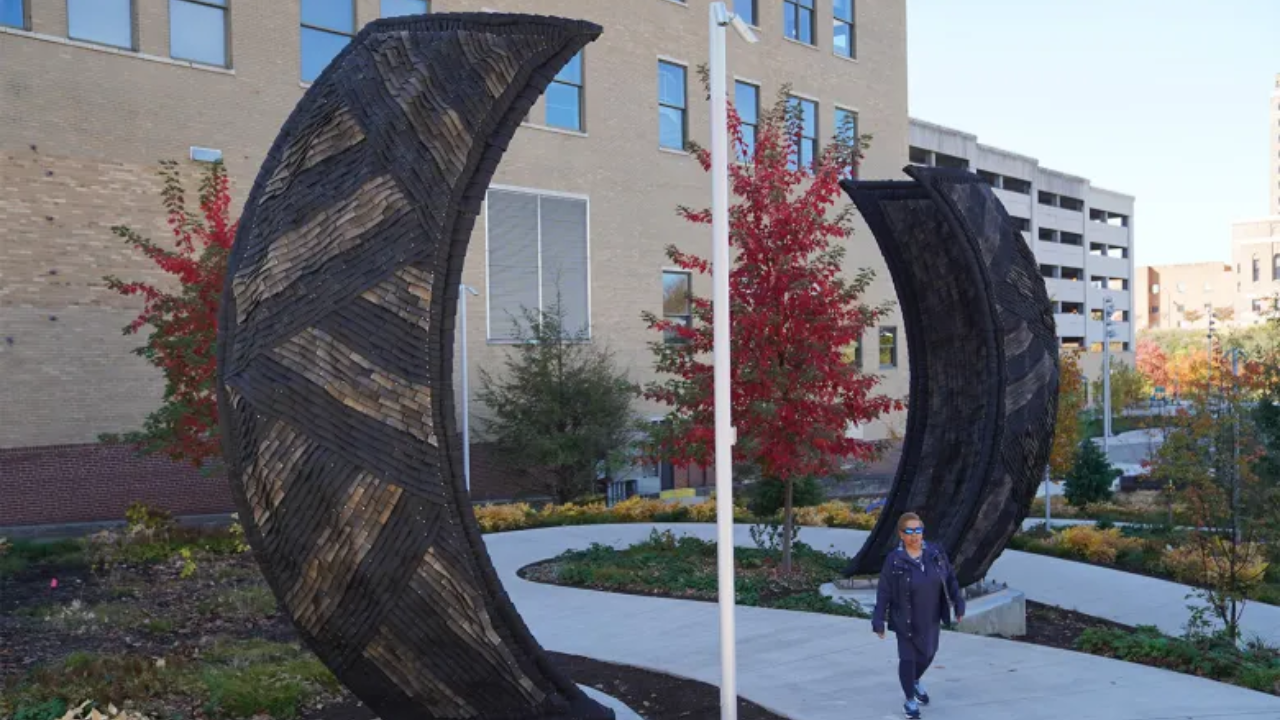
Most public park sculptures are cold bronze statues you walk right past without blinking. Then you turn a corner in an Ohio park and see 17 feet of shredded, twisted racing rubber staring back at you.
Artist Chakaia Booker didn't build her sculpture Transit just to make a neat environmental statement. She took discarded racing tires and turned them into a massive, aggressive monument to movement, industrial labor, and survival. If you think rubber recycling art is just a trendy green-washing gimmick, you're missing the entire point of her work.
What Transit Actually Looks Like in Person
Standing 17 feet tall, Transit refuses to blend into the grass and trees around it. Booker slices, twists, and bolts together discarded racing tires—not standard passenger car tires, which makes a massive visual difference.
Racing tires are wider. They have smoother treads, thicker sidewalls, and completely different wear patterns from high-speed track friction. When Booker cuts into them, those thick rubber walls curl outward like organic petals, jagged armor, or braided hair.
The color isn't flat black either. Look closely at the rubber and you'll catch:
- Deep charcoal grays from track heat
- Scuffed browns and dusty tans from exposure
- Exposed steel belts glinting under sunlight
- Subtle texture shifts where high-speed corners chewed up the tread
It feels alive. Almost violent. You don't just glance at a 17-foot tower of shredded track rubber and keep checking your phone. It demands your physical attention because the material itself carries the memory of speed and friction.
Why Chakaia Booker Uses Tires Instead of Bronze or Marble
Booker has worked with rubber tires since the early 1990s, long before "upcycling" became a buzzword in corporate marketing decks. She started scavenging tires off the streets of New York City because they were free, tough, and loaded with human history.
Think about what a tire actually does. It absorbs every pothole, every sharp turn, every ounce of friction between a machine and the road. For Booker, rubber treads look like African scarification patterns, braided hairstyles, and woven textiles all at once.
Honestly, traditional sculpture materials like marble and cast bronze feel sterile next to vulcanized rubber. Bronze represents permanent, wealthy authority. Tires represent working-class grit, blue-collar manufacturing, and the relentless wear and tear of getting from point A to point B.
By naming the 17-foot Ohio installation Transit, Booker points directly at how goods, workers, and cultures move across the Midwest. Ohio isn't just a random backdrop here. The state is the historic heartland of American tire manufacturing—Akron wasn't called the "Rubber Capital of the World" for nothing. Placing a massive sculpture made of spent racing tires in an Ohio park hits right at the center of that industrial legacy.
What Most People Get Wrong About Tire Art
Whenever a major outdoor tire sculpture makes headlines, the comment sections fill up with the exact same knee-jerk takes. Let's clear up the biggest misconceptions right now.
Misconception 1 It's Just Trash Piled Together
People assume Booker grabs old tires from a junkyard and stacks them up like playground equipment. Nothing could be further from the truth.
Working with steel-belted racing tires is brutal physical labor. You can't shape vulcanized rubber with gentle clay tools. Booker and her studio team use heavy industrial saws, drills, and custom metal armatures to slice through thick rubber and wire reinforcement. Every curve and fold is engineered so the 17-foot structure survives Midwest wind, snow, and summer heat without collapsing.
Misconception 2 The Art Is Only About Recycling
Yes, diverting rubber waste from landfills matters. Scrap tires are notoriously difficult to dispose of because they trap water, breed mosquitoes, and burn with toxic smoke if ignited.
Still, reducing Booker's career to a "recycling project" flattens the work. She isn't making park benches out of ground-up rubber pellets. She's using industrial waste as a high-art medium to talk about race, gender, labor, and human resilience. The environmental angle is a byproduct of her material choice, not the whole story.
Misconception 3 Outdoor Rubber Sculptures Fall Apart Quickly
Vulcanized rubber is designed to survive extreme heat, freezing temperatures, and thousands of miles of asphalt friction. That durability is actually why scrap tires are such an environmental headache in the first place—they don't biodegrade.
In an outdoor park setting, a steel-supported tire sculpture handles rain, snow, and UV exposure far better than painted wood or delicate stone. It ages naturally, picking up subtle weathering from the elements without losing its structural bite.
The Engineering Reality Behind a 17-Foot Tire Sculpture
Building anything 17 feet tall for a public park requires serious structural planning. You can't just bolt rubber to rubber and hope a November windstorm doesn't knock it over.
Inside Transit, a hidden steel skeleton carries the real load. Booker wraps, layers, and bolts the sliced racing tires onto that internal frame so the rubber appears to twist upward on its own.
Because racing tires lack the deep water-channeling grooves of standard commuter tires, their wide, flat profiles act almost like sails if positioned wrong. The gaps and curls in Booker's cuts aren't purely decorative. Allowing wind to pass through the open folds reduces wind resistance across the 17-foot height, keeping the piece stable in open park grounds.
How to Experience Public Sculpture Without Missing the Point
If you're planning to visit Transit in Ohio—or any large-scale outdoor installation—don't treat it like a quick selfie backdrop.
- Walk a full 360-degree circle around it. Booker builds movement into every angle. What looks like a solid wall of black rubber from the front opens up into hollow ribs and curled spirals from the side.
- Visit at different times of day. Harsh noon sunlight flattens black rubber, while late afternoon sun catches the brown oxidation, silver steel wires, and deep shadows inside the folds.
- Look at the cut edges, not just the silhouette. That's where you see the physical effort it took to slice through track-grade rubber.
Go stand next to Transit in person and pay attention to how the scale shifts your posture—you have to crane your neck back just to take in the top edge of the rubber.