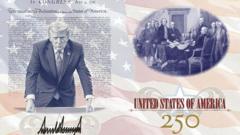
The crisp smell of freshly minted polycarbonate and ink always carries a distinct weight. When you hold a new passport, you are holding a physical manifestation of sovereignty, an expensive little book of permissions that dictates exactly how frictionlessly you can move across the surface of the earth. For decades, the inside pages of the American passport have remained a visual hymn to a specific, idealized version of the nation—bald eagles soaring over Mt. Rushmore, the rugged peaks of the Rockies, and the steady hand of the writing of the Constitution.
But as the United States approaches its 250th birthday, a quiet transformation inside the passport offices has turned a standard administrative update into a fierce debate over national identity. Also making waves in related news: The Illusion of the Dotted Line.
The State Department recently confirmed that a select run of commemorative passports issued for the Semiquincentennial will feature the likeness of Donald J. Trump, the 45th president. For some, the inclusion is a natural nod to modern history during a milestone celebration. For others, it feels like a jarring shift in how the nation projects its image to foreign border officials at midnight in distant airports.
To understand how a piece of security paper became a cultural lightning rod, look at the desk of an ordinary citizen. Let us call her Sarah. She is a freelance graphic designer living in Ohio, someone who rarely thinks about federal print procurement until her own passport expires. When her new document arrived in the mail, she tore open the white government envelope, expecting the usual patriotic iconography. Instead, turning to the interior pages designed to celebrate the nation's recent historical trajectory, she found herself staring at the distinct, engraved profile of a president who remains one of the most polarizing figures in modern memory. Additional information into this topic are detailed by USA Today.
Sarah sat at her kitchen table, turning the page under the light. Her reaction was not just political; it was deeply visceral. A passport is not a campaign poster. It is an extension of the self when you cross a border.
The decision to alter the interior artwork of the passport for the 250th anniversary was born out of a long-standing tradition of updating security features to stay ahead of international counterfeiting rings. Passports are updated roughly every decade, introducing intricate new intaglio printing, variable inks, and holographic threads that make duplication nearly impossible. When planners began mapping out the commemorative edition for 2026, the mandate was to capture the full arc of the American story.
Bureaucracy, by its very nature, prefers the dead to the living and the distant past to the messy present. Traditionally, the artwork featured in the passport has leaned heavily on the 18th and 19th centuries. Washington, Jefferson, and Lincoln are safe choices, ironed smooth by the passing of generations into uncontroversial symbols of statehood.
Introducing contemporary political figures breaks that unwritten rule. The technical justification from the government printing offices hinges on historical completeness. The commemorative series aims to depict the modern presidency as part of the broader American continuum. But human beings do not look at passports through the lens of technical print specifications. We look at them through our values.
Consider what happens next when an American traveler hands that book over to a border guard in a country where American foreign policy is viewed with deep skepticism.
The passport is a shield. When you hand it to an official in a foreign port of entry, you are saying, The entire economic and military weight of my country stands behind this little book. The artwork inside has traditionally acted as a neutral background, a silent chorus of historical motifs. By inserting a highly contemporary, living political symbol into the very fabric of the document, the nature of that interaction changes. The shield suddenly acquires a specific voice.
The debate has exposed a fascinating schism within the traveling public. For supporters of the former president, the inclusion is a validation of a populist movement that redefined American politics in the early 21st century. They see it as an act of historical realism—an acknowledgment that you cannot celebrate 250 years of a nation while pretending its most disruptive chapters never occurred. To them, the image belongs there just as much as the silhouette of the freedom trail or the words of the Gettysburg Address.
On the other side, critics view the move as an unprecedented politicization of a document that belongs to all citizens regardless of party. They argue that a passport should remain an emblem of unity, a shared asset that protects the bearer precisely because it represents the state, not a faction.
Behind the political theater lies the incredible complexity of modern passport manufacturing. These documents are masterpieces of physical security. The pages are made from a complex blend of cotton paper infused with chemical sensitisers that change color if someone attempts to erase an entry. The images themselves are not simply printed; they are built into the paper using security engraving techniques that create raised ridges you can feel with your thumb.
The engraving of the 45th president uses micro-text—tiny lines of printing that appear as solid boundaries to the naked eye but reveal words under a microscope. In this case, the lines forming the portrait are composed of text from historical inaugural addresses. It is a staggering feat of engineering, meant to baffle sophisticated state-sponsored forgers.
Yet, all that engineering cannot iron out the human friction.
A passport is an intensely personal object. It accumulates stamps like scars, tracking the geography of a life lived across borders. It sits in your breast pocket, warming against your body during long flights. When you are stranded, lost, or in danger abroad, it is the only object that truly matters. Forcing a citizen to carry an image that they may fundamentally oppose creates a strange psychological dissonance. It forces a collision between private conscience and public identity.
The State Department has noted that the commemorative version is optional, distributed only to a select percentage of applicants during the anniversary window, with standard designs remaining available for those who request them. But the very existence of the option has opened a door that cannot easily be closed. It raises a uncomfortable question about the future of national symbols: if the artifacts of statehood become customizable or reflective of shifting political tides, do they lose their ability to bind a diverse populace together?
Sarah eventually put her new passport into her travel wallet. She will use it to fly to Europe later this year. She knows that when she hands it over at the border control desk in Paris or Berlin, the agent will likely glance at the data page, scan the machine-readable zone, and flip through the pages looking for an empty spot to press an ink stamp. The agent might not even notice the engraving on page sixteen.
But Sarah knows it is there. Every time she packs her bag, she will look at that book and remember that even the most mundane instruments of federal bureaucracy are deeply vulnerable to the cultural wars tearing at the country below. The blue book remains a ticket to the world, but its pages now reflect a nation that is still deeply unsure of how it wants to tell its own story to the rest of the planet.