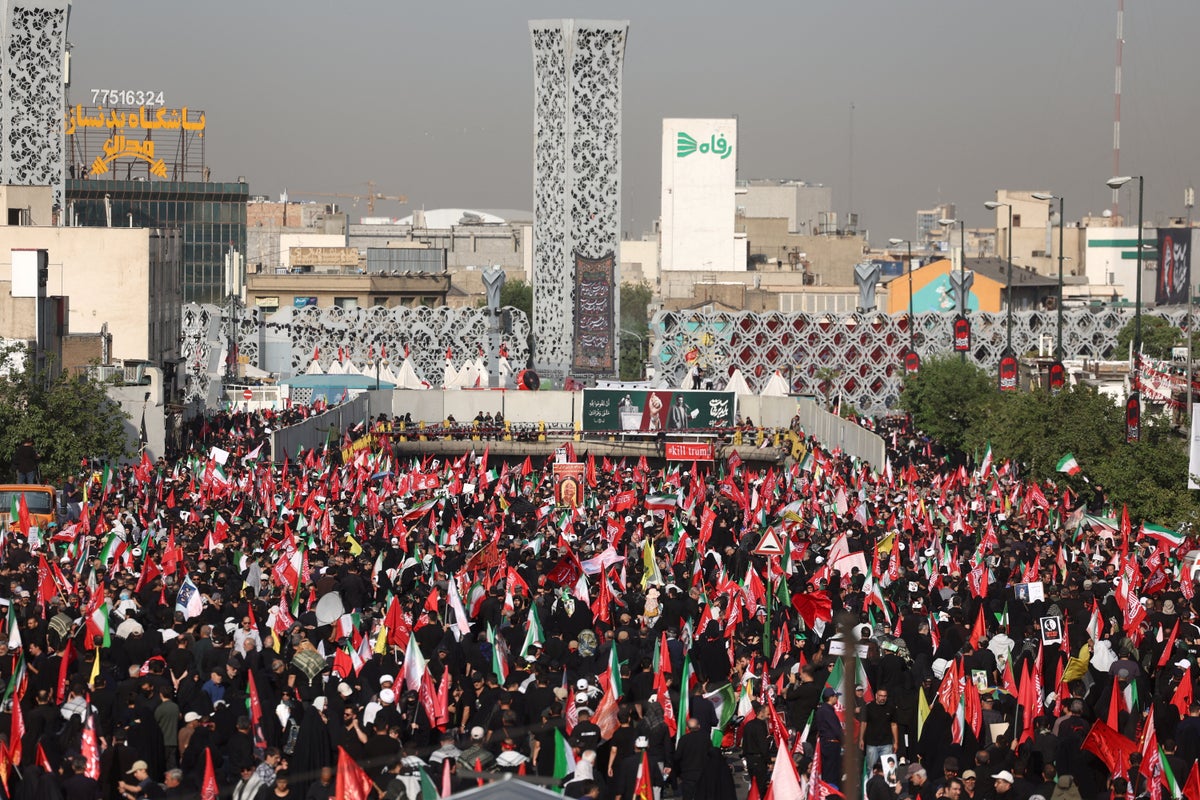
The streets of Tehran are buried under a sea of black shirts, red flags, and raw fury. If you think the assassination of an autocrat automatically triggers the collapse of a regime, the scenes unfolding right now in the Iranian capital will force you to think again. Thousands have packed the avenues as the delayed funeral procession for former Supreme Leader Ayatollah Ali Khamenei creeps toward Mehrabad International Airport. It’s a 12-hour march of political theater, religious fervor, and deep geopolitical risk.
Let's look past the sheer optics of the crowd. Donald Trump just handed the Islamic Republic exactly what it needed to survive its deepest internal crisis in decades. By publicly musing that the United States could have wiped out Iran’s entire leadership cadre at the funeral in "one shot," Trump didn't project strength. He breathed new life into a resistance narrative that was rapidly running out of steam.
The Martyrdom Myth Just Got a Massive Upgrade
Iran is a deeply fractured country. When Israeli airstrikes—backed by United States intelligence—killed the 86-year-old Khamenei alongside four family members on February 28, the internal reaction wasn't uniform grief. Millions of Iranians secretly, and sometimes openly, celebrated the demise of a ruler who oversaw decades of economic ruin and social repression. The regime was staring down a massive crisis of legitimacy.
Then the funeral started.
By delaying the ceremony for months due to the active phase of the war, the state carefully engineered a massive public ritual. The truck carrying the flag-draped coffins of Khamenei and his family has been modified to look like the sacred grating surrounding the shrine of an ancient Shia imam. People are throwing scarves against the vehicle to catch a blessing. Eulogists like Mohammad Rasouli are actively reciting poetry calling for the assassination of Trump, declaring that "Trump's murder is our responsibility."
What the White House fails to grasp is how deeply Shia political theology values the concept of the underdog martyr. Khamenei dying in office from old age would have left a legacy of stagnation. Khamenei dying in an enemy airstrike turns him into a permanent symbol of defiance.
The One Shot Blunder
Donald Trump’s recent interview with Axios highlights the massive disconnect between Washington’s calculations and Tehran’s reality. Trump shrugged off the massive crowds, suggesting the tears were "fake" and boasting that the United States could target the remaining leadership gathered at the Imam Khomeini Grand Mosalla in a single blow. "But we are not going to do that because then we would have nobody to negotiate with," Trump said.
Predictably, the Iranian establishment bit back hard. The Iranian Embassy in Armenia fired off a scathing public response, arguing that while you can kill a leader, you cannot kill an ideal, comparing Khamenei's death to "breaking a perfume bottle whose scent spread everyplace." They even took a swipe at America's 250th Independence Day, mocking the United States as a nation lacking "civilization, history, or honor."
This back-and-forth isn't just empty rhetoric. It has directly complicated the fragile diplomatic track. Delegations are currently sitting in Doha, Qatar, trying to hammer out a permanent end to the war, stabilize global crude flows through the Strait of Hormuz, and rein in Iran's nuclear ambitions. A 60-day ceasefire has kept things relatively quiet, but the technical negotiations scheduled to resume in Pakistan on July 11 are now poisoned by the rhetoric screaming out of the Tehran streets.
Reading the Tehran Power Structure
Look closely at who is standing by the coffin and who is missing. President Masoud Pezeshkian, Parliament Speaker Mohammad Baqer Qalibaf, and Quds Force Commander Esmail Qaani are all front and center, projecting an image of total stability. Khamenei’s sons—Mostafa, Meysam, and Masoud—are visible, crying and praying.
But Mojtaba Khamenei, the son widely tipped to fully solidify his grip as his father’s successor, has been noticeably absent from the public view at the Mosalla.
This isn't an accident or a sign of weakness. Right-wing American commentators and figures close to the Trump administration have openly called the funeral a "target-rich environment." The Islamic Revolutionary Guard Corps (IRGC) is playing a highly calculated defensive game. They are protecting the incoming leadership while using the multi-day procession—which will travel through Qom, Najaf, and Karbala before ending in Mashhad—to rally the hardline base.
What Happens When the Mourning Stops
The temporary pause in US-Iran diplomacy will end the moment Khamenei is buried at the Imam Reza shrine on July 9. If you are watching this crisis, don't get distracted by the anti-American banners or the "Death to America" chants. The real action happens next week when the technical talks resume.
Here is what needs to be watched immediately:
- The Hormuz Bottleneck: While the interim agreement has allowed some Qatari LNG shipments to move, flows are still heavily constrained. Watch the spot prices; if Pakistan and other regional buyers keep paying premiums for diverted cargo, the economic pressure will force both sides to make messy concessions.
- The Nuclear Leverage: Israeli Prime Minister Benjamin Netanyahu reiterated on Sunday that regardless of any US-led deal, Israel will act independently to prevent a nuclear Iran. The risk of a rogue strike remains incredibly high if Tehran miscalculates its leverage during the talks.
- The Successor’s First Move: Once the Interim Leadership Council gives way to a permanent structure, the new Supreme Leader will have to prove his teeth to the IRGC hardliners. Expect a localized show of force—likely via Houthi proxy activity in the Red Sea—to signal that the regime hasn't been softened by the loss of its figurehead.
The United States wants to believe that economic sanctions and tactical strikes will force Iran to the table in a position of total weakness. But as millions of red flags wave in the 36-degree Tehran heat, the regime is proving it still knows how to turn a military loss into a powerful political shield. Washington needs to stop treating this as a simple cleanup operation and start preparing for a much more resilient, furious adversary.