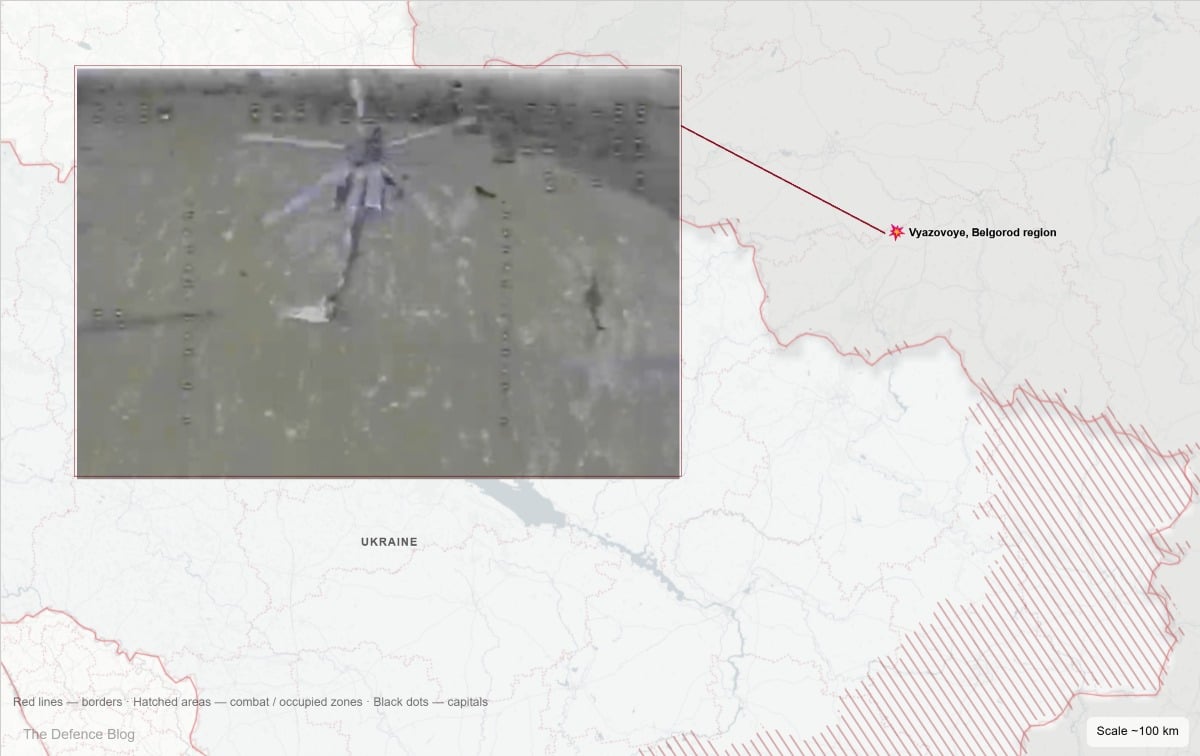
Ukraine's successful intercept of a Russian Mi-28 attack helicopter using a first-person view (FPV) drone marks a structural shift in modern combat. For the first time, a sub-$1,000 quadcopter has hunted and destroyed a multi-million-dollar armored aircraft in mid-air. This is not a lucky fluke. It is the beginning of a systematic campaign to deny low-altitude airspace to manned aviation using cheap, expendable robotics. The implications stretch far beyond the borders of Eastern Europe, forcing global militaries to rethink the survival of the attack helicopter.
The Mechanized David Meets the Flying Tank
The Mi-28 Havoc is Russia’s answer to the American Apache. It is a heavily armored, twin-engine attack platform designed to survive intense ground fire. Its rotor blades can withstand 20mm shells, and its cockpit is encased in titanium armor.
Yet, it was brought down by a plastic quadcopter carrying a strapped-on RPG warhead.
To understand how this happened, you have to look at the mechanics of the engagement. Helicopters are at their most vulnerable when hovering low to provide close air support or running transport missions near the front lines. They rely on speed, low-altitude masking, and electronic countermeasures to survive.
They do not, however, have rear-facing vision.
The Ukrainian FPV drone hit the Mi-28 from behind, striking the tail rotor. This is the Achilles' heel of any conventional helicopter. If you destroy the tail rotor, the aircraft loses its torque compensation. It spins violently out of control and crashes. By targeting this specific vulnerability, Ukrainian operators bypassed the heavy titanium armor protecting the crew and engines.
The Economics of Asymmetric Attrition
Military analysts have watched the cost-to-kill ratio plummet over the last two years. This latest milestone pushes that ratio to an extreme.
- Mi-28 Estimated Cost: $15 million to $18 million.
- FPV Drone Cost: $500 to $1,000.
- Training Time: A helicopter pilot requires years and millions of dollars to train. An FPV operator can be combat-ready in a few weeks.
This economic imbalance creates a tactical crisis for traditional air forces. In the past, air defense meant expensive surface-to-air missile (SAM) systems. A single Patriot or S-400 missile costs millions. Using those to shoot down low-flying helicopters is effective but logistically draining.
Drones turn that equation on its head. A military can build and deploy tens of thousands of FPV drones for the price of a single advanced air defense battery. Ukraine is currently producing these small craft in makeshift workshops, utilizing commercial off-the-shelf components, 3D-printed parts, and basic soldering. They are treated as guided ammunition, not aircraft. When one hits a target, the return on investment is measured in thousands of percent.
The Technical Evolution of Low-Altitude Intercepts
The successful strike on the Mi-28 was the result of months of trial and error. Early attempts by drone operators to chase helicopters failed because of speed differentials. A standard commercial quadcopter tops out around 60 to 70 miles per hour, while an Mi-28 can cruise comfortably at 160 miles per hour.
To bridge this gap, drone units changed their tactics. They stopped chasing. Instead, they began setting up ambushes along known Russian flight corridors.
Operators park their drones on high-altitude vantage points or hover at altitude, waiting in silence. When ground spotters or electronic warfare units report an incoming helicopter, the drone operator dives from above, using gravity to boost their speed. By intercepting the helicopter on a deflection course—striking it from the side or rear as it passes—the speed deficit is nullified.
The technical modifications are equally significant. Standard video signals frequently degrade near the ground due to line-of-sight obstructions. Ukrainian teams are now using "mother-ship" repeater drones. These larger drones hover thousands of feet in the air, acting as relay stations. They pass the control signal from the operator on the ground down to the FPV strike drone flying low behind enemy lines. This eliminates the signal drops that previously saved targeted vehicles.
The Nightmare Facing Helicopter Designers
For decades, helicopter self-defense systems focused on two main threats: radar-guided missiles and heat-seeking man-portable air defense systems (MANPADS). Modern attack helicopters are covered in sensors. They feature radar warning receivers, laser warning receivers, and directional infrared countermeasures designed to blind incoming missiles.
None of these systems work against a plastic hobby drone.
A quadcopter has almost no radar cross-section. It is made of carbon fiber and plastic, containing very little metal. Its electric motors run cool, leaving a negligible thermal footprint. To an automated missile defense system, an FPV drone looks like a large bird. The helicopter's onboard computers simply ignore it.
This leaves the crew blind to the threat until it appears in their physical line of sight. Given that the drone is typically coming from the rear quadrant, the pilots often never see it coming.
The immediate fix attempted by crews on the ground has been the addition of improvised wire cages over critical components, mirroring the "cope cages" seen on tanks. But adding heavy steel mesh to a helicopter reduces its payload, ruins its aerodynamics, and strains the engines. Airframes cannot handle the extra weight the way a main battle tank can.
A Global Shift in Tactical Doctrine
Militaries worldwide are watching this development with deep anxiety. The United States, China, and Western European powers have spent decades building doctrines centered on air superiority and close air support provided by manned helicopters.
If low-altitude airspace becomes a dense cloud of autonomous hunter-killer drones, the utility of the attack helicopter drops significantly. They become too expensive and too fragile to risk near the forward edge of the battle area.
We are likely to see a rapid pivot toward direct-energy weapons, such as high-power microwaves and lasers, integrated directly into combat vehicles to create localized drone-denial zones. Militaries will also have to invest heavily in automated, short-range gun systems capable of tracking and destroying small, fast-moving aerial targets at close range.
The era of the armored helicopter dominating the low-altitude sky is drawing to a close. The sky now belongs to whoever can manufacture the most micro-chips, batteries, and propellers. Manned aviation must adapt to a battlefield where the sky is filled with thousands of cheap, lethal eyes, or face obsolescence.
:max_bytes(150000):strip_icc():focal(749x0:751x2)/auschwitz-2-691cb034ee9e43cfa45a0969012c6337.jpg)