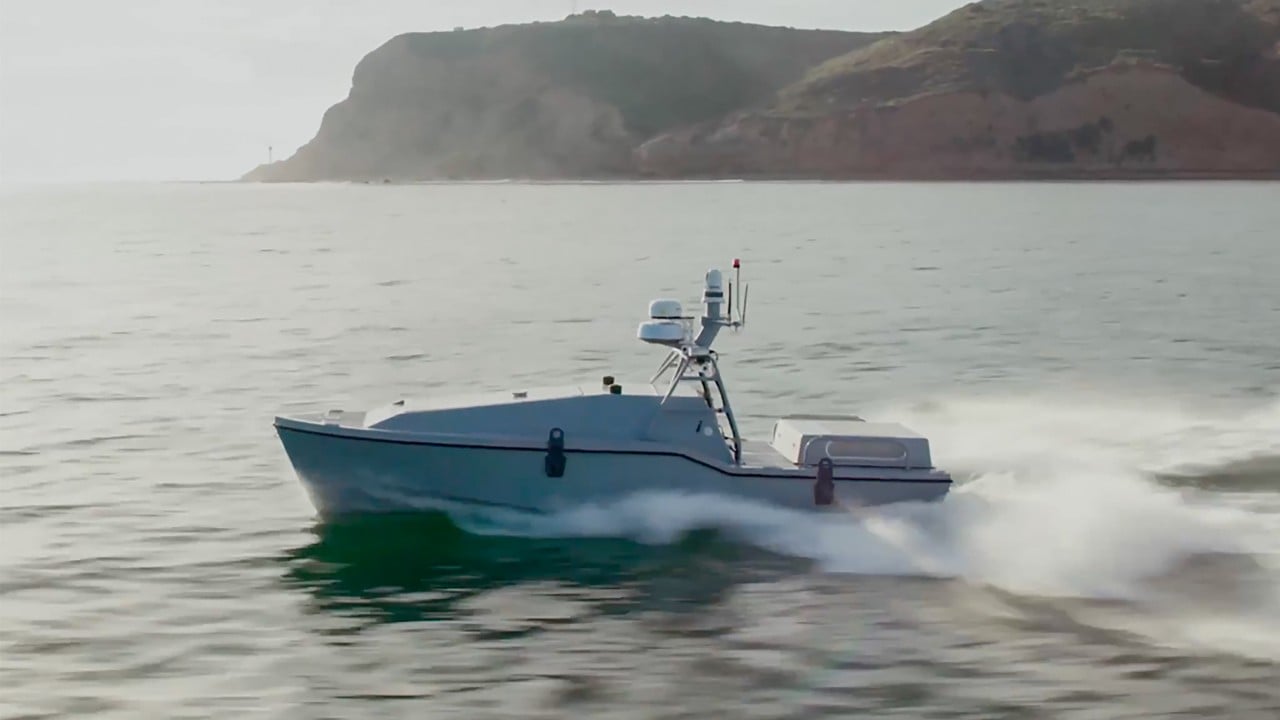
The defense establishment is currently slapping itself on the back over three small unmanned boats.
When U.S. Central Command sent Saronic Corsair unmanned surface vessels into Iran’s Bandar Abbas naval base to detonate against a docked submarine facility, defense pundits immediately rushed to their keyboards. The headline narrative wrote itself: America has revolutionized naval warfare, and Beijing must be shaking in its boots, taking frantic notes on how to defend the Taiwan Strait.
That narrative is complete fantasy.
If you spend five minutes analyzing naval architecture and electronic warfare instead of reading defense contractor press releases, you realize a brutal truth. China learned nothing from the Bandar Abbas strike because China does not operate like a third-tier navy trapped in a shallow gulf.
Washington is celebrating a boutique tactical strike in a dead-end harbor while ignoring the gargantuan industrial reality of the Western Pacific.
The Bandar Abbas Delusion
Let’s strip away the Pentagon PR machine and look at what actually happened at Bandar Abbas.
CENTCOM deployed three 24-foot explosive boats across calm, narrow water against a stationary, sitting-duck repair pier. The target had zero active point-defense systems running, no automated close-in weapon networks active, and practically non-existent radar picket coverage.
It was target practice.
"Launching a remote-controlled explosive boat against a parked submarine in an un-defended harbor isn't a modern warfare breakthrough. It's a high-tech version of a World War II Italian human torpedo raid."
I’ve watched defense procurement officers waste tens of millions of dollars trying to turn specialized, narrow-use hardware into universal doctrine. The U.S. Navy’s Unmanned Task Group 59 built a system that works brilliantly in the Strait of Hormuz, where distances are short, civilian traffic offers easy concealment, and the opponent relies on static infrastructure.
Try taking that exact same concept to the Taiwan Strait.
The Taiwan Strait is over 100 nautical miles of open, violent water. It is monitored 24/7 by phased-array satellite networks, high-altitude surveillance platforms, automated surface scan radars, and an electromagnetic environment so saturated with active jamming that standard radio links burn out before you hit five miles off the coast.
If you send three 24-foot Corsair drones across that stretch of water, they won't hit a pier. They will be detected by passive acoustic arrays, targeted by low-cost kamikaze aerial drones, jammed into brick status, or torn apart by heavy machine-gun fire before they reach mid-channel.
Harbor Target Practice versus Pacific Electronic Warfare
The lazy consensus in Western military media claims that sea drones render traditional surface fleets obsolete. They point to Ukraine’s success in the Black Sea and CENTCOM’s strike in Iran as proof.
This comparison fundamentally misinterprets how real peer conflicts operate.
Russia’s Black Sea Fleet lacked modernized point defenses and failed to maintain active combat air patrols over its harbors. Iran’s naval forces at Bandar Abbas were caught completely flat-footed inside a narrow geographic bottleneck.
China’s People’s Liberation Army Navy (PLAN) is neither of those things.
The Electromagnetic Wall
The PLAN does not wait for a drone to arrive at the harbor mouth. China operates the densest electronic countermeasures mesh on earth.
- Active Directional Jamming: High-powered shore-based transmitters deny GPS, GLONASS, and commercial satellite communications across hundreds of square miles.
- Autonomous EW Interception: Drone communication links relying on standard satellite frequency hops get severed long before terminal terminal guidance initiates.
- Acoustic and Optical Tracking: China's coastal defense arrays don't just rely on radar; they track surface wakes using computer-vision thermal imaging paired with coastal sonar networks.
When you lose signal connectivity in a contested ocean environment, your "autonomous" surface vessel turns into drifting junk. Unless your sea drone costs $20 million and carries an internal inertial navigation setup with expensive onboard processing, it cannot survive a high-intensity electromagnetic firewall.
And if your sea drone costs $20 million, you haven't built a low-cost swarming weapon. You've built a fragile, underpowered missile that moves at a sluggish 35 knots.
Mass Beats Boutique Technology Every Single Time
Here is the strategic joke that Washington defense intellectuals refuse to acknowledge: America is building boutique gadgets while China owns the world's shipyards.
The U.S. Navy awarded a $392 million contract for Corsair vessels. That buys a few hundred small carbon-fiber hulls loaded with proprietary electronics. It makes defense startups in Austin and Silicon Valley look brilliant on paper.
Meanwhile, Chinese commercial shipbuilders produce over 50% of global commercial vessel tonnage.
If Beijing decides it needs 10,000 uncrewed attack craft to swarm a channel, they don't sign a five-year development agreement with a boutique defense firm. They order five commercial fiberglass boat factories in Zhejiang province to change production lines overnight.
+-----------------------------------------------------------------------+
|                       THE INDUSTRIAL GAP                              |
+-----------------------------------------------------------------------+
| U.S. STRATEGY                                 CHINA STRATEGY          |
| - High-cost boutique contracts               - Massive civil-military |
| - Small production batches                    shipbuilding integration|
| - Complex supply chains                      - Infinite manufacturing |
| - Vulnerable to EW signal loss                capacity                |
|                                              - Saturated drone production|
+-----------------------------------------------------------------------+
Beijing isn't studying CENTCOM's strike in Iran to figure out how to build sea drones. They already build more commercial watercraft, recreational jet-skis, and electric marine engines than the rest of the planet combined.
What Beijing actually saw at Bandar Abbas was an adversary showing its tactical hand early for a quick PR win in the Middle East.
Stop Asking What China Learns
The media insists on asking, "What can China learn from this?"
It is the wrong question entirely.
The real question is: Why is the United States military spending time, money, and operational surprise deploying tactical speedboats against secondary targets in Iran when it lacks the shipbuilding capacity to replace a single damaged destroyer in a real conflict?
When you blow up a static dock at Bandar Abbas, you buy a news cycle. You do not change the balance of power in the Western Pacific.
China’s military planners aren't adjusting their doctrine because three explosive hulls hit an Iranian repair basin. They are looking at American industrial shipyards running at a fraction of capacity, watching U.S. ammunition stockpiles drain across multiple regional proxy conflicts, and calculating that Washington's appetite for high-tech party tricks cannot overcome raw industrial depth.
If America wants to deter peer adversaries, it needs to stop mistaking localized skirmishes against regional powers for a real Pacific defense strategy.
Learn more about the tactical footage and strike execution on the official report covering the US sea drone strike on Iranian base, which details how U.S. Central Command deployed Corsair unmanned surface vessels during combat operations in the Strait of Hormuz.