Chinese aerospace engineers are actively developing conformal load-bearing antenna structures designed to embed powerful radar arrays directly into the wings and fuselage skin of the Chengdu J-20 stealth fighter. By turning the physical airframe into a giant sensor, designers aim to bypass the severe physical limits of a traditional nose cone, vastly expanding detection range against rival stealth aircraft while keeping the jet invisible to enemy tracking.
It sounds like science fiction. Yet the engineering reality behind this shift is rooted in basic physics that has frustrated fighter designers for decades.
For as long as military jets have carried radar, the antenna has lived in one place: the nose. That narrow, pointed cone dictates everything. It limits the diameter of the dish, restricts the number of transmit-receive modules you can pack inside, and creates a forward-facing cone of vision that leaves the flanks and rear of the aircraft largely blind to long-range radio frequency tracking. If you want to see farther, you need a bigger aperture. If you make the nose bigger, you ruin the aerodynamics and destroy the aircraft's low-observable profile.
Engineers call this the size, weight, and power trap. When you are trying to spot an American F-22 Raptor or an F-35 Lightning II—aircraft specifically sculpted to scatter incoming radar waves—a standard nose-mounted active electronically scanned array (AESA) simply runs out of real estate. You need lower frequencies, wider baselines, and raw radiated power to burn through modern stealth coatings. You cannot fit that into a nose cone without turning a sleek interceptor into a flying brick.
So you stop treating the radar as cargo and start building it into the skeleton.
The Physics of Turning Wings Into Eyes
To understand what the Chengdu Aircraft Design Institute and its partner research labs are attempting, you have to look at smart skin technology. In a conventional fighter, the wing skin is made of carbon-fiber composites or aluminum-lithium alloys designed purely to handle aerodynamic loads—lift, drag, torsion, and the violent G-forces of air combat. The radar sits inside a separate radome, protected from structural stress.
A conformal load-bearing antenna structure (CLAS) merges those two jobs into one. Instead of bolting a heavy radar array onto a bulkhead, engineers sandwich microscopic radiating elements, feed networks, and structural composite layers together into a single load-bearing panel. The wing skin itself becomes the antenna.
The payoff is massive. Look at the planform of the J-20. It is a large aircraft—significantly longer and broader across the wings than an F-35, featuring a delta-canard configuration with sweeping leading edges. Those broad wing surfaces and forward fuselage chines offer square meters of uninterrupted real estate. By embedding arrays along the leading edges and wing surfaces, designers gain three immediate advantages:
- Massive Aperture Expansion: Radar resolution and detection range scale directly with the physical area of the antenna. Spreading modules across the wings creates a baseline several times wider than the nose cone, dramatically sharpening target discrimination at extreme distances.
- True 360-Degree Situational Awareness: Traditional fighters have to point their noses at a threat to track it with their primary radar. Wing-embedded arrays give the pilot wide-angle, off-boresight coverage, allowing the J-20 to track targets abeam or even behind it while turning away to evade incoming missiles.
- Multi-Band Flexibility: Different radar frequencies do different jobs. High-frequency X-band arrays inside the nose provide the razor-sharp resolution needed to guide a missile onto a target. Lower-frequency L-band or UHF arrays—which are notoriously effective at detecting stealth airframes—require large physical antennas that simply do not fit in a fighter's nose. Embedding low-frequency elements along the wide span of the wing solves the geometry problem overnight.
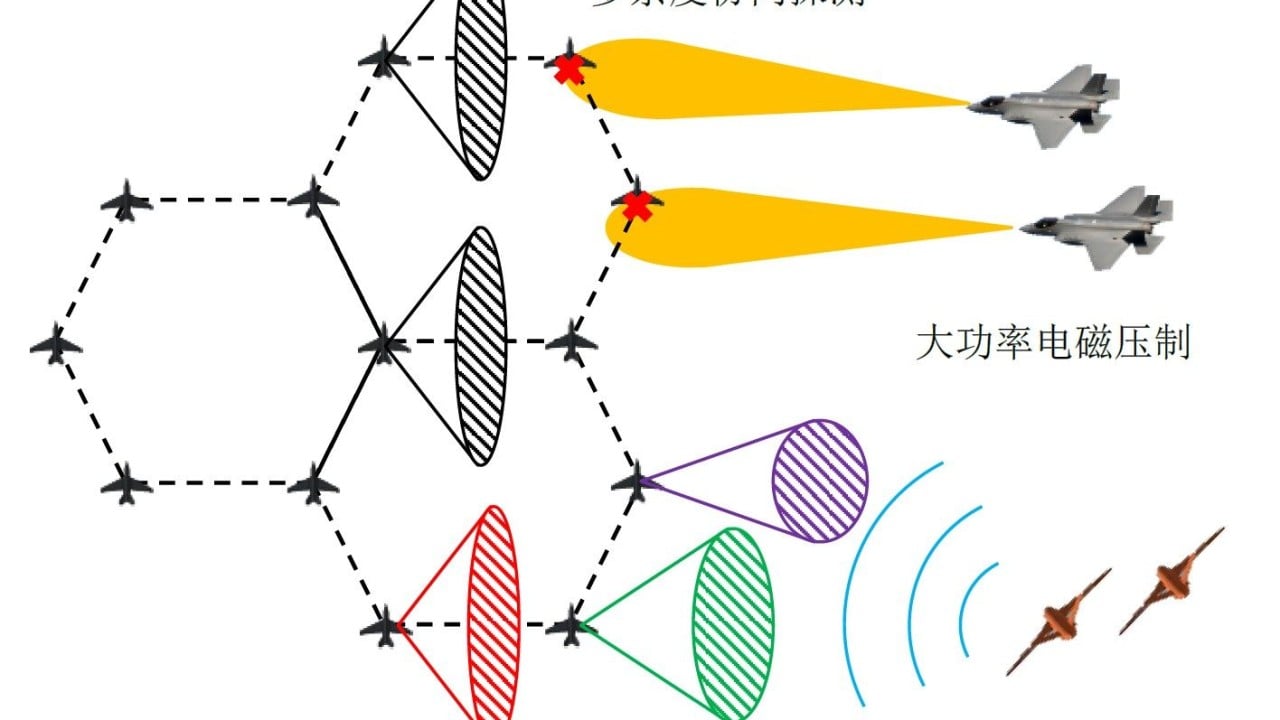
In theory, a fighter equipped with distributed wing radars becomes a flying airborne early warning platform. It does not need to rely as heavily on vulnerable, lumbering AWACS planes lingering hundreds of miles behind the front lines. It brings the big-picture sensor suite directly into contested airspace.
The Thermal and Structural Nightmare
If embedding radars into wings is such an obvious win, why isn't every modern fighter already doing it? Because the moment you put electronics inside a load-bearing wing, physics starts fighting back.
A wing is not a rigid table. In flight, a fighter wing bends, twists, vibrates, and heats up. During a hard 9-G turn, the wingtips can flex upward by more than a foot. If your radar array is laminated into that composite skin, every single transmit-receive module shifts position relative to its neighbors.
To form a coherent radar beam, an AESA system relies on precise phase timing—measured in picoseconds—across thousands of individual emitters. If the wing bends by even a few millimeters, those phase calculations fall apart. The beam smears, false targets appear, and the radar loses its lock. Compensating for real-time structural deformation requires an array of embedded fiber-optic strain sensors feeding continuous geometry data into flight computers that recalibrate the radar beam thousands of times per second. It is a staggering computational burden.
Then there is the heat. Modern gallium nitride (GaN) radar modules are far more efficient than older gallium arsenide chips, yet they still dump immense amounts of waste heat into their surroundings. In a nose cone, engineers have room for dedicated liquid cooling loops, heat exchangers, and thick structural mounts. Inside the razor-thin profile of a supersonic fighter wing, there is barely enough space for fuel bladders and hydraulic actuators, let alone high-capacity plumbing to chill thousands of radiating elements.
If the wing skin overheats, the epoxy resins binding the carbon-fiber composites begin to degrade, weakening the airframe. Worse, a hot wing lights up like a flare on enemy infrared search and track (IRST) sensors, handing adversaries an easy target without them ever needing to turn on their own radars.
Manufacturing at the Razor's Edge
Even if you solve the flexing and the cooling, you still have to build the thing—and fix it when it breaks.
Conventional composite panels are cured in massive autoclaves under intense heat and pressure. Delicate micro-electronics and solder joints do not survive traditional autoclave cycles easily. Engineers have to develop low-temperature curing resins and precision automated fiber-placement machines capable of laying down structural carbon plies around fragile RF circuitry without crushing it.
And consider maintenance on a forward airbase. If a mechanic drops a wrench on a standard composite wing panel, they patch it with resin and move on. If a mechanic damages a load-bearing smart skin panel, or if a bird strike dents the leading edge during takeoff, you are no longer repairing a piece of sheet metal. You are replacing a structural flight-control surface packed with millions of dollars of phased-array electronics. The supply chain and depot-level repair headaches alone are enough to give air force logisticians ulcers.
Stealth vs. Radiation
There is also a fundamental paradox at the heart of putting massive radars on a stealth jet. Stealth is about hiding; radar is about shouting into the dark with a megaphone.
Every millimeter of a stealth fighter's exterior is shaped to bounce enemy radar waves away from the receiver, coated in radar-absorbent materials (RAM) that trap electromagnetic energy and convert it into tiny amounts of heat. When you embed an antenna into the skin, you have to let your own radar signals pass out through that skin—and let returning echoes pass back in—without attenuating them.
If the wing surface is transparent to radio waves at your operating frequencies, it becomes transparent to enemy radar waves at those exact same frequencies.
Engineers call this the in-band radar cross-section problem. To keep the J-20 invisible while its wing radars are powered off, designers have to use frequency selective surfaces—metamaterial layers etched with microscopic metallic patterns that act like a one-way electromagnetic gate. They allow the jet's specific radar wavelengths to pass through cleanly while reflecting or absorbing everything else.
Even with frequency selective surfaces, turning the radar on broadcasts the jet's presence across the electromagnetic spectrum. While modern low probability of intercept (LPI) waveforms spread radar energy across wide frequency bands and hop channels rapidly to mimic background noise, pushing massive power out of wing-mounted arrays increases the risk that passive electronic support measures—like the F-35's AN/ASQ-239 Barracuda suite—will sniff out the emissions and triangulate the J-20's position before it ever fires a missile.
A Broader Shift in Air Combat Doctrine
Watching Chinese aerospace researchers publish papers on load-bearing antennas and embedded wing sensors tells us something vital about how Beijing views the next major air war. They are not trying to build a carbon copy of American airpower; they are engineering around specific asymmetric weaknesses.
For decades, the United States Air Force has relied on a networked ecosystem: stealth fighters operating forward, supported by massive tankers, AWACS surveillance aircraft, and electronic warfare platforms orbiting safely out of reach. China's military planners know they cannot match that global support fleet plane for plane anytime soon. Instead, they have focused on long-range "carrier-killer" and "AWACS-killer" missiles—weapons like the PL-15 and the massive PL-17—designed to push American support aircraft hundreds of miles back from the fight.
If you blind the enemy's AWACS, both sides end up fighting in the dark. In that environment, the fighter that carries its own long-range, multi-band surveillance radar directly on its airframe holds the decisive advantage.
This push also aligns with China's rapid development of unmanned wingmen—so-called loyal wingman drones—and two-seat variants of the J-20, such as the J-20S. A single pilot flying a high-performance stealth fighter cannot easily manage flight controls, defensive countermeasures, drone swarms, and multiple independent radar arrays across the wings and nose simultaneously. Putting a second crew member in the back seat—or handing sensor fusion over to onboard AI processing—turns the J-20 from a traditional dogfighter into a forward-deployed battle management node.
The United States has explored similar concepts for years. Northrop Grumman and Air Force Research Laboratory engineers tested smart skin structures under programs dating back to the 1990s, and elements of conformal array technology have found their way onto unmanned platforms like the RQ-4 Global Hawk and next-generation electronic warfare pods. Yet Western fighter programs have largely hesitated to make load-bearing wing radars a baseline requirement due to cost overruns, structural certification hurdles, and maintenance complexity.
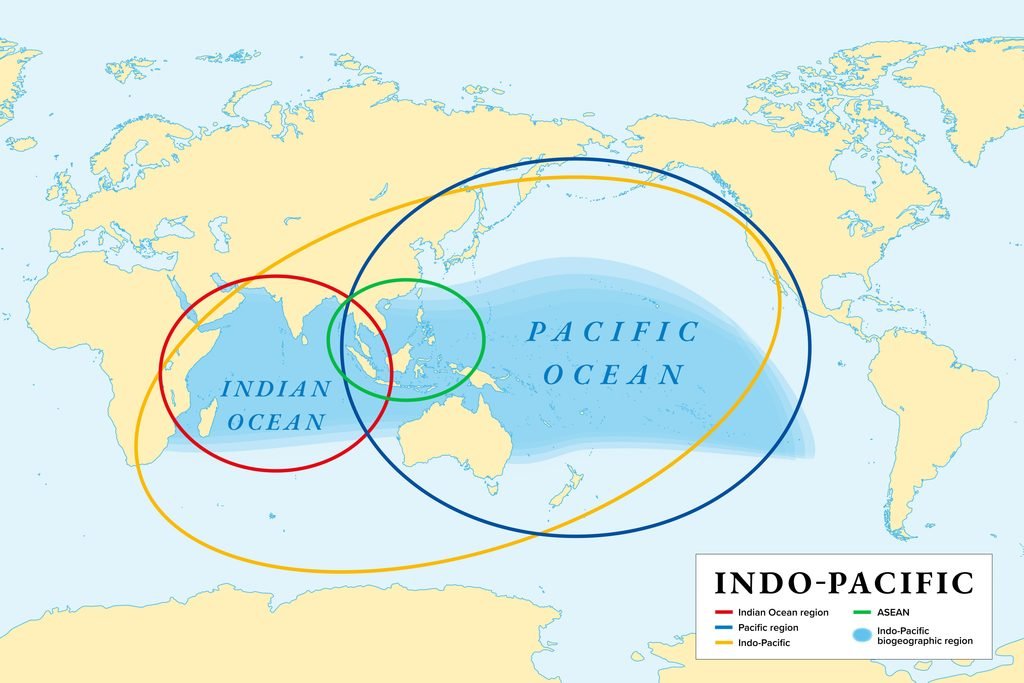
China's state-backed defense complex operates under different incentives. With massive state funding, direct integration between university materials labs and state-owned aviation conglomerates like AVIC, and an urgent strategic mandate to counter U.S. stealth superiority in the Indo-Pacific, Chinese designers are willing to accept higher maintenance burdens and experimental manufacturing risks if it buys them an edge in detection range.
What Happens When the Skin Becomes the Sensor
Whether these wing-mounted arrays appear on the current production block of the J-20, on a future deep-upgrade variant, or serve as the foundational architecture for China's sixth-generation fighter prototypes, the trajectory is clear. The era of treating an aircraft as an empty aluminum shell stuffed with black boxes is ending.
A hypothetical engagement over the Western Pacific illustrates why this matters. Imagine two stealth flights approaching each other at supersonic speeds, both operating under strict radio silence to avoid giving away their positions. In a traditional setup, neither fighter sees the other on X-band radar until they close within a few dozen miles, turning long-range beyond-visual-range combat into a tense game of infrared tracking and blind guesses. Now introduce a fighter whose wings act as a massive, low-frequency phased array. By emitting brief, ultra-wideband pulses from its wing edges and processing the faint returns across a multi-meter baseline, that aircraft can detect the rough shape and trajectory of a stealth opponent dozens of miles earlier—long before the opponent's smaller nose radar can resolve a target.
That extra margin of time is everything in modern air warfare. It dictates who shoots first, who forces the enemy to turn defensive and bleed energy, and who survives the merge.
Of course, drawing a conformal antenna on a CAD screen and proving it in an anechoic chamber are worlds apart from flying it through violent monsoon turbulence, salt-spray corrosion over the South China Sea, and thousand-hour combat deployments. Delamination, micro-cracking under thermal stress, and software latency in beam-forming algorithms could easily delay operational deployment by years.
Aerospace history is littered with brilliant technologies that worked flawlessly in the laboratory and failed miserably on the flight line. Yet ignoring the steady stream of patent filings, wind-tunnel tests, and composite material breakthroughs coming out of Chengdu would be a severe mistake. When a nation decides that its fighter jets are running out of nose room, the only direction left to expand is outward—right into the wings holding the aircraft in the sky.