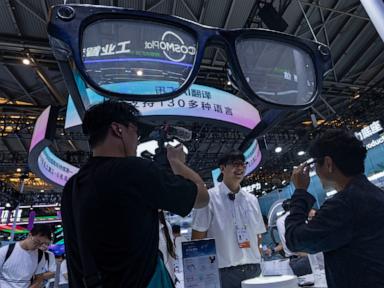
Walk through the floor of the World AI Conference in Shanghai, and one fact becomes glaringly obvious. America might still hold the crown for cloud algorithms and closed-source software, but China is rapidly dominating the physical reality where AI meets raw hardware.
Over 1,100 companies packed the exhibition halls at Shanghai's flagship AI summit. The floor wasn't just filled with chatbots or code editors. It was packed with over 400 distinct humanoid robot models, brain-computer interfaces, custom domestic AI chips, and embodied systems waving Chinese flags, flexing bionic hands, or performing simulated surgical procedures.
If you think Washington's chip export bans halted China's momentum, you're looking at the wrong metrics. China isn't trying to clone Silicon Valley's business strategy. They're building an entirely different playbook around open-source AI and mass hardware manufacturing.
Here's what actually went down in Shanghai, what most Western analysts are getting dead wrong, and why the global AI race is splitting in two.
Hardware Embodiment Is Where the AI War Gets Real
For years, Western tech narrative insisted that whoever controls the absolute highest tier of GPU compute wins AI. But software without a physical body can only automate digital screens. The real economic frontier is embodied AI: physical machines that interact with the real world, from factory floors to home caregiving.
State media reported at the Shanghai event that Chinese manufacturers now produce more than half of the world's humanoid robot products. Think about that scale for a second. While American robotics startups are busy perfecting smooth promotional videos, Chinese firms like Unitree, DaxRobotics, and Magiclab are rapidly pushing hardware into commercial production.
Global Humanoid Robotics Production Share
-----------------------------------------
China:      [####################] 50%+
Rest of World: [####################] <50%
Take Unitree's latest bipedal units showcased on the Shanghai floor. These machines aren't fragile research projects kept behind safety glass. Visitors watched them perform dynamic balance routines, boxing moves, and complex hand grips in real-time. Meanwhile, companies like Yunmu Intelligence Manufacturing displayed hyper-realistic bionic skins and micro-actuators designed specifically to reduce manufacturing costs for robotic limbs.
The takeaway isn't that China's robots are universally smarter than Tesla's Optimus or Boston Dynamics' Atlas. It's that China can iterate physical hardware ten times faster and at a fraction of the cost. When a Chinese startup can source motors, sensors, and structural frames within a 50-mile radius in Shenzhen or Shanghai, development cycles collapse from years to weeks.
The Silicon Bypass Strategy
Western tech sanctions aimed to choke off China's access to top-tier Nvidia silicon. Predictably, that move forced domestic Chinese firms to improvise. What we saw at the World AI Conference was the direct result of that forced adaptation.
Exhibitors proudly showcased systems like the Huawei Atlas 950 SuperPod alongside silicon from domestic vendors like Eastern Computing Chips. Is local Chinese silicon as raw-powerful per chip as top-end American architecture? No. But Chinese engineers are working around hardware limits by optimizing software and running massive cluster configurations.
More importantly, Chinese developers are leaning heavily into open-source foundation models. Models like DeepSeek have demonstrated that clever architectural tweaks and efficient reasoning pipelines can achieve high performance on older GPU hardware.
By pushing open-source models globally, China is undercutting the subscription revenue models of closed American AI giants. If a developer in Southeast Asia, South America, or Europe can download a high-performing open-source model and run it on affordable local hardware, they won't pay monthly API fees to San Francisco. That's how you win market share, even when you're facing chip bans.
Brain-Computer Interfaces and Everyday Integrations
The Shanghai exhibition wasn't limited to metal limbs and rack servers. Neural engineering took center stage too. Companies like Mindtrix demonstrated functional brain-computer interfaces aimed at medical rehabilitation and consumer interactions.
We also saw everyday commercial applications that often get overlooked in big-picture geopolitics:
- Industrial manufacturing robots from manufacturers like Efort working alongside human supervisors on simulated assembly lines.
- Commercial service units from Pudu Robotics designed for hospitality and automated delivery.
- Consumer smart glasses featuring embedded real-time AI translation and heads-up displays.
This reveals a crucial divergence in focus. While the US focuses heavily on general intelligence (AGI) in software, China is obsessed with immediate deployment—getting AI into physical products that generate real revenue right now.
Why Washington's Containment Playbook Is Failing
It's tempting to look at technological rivalry strictly through trade restrictions and export controls. But tech embargos are a double-edged sword. When you cut off a competitor's access to your supply chain, you don't destroy their demand; you just force them to build their own vertically integrated stack.
The sheer volume of hardware on display in Shanghai proves that China's tech ecosystem has reached critical self-sustaining mass. They have the factories, the rare earth supply chains, the engineering graduate volume, and the domestic market scale to sustain massive hardware deployments without needing American components.
The US still leads in pure algorithmic research, frontier model training capacity, and venture capital depth. But software eventually has to touch the real world. If Western companies hold the best software, but Eastern factories produce all the physical bodies that run it, who actually controls the future of automation?
What Tech Leaders Need to Do Right Now
If you're a founder, CTO, or hardware developer watching this rivalry unfold, relying on political restrictions to protect your product roadmap is a losing strategy. You need an operational pivot:
- Stop ignoring open-source model weights. Chinese open-source architectures are advancing fast. Test domestic open-source alternatives for your internal pipelines rather than locking your stack completely inside proprietary API ecosystems.
- Prioritize supply chain agility for mechanical components. If your hardware startup relies on single-source actuators or specialized motors, start auditing alternative vendors outside restricted trade zones immediately.
- Focus on real-world utility over vanity metrics. The market doesn't care about a benchmark score on an obscure academic dataset. It cares whether a robot can stack a pallet, cook food, or navigate a factory without crashing.
The gap between digital software and physical execution is closing fast. The Shanghai forum made it clear that the next phase of the AI war won't be fought on screens—it will be fought on factory floors.



:max_bytes(150000):strip_icc():focal(749x0:751x2)/Arnold-Schwarzenegger-Joseph-Baena-032926-a90f8d3315fc44a6aebc6d7bb44bda01.jpg)