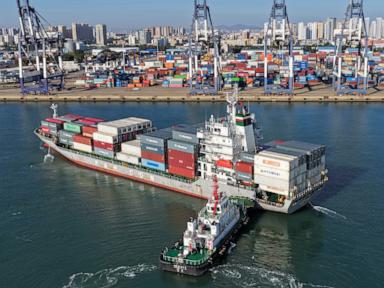
Everyone in financial media is hyperventilating over the headline number. China’s trade surplus cleared $1 trillion for the second consecutive year, riding a staggering 35% surge in exports. Pundits are framing it as an unstoppable industrial juggernaut crushing global competition.
They are reading the scoreboard upside down.
A massive, persistent trade surplus does not signal an invincible economy. In macroeconomics, it is the classic symptom of severe domestic weakness. When an industrial superpower floods the world with discounted goods at that scale, it is not flexing muscle. It is dumping excess inventory because its own citizens refuse to buy it.
I have spent two decades advising cross-border supply chains and watching corporate boards blow millions chasing the wrong signals from Beijing. Whenever export numbers spike like this, executives panic, assuming Chinese manufacturers have unlocked some magical new tier of productivity. Then they look at the margins and realize the truth. You are not watching a victory lap. You are watching a fire sale designed to keep factories running and prevent mass unemployment.
The Accounting Trap Behind the $1 Trillion Headline
To understand why the consensus got this wrong, strip away the political rhetoric and look at basic national income accounting.
Every economy operates on a strict identity:
$$S - I = X - M$$
Savings ($S$) minus Investment ($I$) equals Exports ($X$) minus Imports ($M$).
There is no escaping this math. A $1 trillion trade surplus ($X - M$) mathematically proves that China’s domestic savings exceed its domestic investment by $1 trillion. Why? Because Chinese households are hoarding cash instead of spending it, and private businesses are terrified to invest locally.
When domestic consumption collapses—dragged down by a multi-year real estate bust that wiped out trillions in household paper wealth—factories still have payrolls to meet. Local governments still have debt to service. Beijing’s policy response has been predictable: funnel state-directed credit into manufacturing capacity. Build more solar panels. Assemble more electric vehicles. Stamp out more steel.
If domestic buyers will not absorb that output, it has to go somewhere. So exporters slash prices to the bone and ship it overseas.
Economist Michael Pettis, a senior fellow at the Carnegie Endowment for International Peace and one of the sharpest analysts of Chinese balance-of-payments mechanics, has hammered this point for years. Trade surpluses do not generate growth; they merely transfer weak domestic demand onto trading partners. When an economy relies on external demand to absorb $1 trillion of unconsumed production, it is admitting that its internal growth engine is stalled.
Deflation Is the Hidden Tax on Export Dominance
Look past the volume of shipping containers leaving Shenzhen and Ningbo, and check the prices stamped on the invoices.
A 35% surge in export volume paired with collapsing producer prices is a margin destroyer. China has been fighting entrenched factory-gate deflation. Manufacturers are trapped in brutal price wars—known locally as neijuan (involution)—where competing firms cannibalize each other’s profits just to maintain market share and keep state bank loans rolling over.
- Volume up, profit down: Exporting 35% more goods while cutting unit prices by 15% to 20% means working twice as hard for a fraction of the return.
- Subsidized losses: Many high-profile export sectors survive only through cheap state-backed financing, tax rebates, and subsidized energy inputs.
- Vendor squeezes: Tier-two and tier-three component suppliers are routinely paid in 180-day commercial IOUs rather than cash, masking liquidity stress across the supply chain.
I watched a mid-sized industrial hardware buyer in the Midwest celebrate last year when his Ningbo supplier offered a 22% price cut out of nowhere. Six months later, that supplier went bankrupt mid-production run, leaving my client with $1.4 million in stranded tooling and missed retail deadlines. A desperate exporter is not a reliable partner.
Why Asking "How Do We Stop China's Exports?" Is the Wrong Question
Search trends and boardroom discussions obsess over tariffs, trade barriers, and how Western economies can block this flood of goods. That misses the actual vulnerability.
Tariffs only redirect trade flows. When Washington raises duties on direct shipments from Shanghai, components route through Vietnam, Malaysia, or Mexico for final assembly. The bilateral deficit shifts on paper, while the underlying global imbalance remains intact.
The real question business leaders and policymakers should ask is: What happens when the rest of the world runs out of capacity to absorb China's excess supply?
A $1 trillion surplus requires trading partners willing and able to run a combined $1 trillion deficit. Historically, the United States acted as the consumer of last resort, absorbing global surpluses by issuing dollar-denominated debt. Today, protectionism is hardening across North America, Europe, and emerging markets alike. Brazil, India, and Indonesia have all slapped anti-dumping duties on Chinese steel, chemicals, and textiles.
You cannot export your way out of a domestic demand crisis when every major buyer is putting up walls.
The Import Collapse Nobody Talks About
A trade surplus has two halves: exports and imports. Headlines scream about the 35% export jump while burying the flat or contracting import numbers in paragraph six.
Weak import growth proves two things simultaneously:
- Domestic consumption is comatose: Chinese consumers are not buying foreign luxury goods, imported machinery, or agricultural upgrades at the pace expected of a rising middle class.
- Supply chain localization is peaking: China used to import high-value semiconductors, precision machine tools, and advanced chemicals to assemble finished goods for re-export. As domestic firms substitute local parts for foreign ones, import demand shrinks, artificially inflating the net surplus without necessarily increasing the total economic value created inside the country.
What Everyone Gets Wrong About Capital Flight
Here is the counter-intuitive reality that makes financial analysts uncomfortable: a $1 trillion trade surplus should cause a currency to skyrocket. Under normal market conditions, foreign buyers scrambling to convert dollars and euros into yuan to pay for $1 trillion in net goods would drive the exchange rate through the roof.
Yet the yuan has consistently faced downward pressure, forcing the People's Bank of China to defend the currency aggressively.
Where did the $1 trillion go?
If a country runs a massive current account surplus and its currency weakens anyway, capital is leaking out the back door faster than trade brings it in. Wealthy individuals, private enterprises, and foreign institutional investors have been moving money out of onshore assets into higher-yielding dollar instruments, overseas real estate, and offshore accounts.
Brad Setser, senior fellow at the Council on Foreign Relations, has repeatedly tracked the discrepancy between China’s official customs surplus and the actual foreign exchange inflows recorded by the central bank. Hundreds of billions of dollars in export earnings simply stay offshore in foreign bank accounts rather than being repatriated and converted into yuan. Exporters themselves would rather hold US dollars earning 4% to 5% in Singapore or Hong Kong than bring cash back into a domestic economy yielding under 2% on government bonds.
When a country's own exporters refuse to bring their profits home, calling the trade surplus a "triumph" is pure delusion.
Brutal Answers to the Questions Boards Are Actually Asking
Does this mean China has won the global manufacturing war?
In low-to-mid-tier volume manufacturing and clean-tech hardware (solar modules, LFP batteries, entry-level EVs), yes—scale and supply chain clustering give Chinese firms an unmatched cost advantage. In high-margin enterprise software, advanced logic semiconductors, aerospace propulsion, and biopharma, they remain heavily dependent on Western intellectual property and still struggle to capture global profit pools. Revenue share is not profit share.
Will a $1 trillion surplus force Beijing to launch massive consumer stimulus?
No. Beijing leadership views direct cash handouts to households as wasteful "welfarism" that breeds dependency. Their ideological preference remains supply-side investment—building infrastructure, factories, and technological self-reliance. Until youth unemployment or local government debt defaults threaten social stability directly, expect incremental credit tweaks rather than a true consumer bailout.
Should companies pull out of China entirely?
Only if you enjoy burning capital. Abandoning the world's largest industrial ecosystem overnight is fantasy. However, treating China as your sole global export hub is negligent. The winning play is "In China, For China"—localizing production inside the country strictly to serve the domestic market, while building redundant export capacity in Southeast Asia, India, or near-shoring hubs in Latin America and Eastern Europe.
The Downside of Betting Against the Juggernaut
Intellectual honesty requires admitting where this contrarian thesis can fail—and where shorting China's industrial machine will get you crushed.
Even if the $1 trillion surplus is born of domestic weakness and thin margins, scale has a quality all its own. By flooding global markets with cheap solar panels, wind turbines, and electric vehicles, Chinese firms are bankrupting Western and Asian competitors before those rivals can achieve economies of scale.
If you are a European automaker or an American solar manufacturer, it does not matter that your Chinese competitor is losing money on every unit thanks to state subsidies and domestic deflation. You still go out of business first. Once foreign competitors are wiped out and global market share hits 70% or 80%, Chinese champions can eventually raise prices and harvest monopoly rents.
Furthermore, relentless iteration at massive volume drives real engineering breakthroughs. You do not build 10 million electric vehicles a year without becoming the best on earth at battery chemistry, thermal management, and automated factory tooling. Dismissing the surplus purely as "dumb dumping" ignores the very real technological learning curve happening on those factory floors.
How Smart Operators Play This Imbalance
Stop reacting to top-line customs press releases and restructure how you evaluate Asian supply chains and market exposure:
- Audit your suppliers for margin starvation: If a Chinese vendor cuts prices by more than 10% without a corresponding drop in raw material costs, demand to see their balance sheet or inspect their facility. They are likely bleeding cash to keep credit lines open.
- Separate volume from value in your competitive intelligence: Track operating profit margins and free cash flow of Chinese listed peers, not unit shipment growth. Market share bought at negative margins has an expiration date.
- Hedge against currency volatility, not just tariffs: A massive trade surplus paired with capital outflows creates a coiled spring in foreign exchange markets. Any sudden shift in US interest rates or Beijing's currency defense could trigger violent 5% to 8% swings in the yuan within weeks.
- Exploit the buyer's market for capital equipment: Because domestic factory investment is overbuilt, Chinese industrial machinery, robotics, and automation suppliers are desperate for hard-currency orders. Western manufacturers building plants in Mexico, Texas, or Poland can buy top-tier automation hardware at steep discounts right now.
A $1 trillion trade surplus is not proof of an economy firing on all cylinders. It is the exhaust smoke from an engine burning oil because it cannot get out of first gear. Stop admiring the smoke and look under the hood.