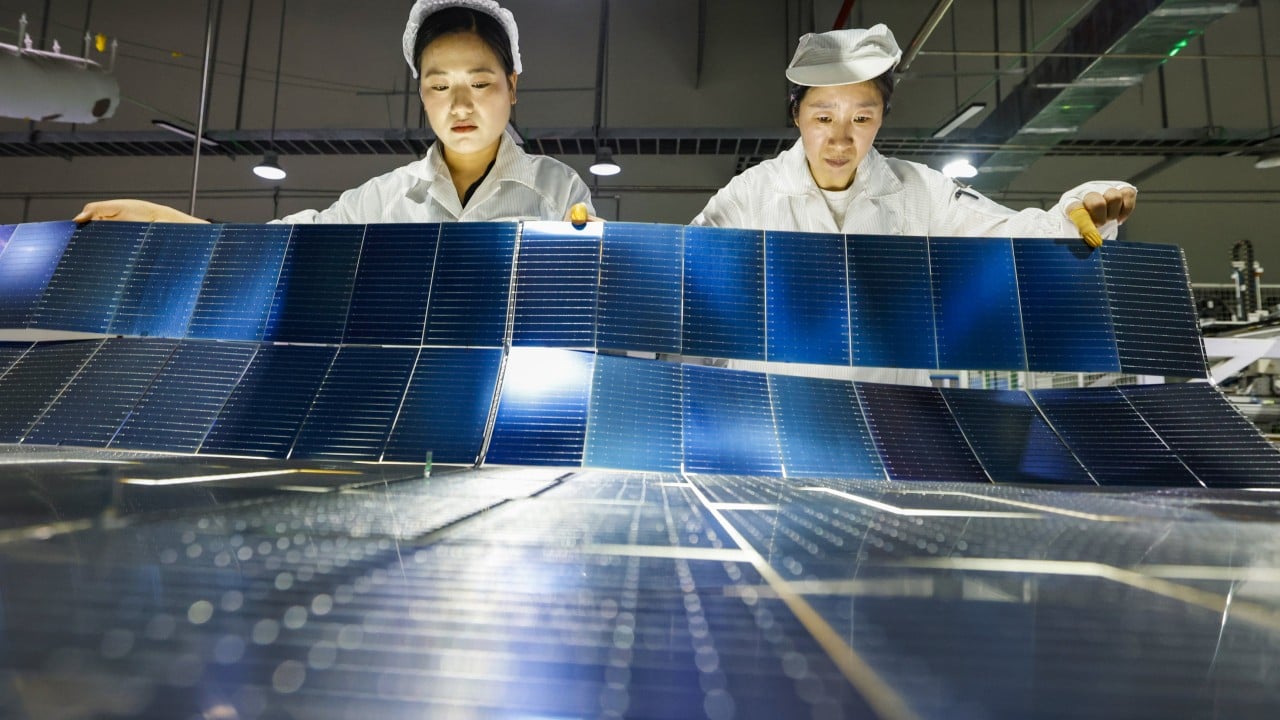
The consensus view among armchair geopoliticians is as comforting as it is wrong. They see China’s massive rollout of solar panels, wind turbines, and electric vehicles as a strategic fortress—a "green shield" that renders the Middle East’s volatility irrelevant to Beijing’s long-term survival. The logic is simple: more sun and wind means less need for Brent crude.
This is a dangerous fantasy.
If the Strait of Hormuz closes tomorrow and Iranian oil stops flowing, China’s green energy infrastructure won’t save its economy; it will likely accelerate its paralysis. We are witnessing the most expensive misunderstanding of energy density and industrial logistics in modern history. China isn’t de-risking; it is trading one form of terminal vulnerability for another, much more brittle one.
The Myth of Intermittency vs. Industrial Reality
The first "lazy consensus" is that a megawatt is a megawatt. It isn't. China’s industrial engine, which produces roughly 30% of global manufacturing output, runs on the unrelenting reliability of high-heat baseload power. You cannot run an aluminum smelter or a semiconductor fab on the hope that the wind blows in Inner Mongolia.
While China leads the world in installed renewable capacity, its dependence on fossil fuels for synchronous power remains absolute. When oil prices spike or supplies are choked, the secondary pressure on coal and natural gas increases instantly. Renewables cannot "flex" to meet a sudden deficit in liquid fuels used for heavy transport and shipping.
Think of it this way: China has built the world’s most advanced sails, but its ship still requires a massive, fossil-fueled engine to move when the wind dies. If the engine room catches fire because of an Iranian conflict, the sails are decorative.
The Logistics Trap: You Can’t Electrify a War Economy
Mainstream analysts love to point at China’s 50% EV penetration in new car sales. They claim this reduces oil demand. It’s a neat trick of math that ignores the physics of the "last mile" and the "long haul."
China’s domestic stability relies on the massive movement of goods across a continent-sized nation. The heavy-duty trucking fleet, the construction machinery building those "ghost cities," and the maritime vessels bringing in raw materials are almost 100% reliant on diesel.
The energy density of lithium-ion batteries is a joke compared to liquid hydrocarbons. To replace the energy in a single tank of diesel for a long-haul truck, you would need a battery so heavy the truck couldn’t carry any actual cargo. In a conflict scenario where oil is rationed, China’s "green" passenger cars won’t keep the grocery shelves stocked or the factories humming.
I have seen supply chains shatter over a 5% increase in logistics costs. Imagine a 300% spike in shipping costs because the Suez Canal is a shooting gallery and the Strait of Hormuz is mined. No amount of solar-powered scooters in Shanghai will offset the inflationary collapse triggered by a diesel shortage.
The Mineral Paradox: Trading Crude for Cobalt
The most glaring blind spot in the "Green Shield" theory is the supply chain for the green tech itself. China doesn't just "have" green energy; it manufactures it using a global, oil-dependent supply chain.
To build a single 3-megawatt wind turbine, you need:
- 335 tons of steel (smelted with coking coal)
- 4.7 tons of copper (mined with diesel-powered behemoths)
- 1,200 tons of concrete (produced in high-heat kilns)
- Rare earth elements (processed with toxic chemicals and massive energy inputs)
If an Iranian war sends oil to $200 a barrel, the cost of mining, refining, and transporting these materials skyrockets. The "deflationary" promise of green energy evaporates. China’s green strategy isn't an exit from the commodity cycle; it’s an intensification of it. You are simply swapping a dependence on a liquid you burn for a dependence on metals you must dig up, refine, and replace every 20 years.
The Financial Fragility of the "Green" Pivot
Let’s talk about the money. Most of China’s green energy expansion is fueled by state-directed debt. The return on investment (ROI) for these projects is calculated based on stable global trade and cheap energy inputs.
In a "shock" scenario, China’s massive overcapacity in solar and battery manufacturing becomes a liability. They have built enough capacity to supply the entire world, but that world will be in a deep recession if oil prices double. Beijing will be left holding the bag on billions in non-performing "green" loans while trying to subsidize the skyrocketing cost of the oil they still desperately need.
It is a classic "pincer movement" on their balance sheet. On one side, the cost of energy imports goes up. On the other, the export markets for their green tech dry up as the global economy cools.
The Strategic Fallacy of Energy Sovereignty
The "People Also Ask" sections of the internet are filled with variations of: "Is China energy independent?"
The answer is a resounding no, and green energy isn't changing that. True energy sovereignty requires a closed loop. China’s loop is wide open. They import the oil to run the mines, the gas to heat the factories, and the food to feed the workers.
If we look at the Malacca Dilemma—China’s fear that its energy supplies could be cut off at the Malacca Strait—green energy does almost nothing to solve it. Why? Because the food supply is also energy-intensive. Modern agriculture is essentially a way of turning oil and gas into calories via fertilizers and mechanized farming.
A "green" China that cannot secure the Persian Gulf is a China that cannot feed itself.
The Brutal Reality of the Power Grid
Even if China could magically flip a switch and make every vehicle electric tomorrow, the grid would melt.
The Chinese power grid is a rigid, top-down architecture designed for coal. Integrating a high percentage of intermittent renewables requires massive amounts of "spinning reserve"—backup plants that stay hot and ready to jump in. Currently, those backups are coal and gas.
In an oil crisis, every molecule of energy is contested. If China has to divert its coal and gas resources to compensate for lost oil (via coal-to-liquids or gas-fired power), the "greenness" of the grid disappears instantly. You end up burning the dirtiest fuels possible just to keep the lights on because your "clean" sources are too fickle to rely on during a national emergency.
The Counter-Intuitive Truth
The reality is that China's green energy push is a peacetime luxury.
It works beautifully when global trade is fluid, when shipping lanes are open, and when the price of raw materials is suppressed by a functioning global economy. But green energy is a poor "war chest." It is geographically fixed, infrastructure-heavy, and requires a high-functioning, high-tech society to maintain.
Oil, for all its faults, is the ultimate "crisis" fuel. It is energy-dense, portable, and can be stored in tanks for years. You can’t store a gust of wind for a rainy day in the South China Sea.
Beijing knows this. That is why, despite the "green" headlines, they are building coal plants at a record pace and scrambling to build overland pipelines to Russia. They aren't building a green shield; they are building a diversified fossil fuel portfolio because they know the solar panels won't save them when the missiles start flying in the Gulf.
Stop looking at the number of solar panels in the Gobi Desert and start looking at the strategic petroleum reserves and the inland coal-to-chemical plants. That is where the real strategy lies. The "Green Revolution" is a marketing campaign for the West and a hedge for the domestic air quality crisis, but as a shield against an Iranian oil shock? It’s made of paper.
China’s transition isn't an escape from the old world of geopolitics. It’s a rebranding of the same old vulnerabilities. They haven't found a way out; they've just found a new way to stay stuck.
When the oil stops, the "green" future stops with it.