The interstate manhunt for 22-year-old Zymire Hughes ended not in a high-speed highway pursuit, but quietly outside an apartment complex in southeast Las Vegas. Federal fugitive task forces do not typically mobilize across state lines for run-of-the-mill street pranks. Yet the multi-state operation that culminated in Hughes' arrest by the U.S. Marshals Service highlights a disturbing evolution in urban crime.
Police state that Hughes terrorized at least a half dozen morning commuters and pedestrians around Philadelphia City Hall while wearing a grotesque, mass-produced Chucky-style horror mask. Armed with a glowing smartphone camera, the suspect allegedly sprinted through Center City at dawn, cornering startled citizens and whispering the chilling question, "Are you ready to die?"
What began as a viral attention-seeking stunt rapidly transformed into a structural security nightmare. This case pulls back the curtain on a modern phenomenon where public spaces become pop-up stages for digital cruelty.
The Anatomy of a Dawn Ambush
The timeline constructed by Philadelphia investigators reveals an aggressive, calculated blitz rather than spontaneous foolishness. At approximately 5:18 a.m. on an ordinary Tuesday in August, the harassment campaign commenced near 15th and Chestnut Streets.
Wearing the plastic visage of a fictional cinematic serial killer, Hughes targeted vulnerable early risers navigating the quiet urban core. Security footage and witness accounts trace the suspect's path as he darted into a local coffee shop, where employees swiftly denied him service due to the terrifying facial covering. Rebuffed, he spilled back out onto the concrete to resume the hunt.
The operational hazard of modern street harassment lies in its total unpredictability. Victims walking to early shifts or heading out for morning jogs possess no defensive framework for unprovoked psychological assaults.
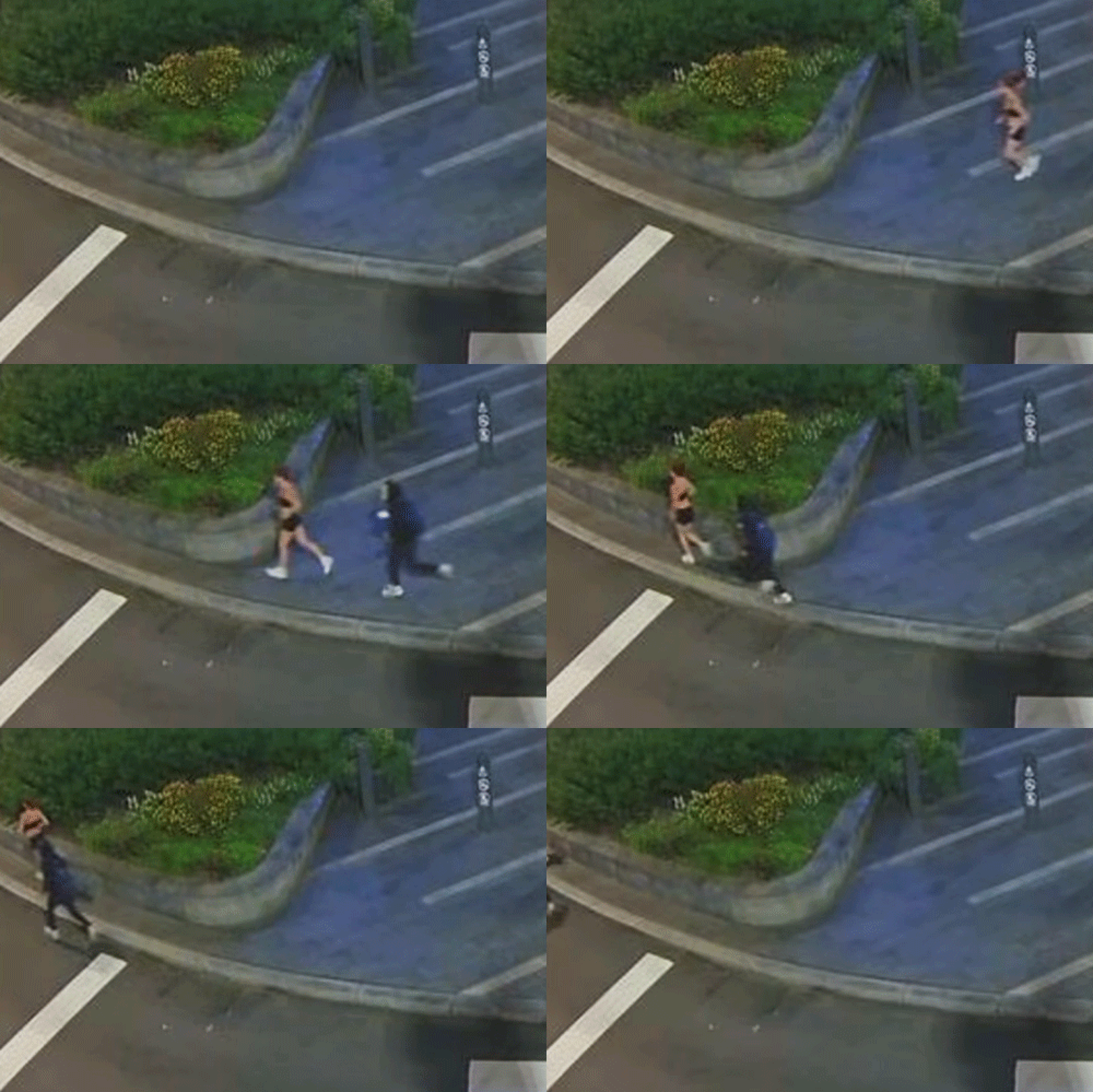
When Hughes cornered a female jogger near Market Street and asked if she was ready to die, the human nervous system reacted predictably to mortal panic. Fleeing in terror, the victim suffered a severe leg injury.
The assailant did not stay to assist or gloat in person. He recorded the devastation, pocketed the evidence of his own felony, and fled toward Suburban Station.
The Digital Incentive Structure
Investigators quickly zeroed in on a primary motivating factor. The glowing smartphone light captured by witnesses pointed directly toward the architecture of algorithmic validation.
Content creators across multiple platforms have spent years normalizing ambush pranks, pushing boundaries to manufacture shock value for views, likes, and digital monetization. When real-world interactions are treated as raw material for online feeds, empathy gets discarded. The street becomes a studio, and every terrified commuter becomes an unconsenting extra in a sociopathic performance.
Law enforcement agencies are discovering that these viral stunts defy traditional deterrence models. Traditional criminals act out of financial desperation, turf wars, or personal grievances. Viral harassers often act out of a hollow craving for digital footprint expansion.
The mask acts as a psychological shield, lowering inhibitions and removing personal accountability from the perpetrator. It transforms a young man into an anonymous monster, separating his physical identity from his online persona until the reality of an arrest warrant shatters the illusion.
The Logistics of Crossing State Lines
Fleeing the jurisdiction did not require an elaborate underground network. Within a week of the rampage, Hughes executed a textbook cross-country escape.
Records show he traveled to New Jersey, boarding a flight out of Trenton-Mercer Airport to Orlando before securing a connecting ticket to Nevada. By mid-February, he had established a residence in Las Vegas while maintaining family ties back in Pennsylvania.
Yet, the digital footprint that fueled his crime also tracked his undoing. Modern fugitive apprehension relies heavily on electronic surveillance, financial tracking, and inter-agency intelligence sharing.
The Eastern Pennsylvania Violent Crime Fugitive Task Force, working in tandem with the Nevada Violent Offender Task Force, closed the loop. U.S. Marshals surrounded the Las Vegas apartment complex, ending the evasion without incident.
Hughes now sits in the Clark County Detention Center, facing a heavy extradition process back to the Commonwealth. The charges waiting for him in Philadelphia include aggravated assault, terroristic threats, and intimidation. These are severe felony classifications that carry substantial prison terms, replacing internet clout with a permanent criminal record.
Society faces a difficult reckoning regarding how public spaces are policed against psychological terrorism disguised as entertainment. When the line between a sick joke and a violent crime blurs, the response from the justice system must be uncompromising.
The Chucky mask is currently locked away in an evidence locker. The phone containing the footage is being parsed for digital forensics. The digital applause has gone completely silent.