At 6:15 in the morning, the East Rail Line smells of damp umbrellas, fried dough, and quiet exhaustion.
Watch the faces pressed against the glass as the train rockets north out of Kowloon, past the concrete canyons of Sha Tin, toward the misty marshes of the New Territories. These are the commuters of Hong Kong’s future—or at least, the people urban planners have already penciled into spreadsheets for 2040. They are engineers, lab technicians, logistics managers, and young parents who spent their twenties crammed into subdivided flats near Victoria Harbour, praying for square footage.
Now, look out the window at the land they are promised.
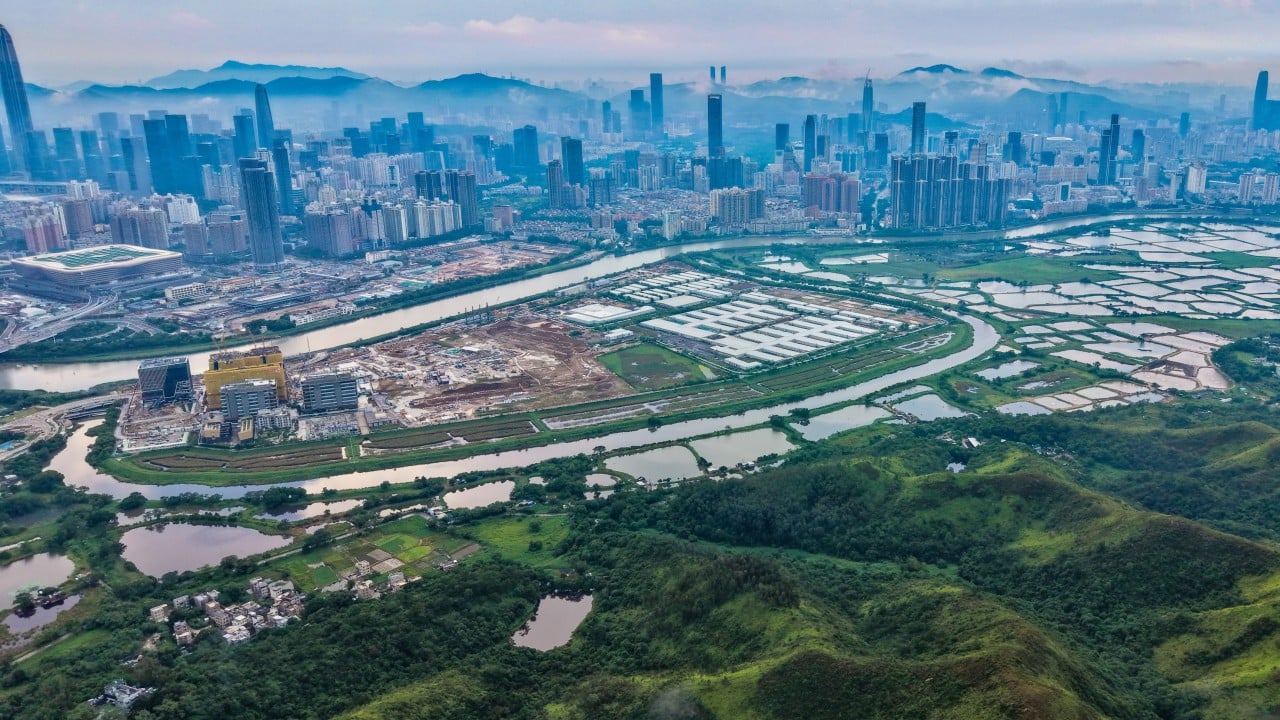
Three hundred square kilometers of fishponds, container yards, sleepy Hakka villages, and scrubland stretching along the Shenzhen border. On government presentation boards, this is the Northern Metropolis—a $100-billion-plus bet meant to rescue Hong Kong’s economy from an aging population, sky-high rents, and an overreliance on finance. It is billed as an innovation powerhouse, a twin engine to the southern Harbour Metropolis, a place where 2.5 million people will eventually live, invent, and thrive.
There is just one problem.
Right now, if you walk through the proposed heart of this mega-project, you hear trucks grinding gears on dusty two-lane roads, frogs croaking in the wetlands, and the distant hum of Shenzhen’s neon skyline gleaming across the Sham Chun River. You do not hear a city waking up. You hear a construction schedule.
And if Hong Kong mistakes a construction schedule for a soul, the entire gamble will fail.
The Anatomy of a Ghost Town
To understand why the Northern Metropolis is at a dangerous crossroads, step into the shoes of a hypothetical founder—let’s call her Chloe.
Chloe is thirty-two. She holds a doctorate in biomedical engineering from a university in Pok Fu Lam and spent four years working at a biotech startup in Boston. She wants to come home to Hong Kong. She has seed funding, three co-founders, and a breakthrough diagnostic device that needs wet-lab space and proximity to manufacturing partners across the border in Dongguan.
On paper, the San Tin Technopole—the crown jewel of the Northern Metropolis, carving out roughly 600 hectares near Lok Ma Chau—was built specifically for Chloe. The tax incentives look great. The floor-to-ceiling glass renderings of the Loop, the Hong Kong-Shenzhen Innovation and Technology Park, shimmer with promise.
So Chloe visits the site on a humid Tuesday afternoon.
She takes an MTR ride, transfers to a minibus that rattles past corrugated-iron warehouses, and steps out onto a sun-baked sidewalk with nowhere to buy a decent cup of coffee. She asks her guide where her team of twenty-somethings will eat lunch. A canteen will open in Phase Two. She asks where they will live while the residential towers are still concrete skeletons. They can commute ninety minutes each way from Tseung Kwan O. She asks where she can meet a venture capitalist at 7:00 PM over a glass of wine without spending two hours in transit.
Silence.
Here is the brutal truth urban planners learn the hard way, from Songdo in South Korea to the half-empty science parks scattered across mainland China: talent does not move to square footage. Talent moves to friction.
Think of a great city like a sourdough starter. You can buy the most expensive stainless-steel oven on earth, measure the flour to the gram, and control the humidity to the decimal point. None of it matters if the yeast is dead. Culture—the messy, unscripted collision of art galleries, late-night noodle stalls, independent bookstores, jazz bars, and public parks—is the yeast. Without it, you just have a very expensive pile of warm dough.
For decades, Hong Kong’s southern core had that yeast in abundance. Central, Wan Chai, and Tsim Sha Tsui were chaotic, vertically stacked pressure cookers where bankers bumped elbows with tailors, film directors argued over dim sum, and a twenty-minute walk could take you from a Michelin-starred dining room to a harborfront promenade packed with teenagers practicing dance routines.
The Northern Metropolis, as currently conceived, reads like an engineer’s checklist: 300 hectares for tech. 500,000 residential units. Three new railway links. It has brains. It has muscle. It has an impressive skeleton of highways and fiber-optic cables.
What it lacks is a beating heart.
The Gravity Problem Across the River
Drive ten minutes north across the border into Shenzhen’s Futian or Nanshan districts, and the stakes become viscerally clear.
Shenzhen does not sleep. At midnight, food delivery scooters swarm outside glittering tech campuses where programmers argue over code beneath giant LED screens. Within a ten-minute walk of almost any major office tower in Nanshan, you find theaters, craft breweries, night markets, design museums, and lush, manicured greenways packed with joggers. Shenzhen spent forty years shedding its reputation as a sterile factory town by aggressively importing culture—building symphony halls, subsidizing indie music venues, and turning abandoned industrial zones like OCT Loft into magnets for creative youth.
Hong Kong is trying to build a rival innovation hub literally across a narrow river from a city that has already perfected the 24-hour urban ecosystem.
Consider what happens next if Hong Kong gets the balance wrong.
Suppose the government succeeds in paving the wetlands, erecting the glass towers of San Tin, and connecting the Northern Link railway by the mid-2030s. Companies set up satellite offices to claim subsidies. Workers clock in at 9:00 AM. At 5:30 PM, a mass exodus begins. Half the workforce sprints for the border checkpoints to spend their salaries in Shenzhen, where dinner costs a third as much and the nightlife is electric. The other half boards crowded trains heading south back to Kowloon and Hong Kong Island, fleeing the quiet, sterile streets of the north.
By 8:00 PM, the Northern Metropolis goes dark.
Urbanists have a clinical term for this: a dormitory-and-office-park hybrid. Residents call it something simpler. Boring. And in a global war for researchers, AI engineers, and entrepreneurs, boring is a death sentence. You cannot force a twenty-six-year-old software architect to live in a master-planned concrete grid when the world’s most vibrant cities are bidding for her talent.
I felt a flash of this exact anxiety last autumn while standing on the edge of the Mai Po wetlands at dusk. To my left lay centuries-old gei wai—traditional tidal shrimp ponds where black-faced spoonbills waded through mirror-still water turning pink in the sunset. Behind me, surveyors in high-visibility vests were hammering wooden stakes into the dirt. It was impossible not to feel torn. Hong Kong desperately needs room to breathe. Millions of residents live in apartments smaller than a suburban American garage; young couples put off marriage because a 400-square-foot flat costs a lifetime of debt. Holding back development in the name of nostalgia is a luxury working-class families cannot afford.
Yet watching those stakes go into the mud, a nagging fear took hold: what if we destroy one of the last wild, soulful landscapes in southern China only to replace it with something nobody actually loves?
Why Master Plans Always Miss the Magic
History is ruthless to cities designed purely from the top down.
Look at Brasília, inaugurated in 1960 as a modernist utopia of sweeping boulevards and sculptural government buildings. Architects separated living zones, working zones, and leisure zones into neat geometric sectors. They eliminated street corners—the very places where neighbors accidentally meet. Within a decade, the city had a word for the malaise that afflicted its residents: brasilite—an acute, crushing loneliness brought on by monumental architecture devoid of human scale.
Hong Kong itself already ran a smaller version of this experiment in the 1980s and 1990s with Tin Shui Wai.
Built rapidly on reclaimed land in the northwest New Territories to house tens of thousands of working-class families, Tin Shui Wai was a triumph of civil engineering and a cautionary tale of social planning. Developers put up towering residential blocks in record time. They forgot the jobs. They forgot the civic squares, the cultural centers, the grassroots markets, and the transit capacity. For years, Tin Shui Wai was known grimly in local headlines as the "City of Sadness," isolated from the rest of Hong Kong by long, expensive commutes and starved of community life.
We cannot afford Tin Shui Wai 2.0 on a massive scale.
Why do governments keep repeating this mistake? Because concrete is easy to measure, and culture is terrifyingly hard to budget.
A civil servant can stand before the Legislative Council and point to a Gantt chart showing the completion date of the Northern Link railway or the square footage of commercial floor space in Hung Shui Kiu. Nobody loses their job over a delayed viaduct. Try asking a treasury official to approve $500 million for "unstructured creative serendipity" or "subsidized rents for experimental theater troupes and indie cafés." The bureaucracy freezes. It wants deliverables. It wants KPIs.
So the culture gets pushed to Phase Three. The parks get shrunk to make room for parking podiums. The street-level storefronts get leased to the only tenants who can afford corporate mall rents: chain pharmacies, bank branches, and fast-food franchises.
And just like that, the soul is engineered out of the neighborhood before the first resident even unpacks a cardboard box.
Giving the North a Pulse
If the Northern Metropolis is going to fulfill Hong Kong’s ambitions—not just as a relief valve for housing, but as a genuine engine of global innovation—the blueprint needs a radical transplant. We have to stop treating culture, ecology, and community life as decorative garnishes and start treating them as core infrastructure, just as vital as sewage pipes and high-voltage substations.
That shift starts on the ground floor, literally.
Right now, too much of Hong Kong’s new town development relies on the "podium" model: massive shopping malls sitting beneath clusters of forty-story residential towers, sealed off from the street behind glass doors and air conditioning. It is efficient, profitable for major developers, and lethal to street life.
Imagine instead if the Northern Metropolis mandated human-scale, open-air street grids in its core districts like Kwu Tung North and Hung Shui Kiu. Wide sidewalks shaded by banyan trees. Low-rise podiums with small, affordable street-front units reserved explicitly for independent restaurants, local artisans, clinics, bookstores, and wet markets. When people walk out of their apartment lobbies onto a lively street rather than down an escalator into a sterile mall, a neighborhood begins to stitch itself together.
Second, Hong Kong must anchor the north with world-class cultural and educational institutions before the tech offices open—not ten years later.
Think about what the West Kowloon Cultural District, despite its massive cost overruns and delays, eventually achieved for the harborfront. Once M+ and the Hong Kong Palace Museum opened their doors, accompanied by the sprawling Art Park along the water, the entire psychological map of Kowloon shifted. Families brought picnic blankets. Young artists congregated. Tourists lingered.
The Northern Metropolis needs that same gravitational pull from day one. Don’t just build laboratory boxes in San Tin; build a flagship contemporary design museum, a concert venue, and a major public library overlooking the water. Move university campuses, research institutes, and international schools into the north early. Twenty thousand university students living and studying in the New Territories will generate more organic nightlife, coffee shops, startups, and cultural energy in three years than a hundred government promotional campaigns could manufacture in thirty.
Third—and perhaps most importantly—the Northern Metropolis has a secret weapon that neither Central nor Shenzhen can replicate: its living heritage and wild ecology.
Scattered across Yuen Long, Fanling, and Sheung Shui are centuries-old walled villages, ancestral halls, terraced farmland, and the sprawling Sam Po Shue wetland conservation zone. Most master plans treat these relics like awkward obstacles to be bulldozed or walled off behind chain-link fences.
That is backward. A tech campus surrounded by restored Hakka villages turned into artist residencies, boutique hotels, and farm-to-table restaurants isn't a compromise; it is an unfair advantage. Picture Chloe, our hypothetical biotech founder, taking an investor from Zurich for a morning walk along a boardwalk through the wetlands, watching migratory birds lift off the water against a backdrop of solar-powered research labs, before grabbing lunch in a 300-year-old courtyard house. Nobody in Silicon Valley or Nanshan can offer that. That is a story only Hong Kong can tell.
The Choice Before the Concrete Sets
Money is tight. Public deficits are real, land sales have slowed, and skepticism about mega-projects runs deep across Hong Kong. When budgets get squeezed, the temptation in government boardrooms is always the same: cut the "soft" stuff. Trim the museum. Shrink the park. Delay the community center. Focus strictly on the roads, the housing blocks, and the commercial plots that bring immediate revenue.
Resist that urge.
A city is not a balance sheet, and people are not livestock to be housed, transported, and parked in front of computer screens. Hong Kong’s magic has always come from its fierce, improvisational energy—the way high finance and street-corner dai pai dongs, ancient temples and avant-garde cinema, exist side by side in glorious, noisy friction.
Down at the edge of the Mai Po marshes, the wooden stakes are already in the ground. Soon, the pile drivers will arrive, pounding steel deep into the bedrock of the New Territories, shaking the earth for miles around.
We know how to build the towers. We know how to bore the tunnels. The real question—the one that will decide whether millions of people actually choose to call this place home—is whether we have the courage to leave room for the unscripted, messy, glorious pulse of human life to grow between them.