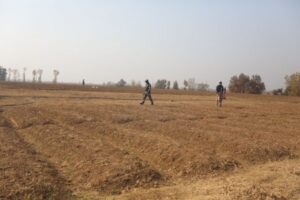
Agriculture operates under a fixed biological timeline bound by seasonal thermal units, photoperiods, and moisture windows. When climate patterns destabilize, these historical parameters lose predictive validity, turning farming into a high-variance exercise in risk management. Traditional agronomy assumes stationary climate baselines, yet modern meteorological data reveals an acceleration of localized volatility. To understand why modern food systems buckle under weather shocks, one must deconstruct the financial and systemic mechanics of agricultural vulnerability, examining how physical disruptions cascade into supply chain failures and margin compression.
The Exposure Matrix of Biological Assets
Crops and livestock are long-cycle biological assets characterized by front-loaded capital expenditure and deferred revenue realization. Unlike industrial manufacturing, which can adjust production throughput weekly based on demand signals or material availability, farming operations commit inputs months in advance of yield validation.
This creates a structural vulnerability. If an unexpected frost, mid-summer drought, or prolonged saturation event hits during the flowering or grain-filling stages, the biological factory suffers permanent yield loss. The cost function is asymmetric: inputs are entirely sunk, but output is variable.
[Capital Input Phase] ---> [Biological Growth Window] ---> [Environmental Shock Event] ---> [Asymmetric Loss Realization]
To quantify this exposure, farm operators track growing degree days and vapor pressure deficits. When temperature spikes exceed physiological thresholds, plant respiration outpaces photosynthesis, leading to carbohydrate starvation and kernel abortion. This is not merely bad weather; it is a direct mechanical disruption of the plant's metabolic engine.
Insurance products attempt to smooth these revenue shocks, but standard indemnity models struggle with systemic, multi-county events. When premium pricing fails to reflect true tail-risk probabilities, underwriting pools face liquidity crises, forcing higher deductibles onto growers who can least afford them.
Hydrological Misalignment and Soil Structural Collapse
Water management underpins agricultural output, yet current irrigation and drainage infrastructure was engineered for historical precipitation distribution curves. Modern climate volatility manifests as extreme binary events: prolonged dry spells punctuated by high-intensity, short-duration deluges.
High-intensity rainfall exceeds the infiltration capacity of agricultural soils. Instead of recharging deep soil moisture profiles, heavy precipitation generates surface runoff. This phenomenon strips topsoil of essential macronutrients—specifically nitrogen, phosphorus, and potassium—while simultaneously eroding the physical soil matrix.
The economic consequence of soil degradation is twofold:
- Short-term yield penalties due to nutrient displacement and root asphyxiation from waterlogging.
- Long-term capital expenditure requirements for soil remediation, terracing, and tile-drainage installation.
Conversely, during deficit periods, reliance on groundwater extraction accelerates aquifer depletion. As water tables drop, pumping costs rise exponentially per acre-foot, shifting the marginal cost curve upward until irrigation becomes economically unviable for low-margin commodity crops. Farms situated over rapidly depleting basins face a hard structural ceiling on operational longevity unless they transition to high-efficiency drip systems or deficit irrigation strategies.
The Logistics Bottleneck and Regional Supply Chain Fragility
Crop vulnerability extends past the farm gate into the post-harvest handling and transportation network. Agricultural commodities are bulky, perishable, and time-sensitive. They require bulk transport via barge, rail, and heavy freight.
Extreme weather directly compromises logistical pathways:
- Low-water conditions on major inland waterways restrict barge draft limits, stranding grain in interior silos and forcing volume onto more expensive rail networks.
- Extreme heat de-rates locomotive engine efficiency and can warp rail lines, reducing network velocity during peak harvest windows.
- Coastal port disruptions caused by severe storm surges interrupt international export parity pricing, trapping supply in domestic markets and crashing local cash prices.
These physical bottlenecks distort price transmission. While consumers may experience high retail food inflation due to perceived scarcity, primary producers often absorb depressed local prices because they lack the storage capacity or transport access to reach alternative markets. This decoupling of farm-gate economics from retail realities breaks the traditional feedback loop that normally encourages capital reinvestment into production capacity.
Capital Allocation and Adaptation Economics
Mitigating extreme weather exposure requires a fundamental shift in agricultural balance sheets. Growers must transition from reactive disaster management to proactive structural hardening. This involves capital reallocation across three primary domains: genetics, precision inputs, and physical micro-climate modification.
Genetics represent the highest-ROI vector for abiotic stress tolerance. Seed companies utilize marker-assisted selection and gene editing to develop cultivars with deeper root architectures, enhanced osmotic regulation, and shorter vegetative cycles to escape peak summer heat. However, adoption rates lag because proprietary seed costs scale faster than commodity price increases, compressing net margins for independent producers.
Precision agriculture tools—including variable-rate irrigation controllers, soil moisture telemetry arrays, and drone-mounted multispectral imaging—allow operators to apply inputs at sub-field resolution. By matching water and fertilizer application precisely to plant stress indicators rather than blanket field averages, producers reduce input waste and preserve soil biology.
The primary barrier to universal adoption is capital expenditure friction. High-precision hardware requires substantial upfront outlays and ongoing data subscription costs. In an industry where operating lines of credit are secured against annual crop yields, cash-flow volatility makes multi-year technology investments difficult to service.
Institutions financing the agricultural sector are updating their risk models to account for these systemic shifts. Lenders now incorporate climate risk scores into land valuations and credit assessments. Properties lacking adequate water rights security or soil conservation infrastructure face higher borrowing costs or outright credit denial.
Future solvency in primary production hinges on balancing biological resilience with financial liquidity. Operators who integrate adaptive genetics, localized water capture, and flexible storage assets will absorb localized weather anomalies without terminal equity erosion. Those relying on historical precipitation assumptions face systematic margin degradation as the frequency of extreme meteorological events accelerates.