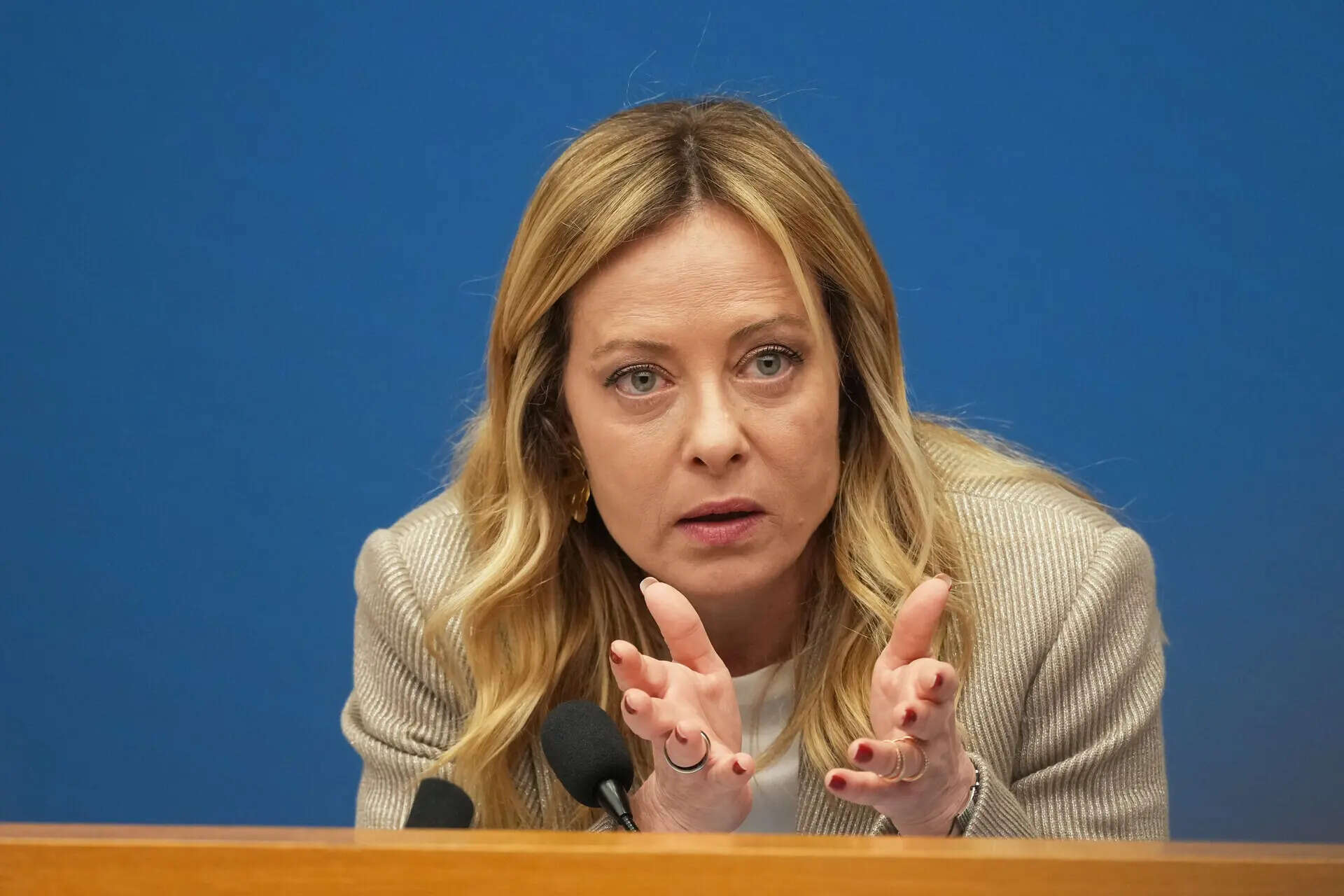
The marble of Palazzo Chigi does not hold warmth. Even in the height of an Italian summer, the grand rooms where prime ministers pacingly decide the fate of the republic retain a certain cold, institutional indifference. It is a building that has watched dozens of governments rise, sputter, and dissolve into the Roman twilight. For a long time, the unwritten rule of Italian politics was simple: nobody stays for long.
Giorgia Meloni set out to break that rule.
When she took office, she brought an aura of disciplined permanence that Rome had not seen in decades. She was the outsider who had successfully stormed the fortress, the political street-fighter who transformed her party from a fringe movement into the gravity well of Italian power. But power in Rome behaves like water in the Tiber—it shifts constantly, eroding the very banks that try to contain it.
Lately, the conversations behind those heavy palace doors have changed. The bravado has softened into something colder, more calculating. The question is no longer just how to govern, but how to survive a coming winter. The whispers escaping the corridors of power suggest Meloni is looking at a calendar, tracking a slow, remorseless decline in the polls, and thinking about doing the one thing her critics never expected.
She is thinking about shortening her own clock.
To understand why a leader with a solid majority would even contemplate calling an early election in April 2027—months before she absolutely has to—you have to understand the peculiar, terrifying physics of political popularity in the Mediterranean.
The Illusion of the High Tide
Every new Italian leader enjoys a honeymoon that feels like an empire. The voters, exhausted by the failures of the previous administration, project their highest hopes onto the newcomer. Matteo Renzi had it. Matteo Salvini had it. Mario Draghi, in his own technocratic way, had it too.
Then, the gravity settles in.
Consider a hypothetical shopkeeper in Bologna—let us call him Marco. In late 2022, Marco voted for Meloni’s coalition because he was tired of soaring energy bills, tired of Brussels dictating local economic terms, and looking for someone who sounded like they actually lived in the real world. For the first two years, Marco felt vindicated. Meloni was pragmatic. She did not start the fires her international detractors predicted. She spoke with a quiet authority on the world stage.
But by 2026, Marco’s reality has stubbornly refused to improve. The cost of living remains stubbornly high. The tax cuts he hoped for feel like drops in an ocean of national debt. The grand promises of structural reform have ground down against the immovable gears of Italian bureaucracy. Marco has not turned against the Prime Minister with fury; he has simply grown quiet. His enthusiasm has evaporated into a weary skepticism.
Multiply Marco by millions, and you get the quiet erosion currently showing up in internal polling.
It is not a sudden collapse. It is a slow leak. A percentage point lost in the north over industrial policy; half a point lost in the south over social spending adjustments. To the casual observer, a minor dip in popularity looks manageable. To a political animal like Meloni, it looks like a countdown.
The real danger is not the opposition. The opposition in Italy remains fragmented, a collection of feuding factions unable to build a coherent alternative. The danger comes from the calendar itself.
The Budget Trap
Every autumn, the Italian government must present its economic blueprint to parliament and to the European Commission. It is a grueling, miserable ritual. The finance minister must find tens of billions of euros to cover existing debts, fund public services, and somehow satisfy the expensive campaign promises of the ruling parties.
By the time the leaves fall in 2026, that exercise will be more painful than ever.
Under the revised European fiscal rules, the era of easy spending is decisively over. Italy is being watched. The bond markets are watching. The ratings agencies are watching. Every euro of spending must be fought for, and every compromise leaves a scar on the government's public standing.
Imagine surviving that meat grinder in late 2026, only to face a general election in the winter or spring of 2027 while the public is still reeling from public service cuts or tax adjustments. It is a recipe for political suicide.
This is where the tactical gamble of an April 2027 vote comes into play.
By pulling the trigger early, before the worst of the economic friction becomes undeniable, Meloni would essentially be asking the country for a mandate while she still possesses the leverage of relative stability. It is the political equivalent of selling an asset just as it peaks, rather than waiting for the market to turn.
But the gamble relies on an incredibly fragile piece of machinery: her own coalition.
The Rivals in the Mirror
In Italian politics, your enemies are in front of you, but your assassins are sitting next to you.
Meloni’s government is a tripod. Her party, Brothers of Italy, is the dominant leg. The other two legs are Matteo Salvini’s League and the late Silvio Berlusconi’s Forza Italia. For over three years, this alliance has held together through a mixture of shared ambition and mutual survival instincts.
But as the polls dip, the balance of fear shifts.
Salvini, a man who once dominated Italian politics with a single social media post, has spent years watching his influence wane under Meloni's shadow. He needs a comeback. He needs to differentiate himself. Every time the Prime Minister moves toward the moderate center to appease international allies, Salvini takes a step to the populist right, trying to reclaim the voters who feel abandoned.
Forza Italia, meanwhile, plays the role of the responsible, pro-European moderate, quietly positioning itself as the indispensable partner that keeps the government grounded.
If Meloni waits until the absolute end of her mandate, she gives her coalition partners months to sabotage her from within. They can vote against controversial bills, stoke public anger over sensitive issues, and position themselves as champions of the people against an exhausted Prime Minister. They can spend a whole year running against their own government while technically remaining inside it.
An early election cuts the ground out from under them. It forces them to decide: either stand with the leader now or explain to the voters why they pulled down a conservative government just as it was trying to secure its future. It is a brutal piece of leverage.
The Weight of the Chair
There is a psychological toll to this kind of calculations that rarely makes it into the news print.
We tend to view politicians as chess pieces, moving across a board with cold intent. We forget that they are humans operating under unimaginable pressure, sleep-deprived and surrounded by people who want their job. Meloni has spent her entire adult life climbing to this peak. She knows how hard it was to get there, and she knows exactly how fast the descent can be.
The historical memory of Italian politics is a graveyard of giants who stayed too long. Matteo Renzi thought he was invincible until a referendum broke his career. Romano Prodi was brought down by his own allies. Even Berlusconi, with all his wealth and media power, was eventually forced out by the sheer weight of economic crisis.
The temptation to control the narrative, to dictate the terms of your own survival, is intoxicating.
If she goes to the polls in April 2027 and wins, she resets the clock. She gets another five years. She cements her place as the most successful Italian leader of the modern era, a figure who defied the systemic instability of her country.
If she miscalculates, if the early vote triggers a backlash from voters who resent being dragged to the ballot boxes for tactical games, she could unleash the very chaos she is trying to outrun. The Italian electorate is volatile. It loves a savior, but it loves a fall even more.
The View from the Tiber
Walk down the Via del Corso on any given afternoon, past the luxury shops and the historic churches, and you will see a city that has outlived every political calculation ever made within its walls. The emperors left. The popes lost their temporal power. The dictators fell. The republics changed numbers.
The people drinking espresso in the piazzas do not think about April 2027. They think about the rent. They think about the state of the local hospital. They think about whether their children will have to move to Germany or London just to find a job that pays a living wage.
That is the profound disconnect at the heart of this story. Inside Palazzo Chigi, the strategic maneuvering feels like a matter of life and death. The graphs, the poll percentages, the regional breakdowns—they become the entire world. But outside, in the heat of the Roman streets, that world feels incredibly distant.
The decision Meloni faces in the coming months is not just about choosing a date on a calendar. It is a confession. It is an admission that the immense power she captured in 2022 is not an infinite resource, but a leaking bucket.
The clock is ticking in the grand rooms of the palace. Every day the numbers change slightly. Every day the options narrow. Whether she chooses to fight the clock to the bitter end or try to stop it early, one truth remains absolute in the long history of Rome.
The palace always wins in the end.


