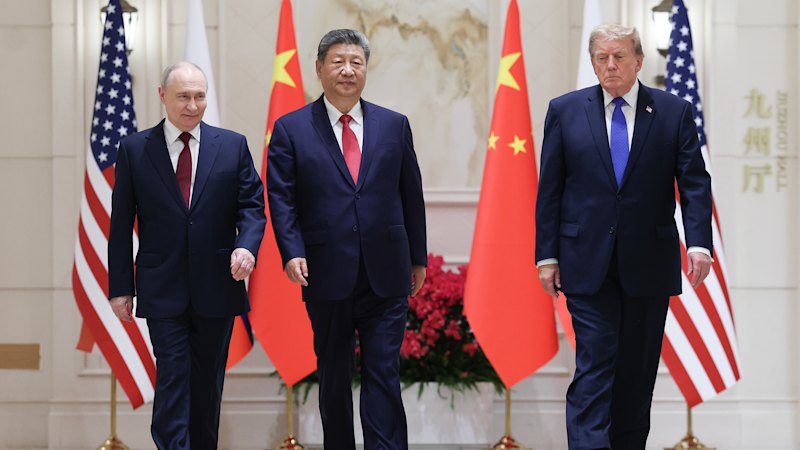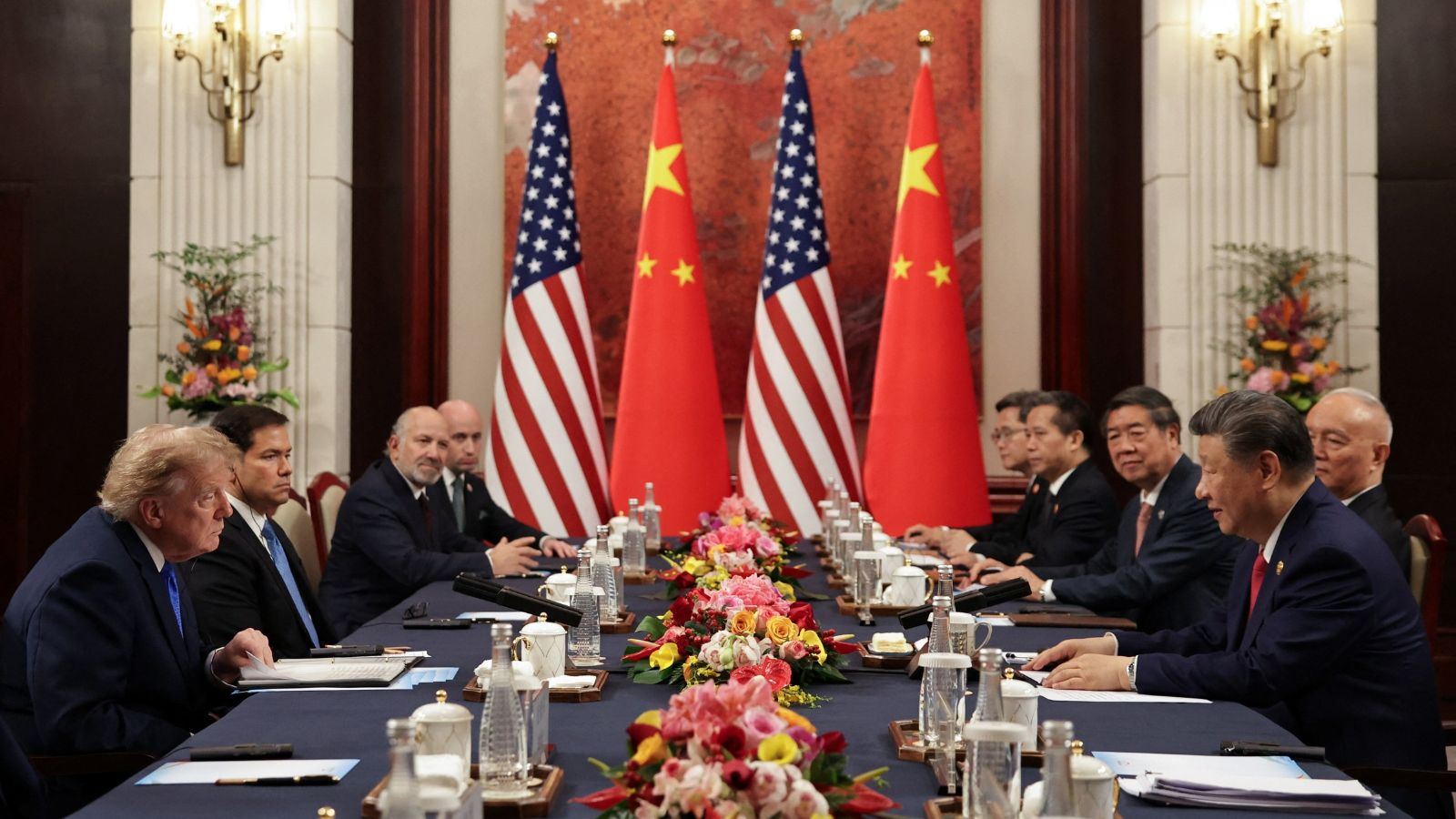
Diplomatic warnings between Beijing and Washington rarely function as literal statements of intent. When Chinese President Xi Jinping instructs U.S. President Donald Trump to handle the Taiwan question properly to prevent setbacks in bilateral ties, the statement operates as an asymmetric signaling mechanism designed to shift the burden of escalation onto Washington. Standard news coverage treats these exchanges as isolated diplomatic friction, missing the underlying structural incentives that dictate both capitals' behavior.
To analyze this interaction accurately, one must strip away diplomatic euphemisms and examine the strategic bargaining architecture governing the Taiwan Strait. Beijing’s rhetoric establishes a conditional framework: bilateral cooperation on trade, macroeconomic stability, and global security is explicitly subordinated to U.S. restraint regarding Taipei. This linkage creates a continuous stress test for the incoming or sitting U.S. administration, forcing decision-makers to calculate the exact domestic and international cost of every arms sale, diplomatic transit, or rhetorical shift.
The Architecture of Conditional Linkage
Standard geopolitical commentary often frames U.S.-China relations as a series of disconnected policy tracks—trade negotiations in one lane, security competition in another. Beijing rejects this compartmentalization. Xi’s warning relies on a doctrine of hierarchical issue linkage, wherein core sovereignty claims act as a foundational gatekeeper for all secondary diplomatic interactions.
In operational terms, this doctrine establishes three distinct tiers of bilateral engagement:
- Tier 1 The Core Sovereignty Perimeter: This encompasses Taiwan, the South China Sea, and internal governance structures. Beijing treats concessions here as non-negotiable prerequisites rather than tradable bargaining chips.
- Tier 2 The Strategic Stability Buffer: This includes military-to-military communication channels, nuclear proliferation talks, and crisis management protocols. Beijing routinely suspends Tier 2 mechanisms to punish Tier 1 perceived violations.
- Tier 3 Transactional Cooperation: Trade tariffs, fentanyl precursor controls, climate coordination, and agricultural purchases sit at the bottom of the hierarchy.
When Xi warns against "setbacks" in U.S.-China ties, he is threatening to weaponize Tier 2 and Tier 3 channels in response to U.S. actions in Tier 1. For a U.S. administration prioritizing domestic economic metrics, tariff restructuring, or bilateral trade deficits, this linkage introduces an immediate operational constraint. Washington cannot extract economic concessions from Beijing while simultaneously expanding security commitments to Taipei without triggering a predictable freeze across the entire diplomatic apparatus.
Deconstructing the Rhetoric of Doing the Right Thing
In Chinese diplomatic parlance, urging a foreign leader to "do the right thing" is not an appeal to shared moral values. It is a standardized linguistic marker indicating that Beijing views the status quo as eroding and demands unilateral corrective action from the counterparty.
This phrasing performs three specific functions within international bargaining theory:
- Establishing the Baseline of Legitimacy: By framing its own position as the historical and legal default—anchored in Beijing’s interpretation of the Three Joint Communiqués—China positions any U.S. support for Taiwan as a revisionist provocation.
- Creating Ambiguity in Retaliation: The phrase "avoid setbacks" avoids specifying the exact kinetic, economic, or diplomatic penalty for non-compliance. In deterrence theory, calculated ambiguity forces the target state to over-insure against worst-case scenarios, inducing self-deterrence without requiring the sender to commit to a costly, pre-determined response.
- Domestic Audience Calibration: State media broadcasts these warnings domestically to project strength and resolve. For the Chinese Communist Party, demonstrating uncompromising posture on national reunification is a central pillar of internal political legitimacy, leaving minimal room for public rhetorical flexibility.
The limitation of this signaling strategy lies in its predictability. Because Beijing deploys identical phrasing across multiple U.S. administrations, Washington’s national security apparatus often discounts the immediate urgency of the threat, treating it as baseline diplomatic noise rather than an acute crisis indicator.
The Structural Friction Between Transactionalism and Deterrence
The dynamic between Xi and Trump introduces a specific collision of political operating systems. Trump’s foreign policy approach historically favors bilateral transactionalism—viewing alliances, security guarantees, and trade balances as quantifiable ledgers subject to direct negotiation. Conversely, Xi’s strategic framework treats territorial integrity as an absolute variable immune to commercial trade-offs.
This mismatch generates acute miscalculation risks across four operational dimensions:
1. The Valuation Asymmetry of Taiwan
Washington evaluates Taiwan primarily through the lenses of semiconductor supply chain security, First Island Chain containment strategy, and alliance credibility. These are strategic and economic assets—high value, yet fundamentally quantifiable. Beijing evaluates Taiwan through the lens of regime survival and historical legitimacy. When one actor views an asset as a negotiable strategic buffer and the other views it as an existential domestic imperative, standard bargaining models break down. A commercial concession offered by Washington cannot offset a perceived sovereignty violation in Beijing.
2. The Erosion of Strategic Ambiguity
For decades, U.S. policy relied on strategic ambiguity—declining to state explicitly whether U.S. forces would intervene militarily to defend Taiwan. This posture served a dual deterrence function: it deterred Beijing from invading by preserving the threat of U.S. intervention, while deterring Taipei from declaring formal independence by withholding a blank check of military support.
Recent legislative shifts in Washington, increased arms sales, and shifting executive rhetoric have pushed U.S. posture toward strategic clarity. Xi’s direct warning to Trump is an attempt to arrest this drift. Beijing seeks to compel the U.S. executive branch to re-establish explicit guardrails against Taiwanese separatism, effectively asking Washington to co-manage and restrain Taipei’s political trajectory.
3. The Semiconductor Chokepoint Variable
Economic interdependence no longer acts as an automatic brake on military escalation; instead, it has become a primary theater of competition. Taiwan’s dominance in advanced logic chip fabrication creates a mutual vulnerability trap. A blockade or kinetic conflict across the Strait would sever global access to sub-3-nanometer semiconductors, triggering a synchronized global depression.
Trump’s focus on reshoring manufacturing and imposing broad tariffs intersects directly with this vulnerability. Pressuring Taiwan to relocate semiconductor fabrication capacity to the United States may reduce long-term U.S. supply chain exposure, yet it simultaneously risks degrading the "silicon shield"—the theory that global economic reliance on Taiwan’s domestic foundries deters Chinese aggression. If Beijing perceives that the U.S. is systematically extracting Taiwan’s strategic economic value while hollowing out its defensive deterrence, China’s timeline for coercion could accelerate rather than contract.
4. The Arms Sales Backlog and Credibility Gap
U.S. statutory obligations under the Taiwan Relations Act require Washington to provide Taiwan with defensive arms. However, industrial base bottlenecks in the United States have created a multi-billion-dollar backlog in approved weapons deliveries.
This creates a dangerous operational gap: Washington absorbs the full diplomatic backlash from Beijing the moment an arms package is announced, yet Taipei receives zero immediate defensive capability on the ground. Xi’s warnings exploit this vulnerability. Beijing can escalate diplomatic and gray-zone military pressure in response to U.S. announcements, imposing immediate costs on Washington while Taiwan’s actual defensive posture remains static.
Operationalizing Gray-Zone Coercion
When Washington ignores Beijing’s rhetorical warnings, China rarely jumps directly to full-scale amphibious invasion. The operational cost and existential risk of a failed kinetic assault remain prohibitively high. Instead, Beijing utilizes gray-zone coercion—activities designed to alter the physical and legal status quo below the threshold of conventional warfare.
Understanding Xi’s warning requires mapping the escalation ladder Beijing deploys when it judges that Washington has failed to "do the right thing":
- Airspace and Maritime Normalization: People’s Liberation Army (PLA) aircraft and naval vessels systematically cross the median line of the Taiwan Strait. By turning irregular incursions into daily operational routines, Beijing degrades Taiwan’s early warning reaction times and accelerates the physical wear-and-tear on Taiwan’s airframe and naval fleets.
- Quarantine and Inspection Regimes: Rather than a formal military blockade—which constitutes an act of war under international law—China’s Coast Guard can enforce selective customs inspections on commercial shipping entering Taiwanese ports. This tests U.S. willingness to intervene in law-enforcement-framed maritime disputes.
- Subsea Infrastructure Disruption: Taiwan relies on a dense network of submarine fiber-optic cables for international data transmission and financial clearing. Targeted severance of these cables by ostensibly civilian vessels isolates the island digitally without firing a shot.
- Targeted Economic Sanctions: Beijing selectively suspends tariff reductions under the Economic Cooperation Framework Agreement (ECFA) or bans specific Taiwanese agricultural and petrochemical imports. This applies direct economic pressure on specific voter demographics within Taiwan ahead of elections.
Each rung on this ladder is calibrated to force Washington into a binary dilemma: either accept a permanent degradation of Taiwan’s autonomy or initiate a direct military confrontation over an ambiguous, non-kinetic provocation.
Limitations of U.S. Counter-Strategies
Analysts frequently propose straightforward solutions to counter Beijing’s coercion, such as rapid militarization of Taiwan or total economic decoupling from China. Both approaches carry severe operational limitations that constrain U.S. policymakers.
Turning Taiwan into an asymmetric "porcupine" fortress—saturated with mobile anti-ship missiles, sea mines, and air defense systems—requires years of procurement, training, and doctrinal integration. Rapidly accelerating this process risks triggering the exact preemptive Chinese intervention it is designed to deter. Beijing’s leadership operates under a closing window of opportunity; if they conclude that Taiwan is on an irreversible trajectory toward permanent military separation, the incentive to strike before those defenses mature increases sharply.
Similarly, aggressive economic decoupling reduces Beijing’s leverage over Tier 3 transactional issues, yet it simultaneously removes the primary non-military deterrent restraining Chinese aggression. Once bilateral trade and financial integration fall below a critical threshold, Beijing loses the economic incentives that favor stability, leaving military and coercive instruments as the primary tools of statecraft.
The Strategic Imperative for Washington
Managing the bilateral relationship following Xi’s warning requires abandoning reactive diplomatic skirmishes in favor of disciplined deterrence architecture. Washington cannot resolve the fundamental sovereignty dispute over Taiwan, nor can it alter Beijing’s core ideological commitments through commercial tariffs alone.
To prevent severe bilateral setbacks while preserving regional stability, U.S. strategy must execute three precise adjustments:
- Re-establish Quiet, High-Level Strategic Channels: Public rhetorical sparring forces both leaders into inflexible domestic postures. Washington must utilize back-channel diplomacy to privately reaffirm adherence to its long-standing One China policy—distinct from Beijing’s One China principle—while clearly delineating the specific kinetic actions that would trigger an automatic U.S. military response.
- Prioritize Asymmetric Delivery Over High-Profile Announcements: Stop announcing massive, politically provocative arms packages that remain stuck in manufacturing backlogs for years. Shift procurement toward rapid, discreet transfers of asymmetric munitions, spare parts, and electronic warfare systems that immediately harden Taiwan’s defensive resilience without generating daily diplomatic flashpoints.
- Decouple Trade Leverage from Security Guarantees: Explicitly reject Beijing’s hierarchical issue linkage during negotiations. Washington must treat trade deficits, industrial tariffs, and technology export controls as standalone economic variables, refusing to trade away defensive commitments to Taiwan in exchange for short-term agricultural purchases or superficial commercial concessions.
Beijing’s warning to do the right thing is a predictable opening gambit in a multi-year bargaining cycle. Success depends on Washington’s ability to absorb the rhetorical pressure without conceding strategic ground, maintaining a credible military balance in the Strait while keeping economic competition within manageable boundaries.