Cold Water and Forgotten Dreams
In 1957, a Soviet engineer named Petr Borisov sat down with a pen, a stack of blueprints, and an ambition so vast it bordered on madness.
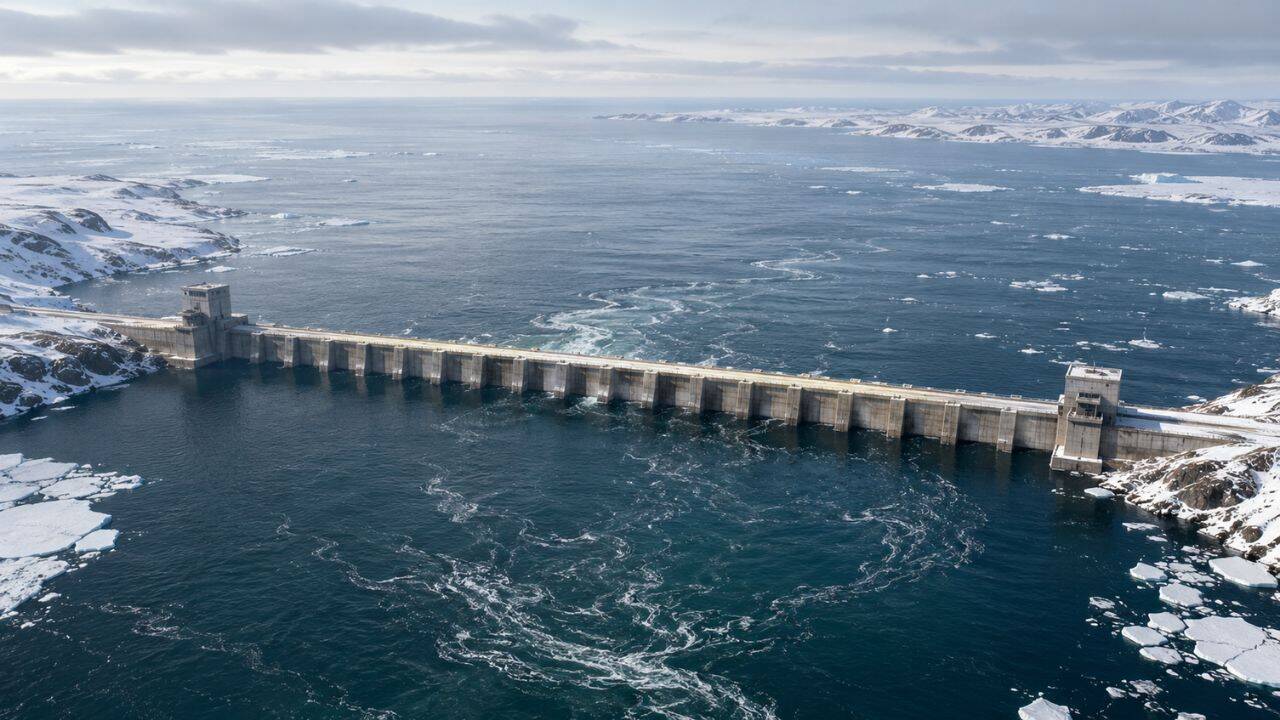
His proposal was simple to state, yet staggering to comprehend. He wanted to build a dam across the Bering Strait. A fifty-mile mega-structure of concrete and steel spanning the freezing Gap between Siberia and Alaska.
Borisov wasn't trying to generate electricity, nor was he trying to block an invading army. He wanted to pump the Atlantic Ocean's warm waters directly into the frigid Arctic Basin. The goal? To melt the polar ice cap entirely. He envisioned turning the harsh, barren tundra of northern Russia into fertile farmland, creating a temperate paradise out of a frozen wasteland.
Back then, humanity viewed nature as a wild beast that simply needed breaking.
The plan was eventually shelved. The geopolitical friction of the Cold War, paired with the sheer, terrifying cost of moving millions of tons of concrete into sub-zero waters, buried the dream. Borisov’s grand design faded into historical obscurity, becoming little more than a trivia footnote in old engineering journals.
Until now.
[Image of the Bering Strait]
The Ice Bridge That Isn't There
Fast forward to the present day.
Imagine standing on the bleak, wind-whipped shore of Wales, Alaska—the westernmost point of the North American mainland. The air smells intensely of salt and frozen earth. Across fifty miles of grey, white-capped sea lies Russia’s Chukotka Peninsula.
To stand there is to realize just how small the choke point between our planet's major oceans really is.
Today, climate researchers are pulling Borisov's old schematics out of the archives. But their intent is the exact opposite of his. Borisov wanted to melt the ice to tame the North. Modern scientists are asking a radical, desperate question: Could a barrier built across the exact same stretch of water actually save the ice, stabilizing the delicate circulatory system of the entire planet?
To understand why anyone would reconsider an idea this insane, you have to look at how ocean currents actually work.
Think of the global ocean as a massive, interconnected conveyor belt. Warm water travels north from the equator along the surface, cooling as it reaches the poles. As it freezes into sea ice, it leaves salt behind in the surrounding water. This cold, ultra-dense, salty water sinks deep into the ocean abyss, driving the global circulation system that keeps weather patterns stable from Kansas to Kenya.
Now, picture what happens when millions of tons of fresh, melting glacial ice pour into that delicate machine.
The balance breaks.
A Giant Plug in the Planet's Throttle
The Bering Strait acts as a narrow pressure valve. It controls the flow of low-salinity water moving from the Pacific into the Arctic Ocean.
When Pacific water streams through that narrow neck, it carries warmth. In a warming world, that inflow acts like a blowtorch against the underside of sea ice, accelerating the melt from below while the sun bakes it from above.
This is where the modernized version of the Soviet concept enters the conversation.
What if we didn't melt the ice? What if we throttled the valve?
By constructing a targeted geoengineering barrier—essentially a giant, semi-permeable underwater gate across the Bering Strait—scientists believe we could regulate the volume of warm, lower-salinity Pacific water entering the Arctic.
Hypothetical Scenario: Picture an array of massive underwater tidal gates anchored to the seabed fifty meters below the surface. During seasons of peak warm-water transport, the gates close, acting as a baffle. They divert the warmer currents away, preserving the cold, dense Arctic environment above. When winter sets in, the gates adjust, allowing natural nutrient flows to pass while keeping the thermal balance intact.
It sounds like pure science fiction. It feels like playing God with a wrench.
The Cost of Desperation
Why are serious oceanographers even running computer simulations on an idea this absurd?
Because the alternative is worse.
We are approaching tipping points where natural feedback loops take the driver's seat. When sea ice vanishes, dark water absorbs heat instead of reflecting it. The Arctic warms twice as fast as the rest of the planet. Weather systems stall. Droughts linger. Storms intensify.
When you talk to the researchers modeling these scenarios, you don't hear arrogance. You hear panic wrapped in cold mathematical precision.
The engineering hurdles alone are mind-boggling. Building permanently submerged infrastructure in one of the most hostile marine environments on Earth makes offshore oil drilling look like assembling plastic building blocks. The Bering Strait is notorious for crushing sea ice, violent polar storms, and months of complete darkness.
Then come the human consequences.
Indigenous communities have navigated, fished, and survived around the Bering Strait for millennia. Their lives, cultures, and food security are tied directly to the natural ebb and flow of these waters. Dropping a mega-project into their backyard would rewrite their ecosystem overnight.
And then there's the international nightmare. Who holds the remote control to the Arctic's thermostat? Washington? Moscow? Beijing?
Imagine a dispute over weather patterns where one nation demands the gates stay closed to protect their coastal cities from sea-level rise, while another demands they open to clear shipping lanes.
A single structure could spark the world's first true climate war.
The Mirror in the Water
It is easy to look at Petr Borisov’s 1957 plan and laugh at the hubris of the mid-century mindset. They wanted to bend nature to their will without understanding the consequences.
Yet, as modern supercomputers crunch the data on a revived Bering Strait barrier, the irony is heavy enough to sink a battleship.
We are looking at the exact same physical structure, framed by the exact same geopolitical waters, to solve a crisis created by our own historical hubris. Borisov wanted to remake the world. We are reduced to figuring out how to stop it from breaking entirely.
The Bering Strait remains quiet for now. The waves crash against the rocky shores of Big Diomede and Little Diomede, two islands sitting in the middle of the strait, separated by just two miles of water and twenty-one hours of time zones.
Between them lies the line separating yesterday from tomorrow.
Whether an engineering marvel ever rises from that seabed matters less than what the debate tells us about our present moment. We are standing on the shore, watching the ice retreat, realizing that the wild choices we once laughed off as Cold War fantasies may soon be the only choices we have left.

/https://i.s3.glbimg.com/v1/AUTH_e84042ef78cb4708aeebdf1c68c6cbd6/internal_photos/bs/2026/g/B/3vpkvHQKizRKAfzDxjXA/vini-jr-antes-e-depois.jpg)