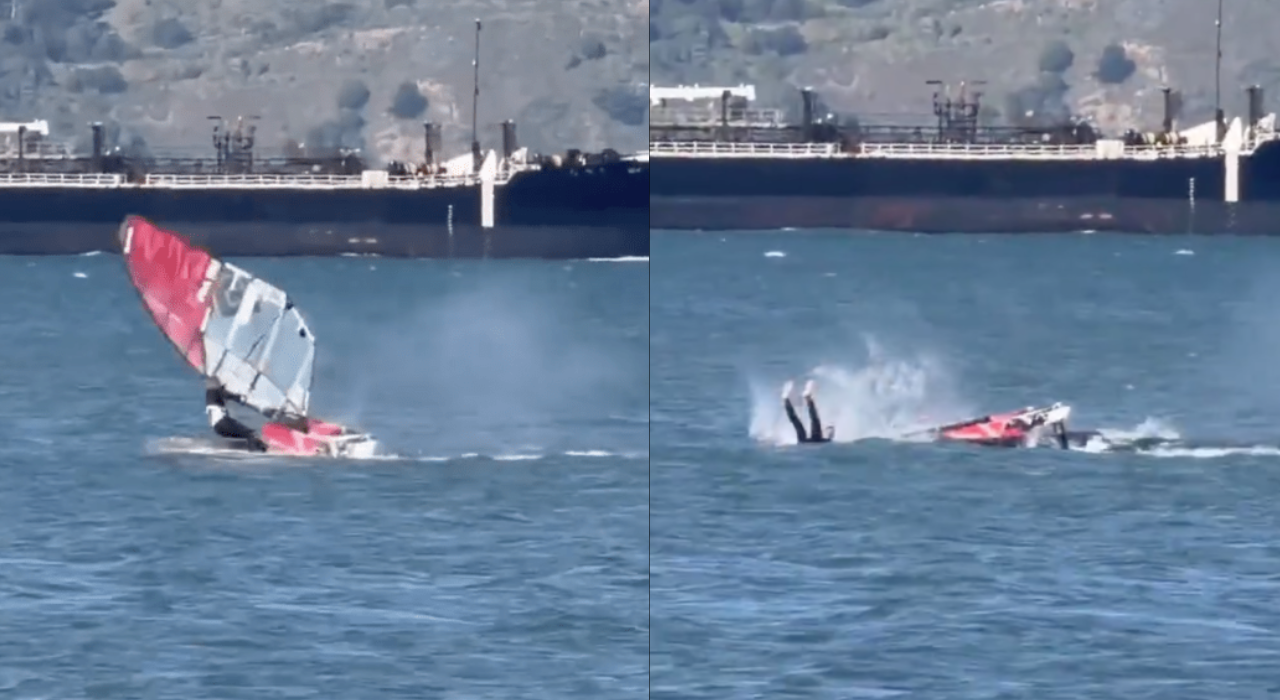
The footage is visceral and immediate. A windsurfer, locked into a high-speed plane across a shimmering stretch of coastal water, suddenly lurches skyward. There is no wave, no gust of wind, and no visible debris to blame. Instead, the board strikes the massive, slick back of a surfacing whale. In a split second, the athlete is airborne, the gear is compromised, and a multi-ton marine mammal is left with a gashed flank. While viral media outlets treat this as a "one-in-a-million" fluke, those who spend their lives on the water know better. This is not a freak accident. It is the inevitable result of a technological arms race in water sports that has outpaced both maritime law and biological reality.
The incident highlights a growing friction between human recreation and marine conservation. As windsurfing and kiteboarding evolve—specifically with the integration of hydrofoil technology—the speeds at which humans move across the water have doubled. We are no longer skimming the surface; we are flying above it on carbon-fiber blades that act like underwater scalpels. When these blades meet the soft tissue of a cetacean, the "unbelievable" moment becomes a predictable tragedy.
The Physics of a Silent Strike
To understand why these collisions are becoming more frequent, you have to look at the mechanics of the modern foil. Traditional windsurfing boards drag across the surface, creating a significant amount of "white noise" through cavitation and hull slap. Whales, which rely heavily on acoustic awareness to navigate their environment, can often hear a standard boat or a dragging board from a distance.
Hydrofoils changed the game by eliminating that noise. By lifting the hull out of the water, the foil reduces drag to almost zero, allowing riders to reach speeds exceeding 30 or 40 knots in relatively light winds. The result is a silent, high-speed projectile. A whale resting just below the surface or rising to breathe has almost no acoustic warning that a sharp metal or carbon strut is closing in at highway speeds.
The impact is often devastating for both parties. For the rider, hitting a whale at 30 knots is equivalent to hitting a concrete wall. The kinetic energy has nowhere to go but into the equipment and the rider’s body. For the whale, the damage is often internal. While their skin is thick, their blubber and muscle layers are highly vascularized. A foil can slice deep into these layers, leading to infections or hemorrhaging that may not kill the animal instantly but will lead to a slow, agonizing decline.
The Blind Spot of Modern Maritime Regulation
We currently operate in a regulatory vacuum. Most maritime "rules of the road" were written for commercial shipping, fishing vessels, and slow-moving pleasure craft. These laws mandate distance requirements—usually 100 yards or more—from protected species like Humpbacks or Right whales. However, these rules are almost impossible to enforce for individual windsurfers or kite-foilers who can cover that 100-yard distance in less than six seconds.
The burden of avoidance is currently placed entirely on the human, yet the technology is designed to ignore the environment. High-speed foiling requires intense focus on the "trim" of the board and the tension of the sail or kite. When a rider is focused on micro-adjustments to stay balanced on a literal knife-edge, they are rarely scanning the water 50 meters ahead for the subtle shimmer of a whale’s back.
Furthermore, many of the world's premier windsurfing spots overlap directly with migratory corridors. From the coast of Western Australia to the bays of Maui and the inlets of South Africa, we have invited high-speed extreme sports into the equivalent of a biological nursery.
The Myth of the Unavoidable Accident
Industry insiders and gear manufacturers often frame these events as "acts of God" to protect the image of the sport. If the public perceives windsurfing or foiling as inherently dangerous to wildlife, access to beaches and waterways could be restricted. This leads to a culture of silence. Many "bumps" or "near misses" go unreported because riders fear the legal repercussions of admitting to striking an endangered species.
The truth is that many of these collisions are avoidable through better timing and seasonal awareness. Whales are migratory. Their presence in specific bays is often predictable to within a few weeks. Yet, organized events and casual riders rarely adjust their schedules to accommodate these cycles. The "unbelievable" nature of the video currently circulating is a marketing tactic; in reality, it is a data point in a mounting trend of human-wildlife conflict.
Carbon Fiber and Conservation
There is a technical argument to be made for better safety integration. In the world of commercial shipping, "whale-safe" propellers and acoustic deterrents are being tested with varying degrees of success. In the recreational sector, there is zero movement toward this. We are seeing boards become stiffer, foils become sharper, and riders become more daring.
The Hidden Costs of Performance
- Acoustic Stealth: Foils eliminate the vibration that acts as a natural warning signal to marine life.
- Closing Speeds: The window for reaction has shrunk from seconds to fractions of a second.
- Blade Geometry: Leading edges are sharpened to reduce drag, increasing the likelihood of deep lacerations upon impact.
If the industry does not self-regulate, the hand of the law will be forced. We have already seen "slow zones" implemented for motorboats in manatee habitats and whale sanctuaries. It is only a matter of time before these same restrictions are applied to wind-powered craft. A "no-foil" zone in migratory corridors would be a death knell for local enthusiasts, yet it remains the most logical solution for agencies tasked with protecting marine biodiversity.
Beyond the Viral Clip
The viral video serves as a Rorschach test for the viewer. To the casual observer, it’s a "nature is metal" moment—a crazy story to tell at a bar. To the marine biologist, it’s a record of a potential wildlife crime. To the industry analyst, it’s a warning shot across the bow of a sport that is growing too fast for its own good.
We cannot continue to treat the ocean as an empty stadium. It is a crowded, living space where we are the intruders. The "unbelievable" collision is actually a very believable consequence of our desire for frictionless speed.
The path forward requires a shift in the culture of extreme sports. It means acknowledging that a "clean" ride isn't just one where you don't fall; it's one where you don't leave a trail of injured wildlife in your wake. Riders must become amateur naturalists, learning the breach patterns and blowhole signatures of the creatures they share the water with.
Manufacturers have a role to play as well. Developing foils with "blunt-force" leading edges that maintain performance but reduce cutting potential is a technical challenge, but a necessary one. We need to stop designing for the vacuum of a laboratory and start designing for the reality of the ecosystem.
The next time a video like this surfaces, look past the splash and the shock of the rider. Look at the water. Consider the shadow beneath the surface that didn't ask to be part of an adrenaline junkie's highlight reel. If the sport of windsurfing wants to keep its soul—and its access to the world's best waters—it has to stop hitting the locals.
Stop viewing the ocean as a static backdrop for personal achievement and start seeing it as a high-stakes environment where your gear is a weapon.