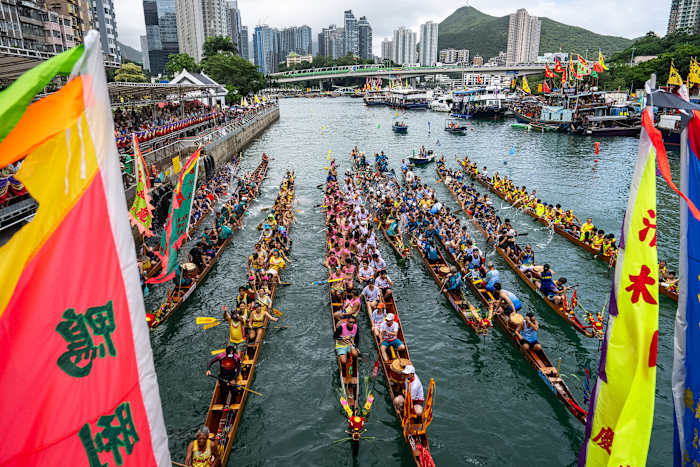
The Dragon Boat Festival connects modern China to traditions spanning over two millennia, but the survival of this ancient holiday depends on economic reinvention rather than pure historical reverence. Beneath the surface of Zongzi wrappings and racing crews lies a sophisticated state-backed cultural apparatus and a multi-billion-dollar commercial engine. Without this modern financial scaffolding, the festival would risk fading into the background of a hyper-urbanized society. The holiday persists because it has been successfully monetized, adapted for corporate branding, and integrated into national soft-power initiatives.
The Myth and the State Market
Every June, the standard historical narrative resurfaces. Media outlets dutifully recount the story of Qu Yuan, the patriotic poet of the Chu kingdom who drowned himself in the Miluo River to protest government corruption. Citizens threw sticky rice dumplings into the water to prevent fish from consuming his body.
This tragic tale serves as the official emotional anchor of the holiday. However, historical reality is far more complex. Anthropological evidence suggests that the core practices of the festival—dragon boat racing and the use of calamus and wormwood—existed as agricultural and disease-prevention rituals long before Qu Yuan lived. The early fifth lunar month was historically viewed as an ominous time of pestilence and changing weather. The rituals were practical public health measures disguised as spiritual traditions.
In 2008, the Chinese government designated the Dragon Boat Festival as a national public holiday. This was not a purely sentimental decision. It was a strategic legislative move designed to stimulate domestic tourism, boost consumer spending, and solidify national identity amid rapid globalization. By legally embedding the festival into the modern work calendar, the state transformed an agrarian ritual into a reliable economic driver.
The Industrialization of Sticky Rice
The humble Zongzi—a pyramid of glutinous rice wrapped in reed leaves—has evolved from a homemade family comfort food into a highly competitive consumer packaged goods industry. The market is no longer driven solely by grandmotherly tradition.
Zongzi Market Evolution:
Traditional: Homemade -> Local Markets -> Seasonal Consumption
Modern: Industrial Production -> Luxury Collaborations -> Year-Round E-commerce
Major food brands and luxury fashion houses have co-opted the snack, turning it into a status symbol and a corporate gifting tool.
- Luxury Branding: Companies like Fendi, Gucci, and Prada routinely design high-end Zongzi gift boxes for clients, replacing traditional packaging with leather cases and silk wraps.
- Flavor Innovation: While traditionalists argue over the merits of sweet northern jujube Zongzi versus savory southern pork and salted egg yolk variants, mass-market manufacturers introduce truffle, abalone, and cheese fillings to appeal to younger consumers.
- Cold Chain Logistics: The expansion of high-speed rail and advanced refrigeration networks allows regional variations of Zongzi to be shipped fresh across the country within 24 hours, flattening regional culinary boundaries.
This commercialization draws criticism from cultural purists who lament the loss of domestic preparation. The reality, however, is clear. If the preservation of the holiday relied entirely on busy urban professionals spending hours soaking reeds and boiling rice from scratch, consumption would plummet. Industrialization has saved the artifact by altering its production.
From Village Ritual to Corporate Sport
Dragon boat racing has undergone a parallel transformation. What began as an regional, community-organized ritual to appease the rain gods is now an organized, commercialized sport with corporate sponsorships, broadcast rights, and international ambitions.
In the southern provinces, particularly Guangdong and Fujian, village bragging rights remain intense. Local clans spend hundreds of thousands of yuan to commission custom carbon-fiber boats and hire professional coaches. Yet, the financing of these events has shifted away from informal community donations toward corporate backing and local government tourism budgets.
The Sponsorship Ecosystem
Modern races look more like Formula 1 tracks than ancient village gatherings. Financial institutions, real estate conglomerates, and automotive brands plaster their logos across the hulls of the boats and the jerseys of the paddlers. The athletes themselves are changing. While older village residents still form the spiritual core of many teams, elite universities and professional sports clubs now field highly trained squads that compete in national leagues.
This professionalization creates a tension between authentic local heritage and standardized entertainment. When a sport becomes optimized for television broadcast and corporate hospitality suites, the quirky, dangerous, and unpolished aspects of the traditional village race are systematically removed. Safety regulations, while necessary, have homogenized the events, turning wild regional variants into a uniform sprint down a straight, manicured canal.
The Soft Power Agenda
Beyond domestic commerce, the Dragon Boat Festival serves as a valuable tool for international diplomacy and cultural projection. In 2009, the festival was inscribed on the UNESCO Representative List of the Intangible Cultural Heritage of Humanity, giving Beijing a validated platform to showcase its historical depth to the world.
Dragon boat clubs now exist in over 80 countries, from the United States to Germany and South Africa. For the state, these clubs represent an organic, non-threatening entry point for cultural diplomacy. It is a form of soft power that paddles under the radar. By exporting the sport, the underlying cultural narratives regarding Chinese collectivism, discipline, and historical longevity are exported along with it.
Yet, this global expansion dilutes the specific historical context of the holiday. To an oarsman in Vancouver or Frankfurt, the race is an excellent cardiovascular workout and a team-building exercise, completely divorced from the tragic fate of an ancient Chu state bureaucrat or the protective properties of mugwort.
The Survival Paradox
The enduring nature of the Dragon Boat Festival is not proof of the unchanging nature of tradition. It is proof of its elasticity. To survive, an ancient custom must submit to the demands of the contemporary economic system.
The festival survives because it acts as a mirror for China's shifting societal priorities. When the nation was agrarian, the holiday focused on crops and disease. When the state sought national cohesion, it focused on patriotism and Qu Yuan. Now that the country is a consumer powerhouse, the holiday focuses on retail metrics, tourism revenue, and global brand building. The ancient rituals are not dying, but they are no longer free.