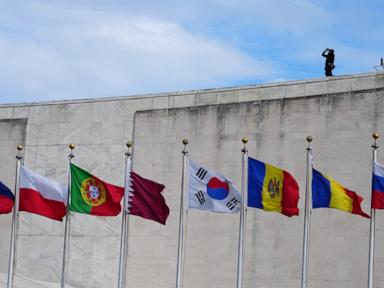
Autumn arrives in New York with a specific kind of violence. The humidity finally breaks, replaced by a crisp, sharp air that makes every brick on the Upper East Side look painted. For a brief moment, the city feels like a movie set waiting for cameras to roll.
Then September comes.
And with it, the United Nations General Assembly descends upon Turtle Bay like an iron fist closing around a beating heart.
If you have never stood on First Avenue during high-level week, you might imagine a diplomatic summit as a quiet affair of hushed voices in wood-paneled rooms. You picture grey suits shaking hands under chandeliers, sipping lukewarm water, and calmly redrawing the borders of the world.
You would be wrong.
Outside those guarded doors, the reality is a symphony of screaming sirens, snarled traffic that backs up all the way into the Queens Midtown Tunnel, and a security apparatus so vast it feels less like event management and more like the occupation of a sovereign micro-state.
The Morning the East Side Froze
Consider a hypothetical delivery driver named Mateo, though his story repeats a thousand times over every autumn morning. Mateo wakes up at four in the morning in Queens. His van is packed with fresh produce destined for a French bistro on East 48th Street. He knows the route by heart. He has driven it for twelve years, timing every red light from the Long Island Expressway to the FDR Drive.
By seven o'clock, Mateo hits the bottleneck.
It is not a normal rush hour delay caused by a fender bender or construction on the bridge. This is total urban paralysis. Concrete barriers—heavy Jersey barriers stamped with Department of Transportation serial numbers—have appeared overnight, sealing off streets that were open to pedestrians yesterday. Armed police officers in heavy tactical vests stand at intersections where children usually walk to school. Bomb-sniffing dogs circle delivery trucks. The air smells of diesel exhaust and sudden, coiled tension.
Mateo’s delivery window is forty-five minutes. He sits on Second Avenue for two hours, watching the meter tick while a row of black diplomatic SUVs with tinted windows and flags from nations he has only seen on maps glides past in a dedicated, empty lane.
This is the hidden cost of international peace. To keep the leaders of the planet safe inside a glass skyscraper on the river, the surrounding neighborhood is transformed into a fortress.
Behind the Blue Glass
The United Nations headquarters was designed in an era of different anxieties. Built between 1948 and 1950, its glass secretariat tower was meant to symbolize transparency. The world could look in; the diplomats could look out. It was an architectural promise that humanity could talk through its differences instead of shooting through them.
But glass is fragile. And the modern world is terrifying.
Every September, that original promise of transparency clashes violently with the grim realities of contemporary threat intelligence. This year, the security posture around the General Assembly reached an entirely new tier of severity. Federal, state, and local agencies merged into a unified command structure that turned Midtown East into a zone of absolute lockdown.
Let us look at what this actually means on the ground. When law enforcement speaks of "beefed-up security," they are not simply adding a few extra patrol cars. They are deploying a multi-layered defense matrix that costs millions of dollars and disrupts the daily lives of hundreds of thousands of ordinary residents.
Rooftops play host to counter-assault teams equipped with long-range optics. Underneath the asphalt, marine units patrol the East River in Zodiac boats, their machine guns covered in waterproof shrouds. Automated license plate readers log every vehicle entering the cordon. Airspace is restricted, turning the skies above Manhattan into a no-fly zone for civilian aircraft and drones alike.
To walk down 42nd Street during General Assembly week is to feel the invisible architecture of fear pressing down on your shoulders. Every trash can has been removed from the sidewalks to prevent improvised explosive concealment. Manhole covers are welded shut. Plainclothes detectives mingle with tourists, their eyes constantly scanning the crowd, looking for the anomaly, the twitch, the backpack left unattended for three seconds too long.
The Gridlock Engine
Traffic in New York is already a living, breathing organism. It has its own rhythm, its own circulatory system of yellow cabs, delivery bicycles, pedestrians, and cross-town buses.
When you introduce a hundred and ninety-three delegations—each accompanied by motorcades, security details, and police escorts—that circulatory system suffers a massive stroke.
The security protocols require rolling street closures. When a head of state moves from a luxury hotel on Central Park South to the UN compound, entire avenues are frozen in place. Traffic lights are manually overridden. Pedestrians are held behind metal barricades, packed shoulder-to-shoulder, waiting for twenty black Suburbans to roar past.
It is infuriating. It is exhausting. But beneath the frustration lies a deeper paradox.
Why do we do it?
Because the alternative is worse. The alternative is a world where nations stop talking, where diplomacy retreats entirely behind digital firewalls, and where the physical gathering of human beings to hash out grievances ceases to exist. If the UN General Assembly represents humanity's messy, imperfect attempt at collective survival, then the gridlock and the armed guards are the ugly physical manifestation of the stakes involved.
We are paying for the privilege of speech. We are subsidizing the fragile peace of the planet with our lost hours, our snarled commutes, and our temporary loss of personal freedom on the streets of Manhattan.
Living in the Shadow of the Summit
For the people who actually live here—the teachers in apartment buildings on First Avenue, the pharmacists on 46th Street, the dog walkers in Dag Hammarskjold Plaza—September is a season to endure.
They develop coping mechanisms. They learn the secret pedestrian shortcuts through hotel lobbies and underground arcades. They stock up on groceries a week early to avoid venturing out into the chaos. They accept that for one week out of fifty-two, their neighborhood belongs not to them, but to the world.
There is a strange sort of poetry in it, if you look past the exhaust fumes.
Think of the sheer audacity of the gathering. Men and women fly in from war zones, from glittering capitals, from impoverished rural states, and from island nations slowly sinking into the warming ocean. They sit in the same room. They listen to translations through cheap plastic headphones. They argue, they posture, they compromise, and occasionally, they change the course of history.
And all around them, oblivious to the speeches inside, the city grinds its gears. Delivery drivers curse at idling engines. Police officers drink coffee from cardboard cups in the damp morning chill. Pigeons wheel over the river, indifferent to the motorcades below.
When the week finally ends, the barriers are hauled away on flatbed trucks. The armed officers pack up their gear. The traffic lights return to their normal, maddening rhythms. The East Side exhales, the heavy concrete weight lifting off its chest until the calendar rolls around to September once again.
The sirens fade into the distance, leaving behind only the steady hum of the city, bruised, resilient, and breathing on its own once more.