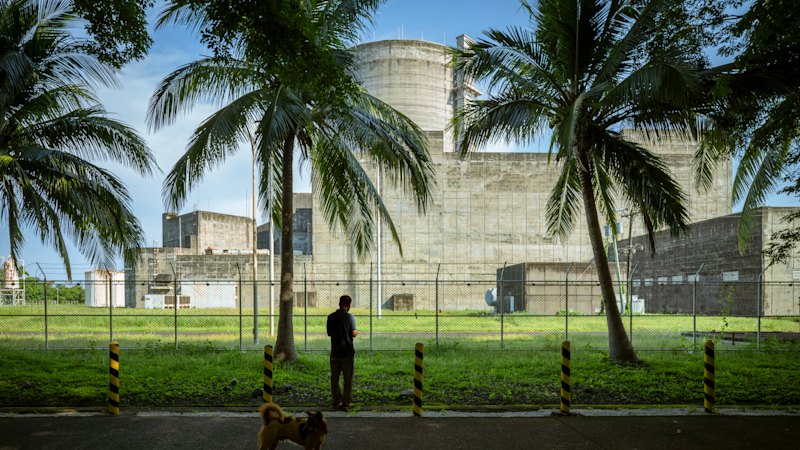
The air inside the turbine hall smells of old iron, sea salt, and a strange, heavy stillness that feels almost sacred. It is the smell of a machine that has been waiting forty years for a breath it was never allowed to take.
Stand on the concrete floor of the Bataan Nuclear Power Plant, and you can hear the ghosts of an industrial ambition that died before it could walk. Outside, the turquoise waves of the West Philippine Sea crash against the jagged coastline of the peninsula. Inside, miles of unused copper cable, pristine control panels covered in dust-free plastic wrappers, and a massive Westinghouse pressurized water reactor vessel sit in a state of suspended animation. It looks like a cathedral left behind by an advanced civilization that suddenly lost its nerve.
For decades, this silent dome in Morong has been treated as a national monument to regret. It is a financial scar. Generations of Filipinos grew up paying off the multi-billion-dollar debt incurred to build a plant that never generated a single kilowatt-hour of electricity. To many, it is a white elephant, a monument to crony capitalism, corruption, and a cautionary tale of hubris.
But history is a cruel editor. And the calculus of survival changes when the lights begin to flicker.
Picture a small bakery in Malabon on a stifling Tuesday afternoon. The ceiling fans hang motionless, dead weights in the thick, humid air. The dough on the counter is sweating, proofing too fast because the local grid has buckled under the load of a summer heatwave. The owner, a man named Mang Ramon whose hands are permanently dusted with flour and scored by decades of honest work, wipes sweat from his forehead with the back of his forearm. He stares at the generator stuttering outside, coughing black smoke into the alley, burning diesel he can barely afford just to keep his refrigerators from failing.
Multiply Mang Ramon by a hundred million.
The Philippines faces a creeping, silent crisis. The archipelagic nation is growing faster than its power sources can keep pace. Coal still dominates the energy mix, anchoring the grid to imported fossil fuels that leave the country vulnerable to global price shocks, currency fluctuations, and geopolitical tremors. Natural gas fields like Malampaya are running dry, their subterranean reservoirs gasping for their final breaths. The energy crunch is not a distant hypothetical threat written in white papers by think tanks in Manila. It is a daily reality of brownouts in the provinces, skyrocketing utility bills that squeeze middle-class families, and industrial investors looking elsewhere in Southeast Asia because they cannot trust a steady, affordable stream of electrons.
This is why engineers, pragmatists, and politicians are walking back into the shadow of the dormant reactor in Bataan. They are asking a terrifying, desperate question. Can a ghost save the future?
To understand why the plant was never turned on, you have to wind the clock back to the turbulent era of the 1970s. The world was convulsing through an oil crisis. Dictator Ferdinand Marcos Sr. looked at a country bleeding cash for imported petroleum and panicked. Nuclear energy was the shining promise of the atomic age, a technological firewall that could guarantee national self-sufficiency and cement his regime's legacy. The government signed a contract with Westinghouse Electric, chose a scenic coastal site near a dormant volcano, Mount Natib, and poured concrete at a furious pace.
Then came 1986.
The ground shifted beneath the regime. The People Power Revolution swept Corazon Aquino into power, dismantling the Marcos government amid revelations of massive overpricing and safety concerns. Months later, halfway across the globe, reactor number four at Chernobyl exploded, painting the sky over Europe with radioactive poison and burning the word meltdown into the global consciousness.
Fear is a powerful solvent. It dissolved the political will to finish the Bataan plant. The newly installed government mothballed the facility. The nuclear fuel rods were never purchased. The core was never loaded. The heavy water was never poured. It was locked up, handed a security guard, and left to wait.
For years, keeping the plant safe cost millions annually, even though it sat completely inert. Taxpayers paid for maintenance, security patrols, and the staggering national debt that took decades to settle. The final installment of that debt was paid off in 2007, a bitter milestone for a population that paid for a machine they were never allowed to use.
Yet, the irony of history cuts deep. While Bataan sat frozen in time, South Korea—which bought an identical nuclear design from Westinghouse around the exact same period—built a fleet of reactors. South Korean engineers went on to power an industrial miracle, transforming their nation into a global economic powerhouse while exporting nuclear technology to the world. The blueprints sitting in the filing cabinets of Morong were built in Seoul, brick by brick, plant by plant, lighting up millions of homes.
Meanwhile, the Philippine plant became a tourist attraction. School children walked through the cavernous corridors, gazing at analog dials that looked like props from a science fiction movie.
Yet, the reactor itself was built with extraordinary engineering rigor. Constructed during an era when nuclear engineering meant over-engineering, its containment structure was designed to withstand extreme earthquakes and typhoons. International atomic inspection teams have visited the site over the years, running diagnostics, poking at the plumbing, and shaking their heads in quiet disbelief. The heavy equipment, preserved in climate-controlled stillness, is remarkably intact.
Critics argue that trying to revive a forty-year-old facility is an exercise in madness. They point to the seismic vulnerabilities. Mount Natib, despite being classified as inactive, looms too close for comfort in a country that sits squarely on the Pacific Ring of Fire, a volcanic and seismic hazard zone. Others argue that by the time you upgrade analog systems to modern digital safety standards, retrain a workforce, and navigate the labyrinthine regulatory hurdles, you could build a brand-new facility from scratch.
And they have a point. Reviving Bataan is not simply a matter of turning a giant brass key. It requires an exhaustive, multi-year, multi-billion-dollar rehabilitation process. Every valve, every seal, every foot of wiring must be inspected against twenty-first-century safety protocols. Public trust must be rebuilt from the ground up in a nation that remembers the terrifying images of Fukushima and Chernobyl, a nation where institutional skepticism runs deep.
Insurance companies will hesitate. Communities will protest. The political opposition will organize marches. Every single hurdle that stopped the plant in the 1980s will rear its head again, sharper and more urgent.
Yet the alternative is far worse.
Consider the arithmetic of the grid. The Philippines has committed to ambitious carbon reduction targets while facing surging electricity demand driven by urbanization, data centers, and manufacturing growth. Solar and wind are vital, but they are intermittent. Batteries can bridge short gaps, but they cannot carry an entire industrialized economy through weeks of monsoon cloud cover or windless tropical calms. Baseload power is non-negotiable. It requires something heavy, constant, and dense.
Nuclear energy packs an astronomical punch into a tiny physical footprint. A single uranium pellet the size of a fingertip contains the energy equivalent of a ton of coal or nearly five hundred gallons of oil. It emits no carbon during operation. It does not depend on the whims of global shipping lanes, maritime blockades, or the price volatility of liquefied natural gas.
If the country wants to avoid industrial stagnation, it cannot rely solely on the sun and the breeze. It needs power that does not sleep.
And right there on the coast of Bataan sits a multi-billion-dollar shortcut. Whether that shortcut is a bridge to energy security or a trapdoor into a nuclear nightmare remains the most contentious debate in modern Southeast Asian governance.
Governments come and go. Presidents rise and fall. But the physics of energy remain brutally indifferent to politics.
Walk through the turbine hall today, and the air is still cool. The silence is profound. In the control room, rows of toggle switches remain flipped down, waiting for a hand that never arrived. Outside, the tide rolls in, indifferent to the political squabbles and economic anxieties of the millions living just miles away.
The machine waits. The energy crunch approaches. Somewhere in the dark, the lights flicker, and the clock keeps ticking.