The marble of the John F. Kennedy Center for the Performing Arts does not care about election cycles. It absorbs the gray damp of a Potomac evening, holding the chill of the river in its porous pores, indifferent to the shifting tides of political ambition. For decades, those white Carrara blocks have stood as a monument—not merely to a fallen president, but to an elusive idea that a society might measure its greatness not by the tonnage of its steel or the yield of its treasury, but by the cadence of its orchestras, the grace of its dancers, and the fierce, unyielding honesty of its playwrights.
Then came the rumors. Then came the words cast into the digital ether like a match tossed into dry brush: the suggestion that perhaps the monolith should come down. That the structure itself, heavy with federal heritage and cultural prestige, was somehow an enemy fortification ripe for razing or repurposing.
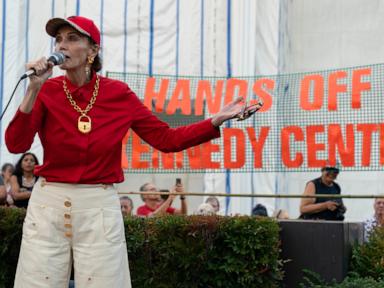
On a biting Tuesday evening, the marble stopped being indifferent. Thousands of people arrived, walking up the sweeping concrete plazas with coats buttoned against the wind, carrying signs scribbled in marker, breathing clouds of white vapor into the night. They were not just fans of theater. They were citizens standing vigil over an architectural body, defending a space where collective memory lives.
To understand why thousands would brave the bitter winter air to protest the theoretical destruction of a performance hall, one must look past the box office receipts and the glittering opening nights. One must look at what a building like the Kennedy Center actually is. It is a massive, acoustic cavern built to hold the echoes of human vulnerability. When an actor steps onto that stage and drops their voice to a whisper that somehow carries to the back row of the terrace, something happens in the dark. Hundreds of strangers breathe together. They laugh at the same punchline, weep at the same tragedy, and for two hours, forget the tribal fractures tearing at the country outside.
Totalitarian impulses throughout history have shared a common architectural instinct. When you want to break a people, you do not merely silence their leaders; you dismantle their gathering places. You turn their cathedrals into warehouses, their theaters into parking lots, their public squares into checkpoints. The logic is chillingly simple: if people have nowhere to gather in shared awe or shared grief, they cease to be a public. They become isolated units, easily managed, easily frightened, easily controlled.
The murmur that the Kennedy Center might be torn down or hollowed out struck a nerve precisely because it tapped into this ancient, primordial fear of cultural erasure. When a politician floats the idea of leveling a monument to the arts, they are signaling an intent to rewrite the nation's biography, erasing the chapters written in harmony and substituting them with a single, blaring monologue of power.
Consider Arthur, a retired union stagehand who spent thirty-five years behind the fly ropes of the Opera House. When asked why he stood on the plaza for four hours in the freezing mist, his hands—calloused from decades of hauling hemp lines and counterweights—tightened around a cardboard sign.
"People think this is just a building where rich folks drink white wine at intermission," Arthur said, his voice raspy from the damp air. "They don't see the ghosts. Every ghost light left burning on that stage at midnight belongs to someone who poured their soul into making sense of this messy world. You don't tear that down because you're angry at an election result. If you tear this down, you’re tearing down the mirror. And God help us if we ever lose our reflection."
Arthur’s perspective is not born of partisan loyalty. It is born of physical labor and spatial reverence. He knows every bolt in the grid, every foot of the cherrywood flooring, every acoustic panel designed by masters of sound. To him, the building is a living organism stitched together by human sweat and artistic devotion.
The threat, whether deployed as a deliberate trial balloon or an offhand provocation, weaponizes the architecture of culture. It treats a national cultural center as a piece of partisan real estate rather than a public trust. This is the modern tragedy of public life: everything, down to the very stones of our memorials, is dragged into the grinder of perpetual grievance.
Look closely at the architecture of the Kennedy Center itself. Edward Durell Stone designed it as a colossal slab of white marble, often criticized in its early days for being too grandiose, too imposing against the low-slung skyline of Washington, D.C. Yet, once you step inside its grand foyer—with its soaring red-carpeted halls, the massive crystal chandeliers gifted by the people of Sweden, and the long, glass-walled galleries looking out over the grey expanse of the river—the scale shifts from monumental to intimate. It is designed to make you feel small in the best possible way: small before beauty, small before history, small before the vast, aching expanse of human capability.
When thousands of citizens surrounded that monument, they were enacting a ritual older than the republic itself. They were forming a human barricade around their shared heritage. They brought violins. They brought French horns. A makeshift orchestra formed near the river entrance, playing Bach into the teeth of the wind. The music did not sound like protest music; it sounded like an invocation. It sounded like an insistence that beauty has a right to exist outside the whims of whoever happens to hold the temporary lease on executive power.
History is littered with the ruins of regimes that tried to govern by subtraction. They banned books, they smashed statues, they silenced poets, and they burned theaters. And invariably, those regimes collapsed under the weight of their own sterile paranoia, while the poets and the musicians—often writing from exile or scratching lines into prison walls—outlived them all.
The fear that animated the crowd outside the Kennedy Center was not an irrational panic. It was a clear-eyed recognition of how fragile civilization actually is. We treat our institutions like unbreakable bedrock, forgetting that they are actually delicate sandcastles maintained entirely by the collective agreement that they matter. Once you convince people that nothing is sacred, nothing is safe. Once you normalize the casual destruction of cultural landmarks, you pave the way for the demolition of everything else that holds a diverse society together.
As the protest wore on into the small hours of the morning, the temperature plummeted. The breath of the crowd hung thick in the air beneath the massive concrete overhangs. Security guards inside stood behind the glass doors, watching with expressions that flickered between professional wariness and quiet solidarity. Some of them nodded in time with the music. Some of them watched the signs rise and fall against the night sky.
Nobody tore down the building that night. The marble stood firm against the wind, holding its ground as it has for over half a century. But the illusion of permanence was broken. The people who stood on the plaza learned something vital about themselves: they learned that they still care enough to show up. They learned that the preservation of culture is not someone else's job description. It is a hands-on, freezing-cold, stubborn duty.
The river kept flowing past the terrace, black and heavy, sliding toward the sea. Inside the dark halls, the ghost lights burned on the empty stages, casting a pale, lonely glow across rows of velvet seats waiting for the next story to be told. Outside, the last of the demonstrators rolled up their signs, stuffed their cold hands into their pockets, and walked back down the ramp into the city, leaving the monument standing in the dark, bruised by politics but defended by memory.