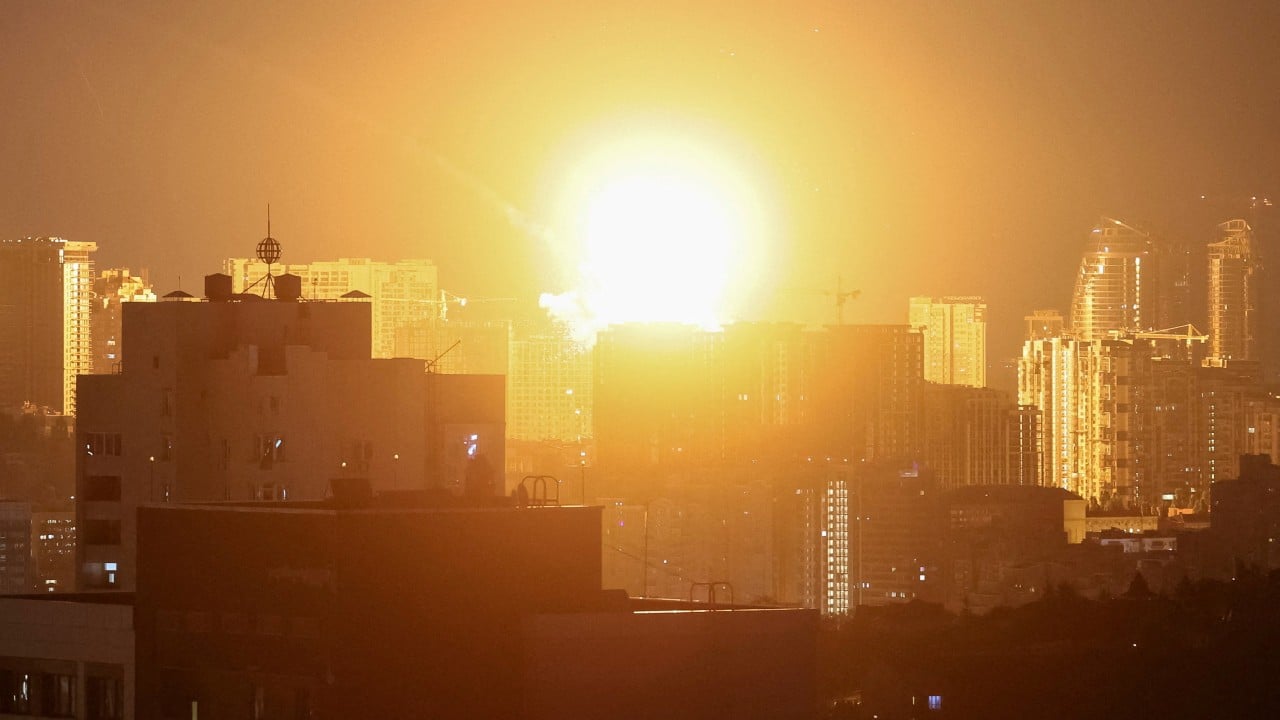
The siren does not begin with a scream. It starts as a low, mechanical moan, vibrating through the floorboards before it ever reaches the ears. In Kyiv, this sound has long stopped being an alarm. It is a weather report. It dictates whether you finish your coffee, whether you kiss your daughter goodbye at the school gate, or whether you spend the next four hours sitting on a yoga mat in a damp subway station, watching dust shake loose from the vaulted ceiling.
On a Monday morning, the city was waking up to a sun that felt too bright for July. Commuters were pouring out of the apartment blocks, their minds fixed on the mundane tasks of a new work week. Then the sky tore open.
Russia launched a massive, daylight barrage across Ukraine, sending dozens of missiles screaming toward civilian centers. The capital bore the brunt of the fury. This was not a midnight raid designed to terrorize under the cover of darkness. This was calculated, high-visibility destruction executed on the literal eve of a major NATO summit in Washington. The timing was a deliberate message written in smoke and iron. While world leaders prepared to gather in air-conditioned rooms to debate the language of future communiqués, ordinary Ukrainians were running for their lives.
Consider the Okhmatdyt Children’s Hospital. It is Ukraine’s largest pediatric medical center, a place where the country’s sickest children are sent for specialized care, cancer treatments, and open-heart surgeries.
When the strike hit, the blast did not just shatter windows; it pulverized the very concept of sanctuary. Imagine standing in a ward where children are hooked up to intravenous drips, their bodies already fighting for survival against disease, only to have the walls collapse inward. Parents covered their children with their own bodies. Doctors, mid-surgery, refused to leave their patients as dust blinded them and the smell of burning wiring filled the air.
Blood mixed with toxic debris on the linoleum floors. Survivors emerged into the blinding daylight carrying toddlers wrapped in blankets, some still attached to medical equipment, their small faces smeared with soot.
Outside, a human chain formed instantly. Hundreds of everyday citizens—lawyers in business suits, baristas in aprons, construction workers, and grandmothers—lined up to clear the rubble bare-handed. They passed chunks of concrete and twisted metal down the line, working against the clock to reach those trapped beneath the collapsed wing of the toxicology department. There was no shouting. Only the rhythmic, scraping sound of debris being cleared and the quiet, desperate hope that the next stone lifted would reveal a breathing space.
The statistics tell one story: over forty dead across the nation, dozens injured in the capital alone, and a volley of advanced weaponry that included hypersonic Kinzhal missiles designed to evade modern air defenses. But statistics are cold. They smooth over the sharp edges of reality. The reality is the single shoe left behind on a blood-stained pavement, or the look of absolute numbness on a father's face as he realizes the apartment block he left an hour ago no longer has a center.
This escalation exposes the massive disconnect between geopolitical theater and the dirt-and-blood reality on the ground. For months, the conversation in Western capitals has focused on boundaries and red lines. Can Ukraine use provided weapons to strike back at the launchpads inside Russian territory? Will the upcoming summit offer a concrete path to alliance membership, or just another vague promise of an "irreversible bridge"?
To the person standing in the wreckage of a Kyiv suburb, these debates feel agonizingly abstract. The delay in decision-making is measured not in political capital, but in human skin.
Ukraine's air defense networks are highly sophisticated, manned by crews who have turned the interception of incoming missiles into a precise, frantic art form. Yet, no shield is impenetrable when a swarm of missiles is directed at a single city from multiple directions simultaneously. The calculus is brutal. If ten missiles are fired and nine are shot down, the victory is celebrated in military briefings. But the tenth missile—the one that slips through the net—is the one that finds a residential building, a bustling market, or a ward full of sick children.
The strategy behind these daylight strikes is psychological warfare aimed at the collective will of a population. By striking during the day, when the streets are full and life is attempting to mimic normalcy, the attacker seeks to prove that nowhere is safe, that no routine is sacred, and that the shield provided by international promises is porous.
Yet the reaction on the streets of Kyiv reveals something entirely different from the intended panic. It reveals a hardened, quiet defiance that has become the true backbone of the country's survival. The immediate rush to volunteer at the blast sites, the quick organization of blood donations, and the refusal to let the city grind to a halt are acts of resistance just as vital as any drone strike on a frontline trench.
The Western alliance faces a stark choice as delegates take their seats in Washington. The policy of incremental assistance—giving enough to prevent total defeat but not enough to secure a decisive victory—has created a prolonged twilight zone of conflict. In this zone, the civilian population pays the daily interest on strategic hesitation.
The smoke over Kyiv eventually clears, replaced by the persistent haze of summer heat and the smell of wet plaster. The sirens fall silent, reverting to their low, mechanical hum as they power down, waiting for the next command. The human chain at the children’s hospital disperses as night falls, their hands cut and blackened by the stones of their own city. They will go home, wash the dust from their faces, and check their phones for the next alert.
The summit will produce speeches, signed declarations, and group photographs of leaders standing shoulder-to-shoulder. But the real security architecture of Ukraine is not being built in Washington. It is being forged in the mud, the shattered glass, and the stubborn refusal of a people to look at a broken sky and see anything less than their eventual freedom.