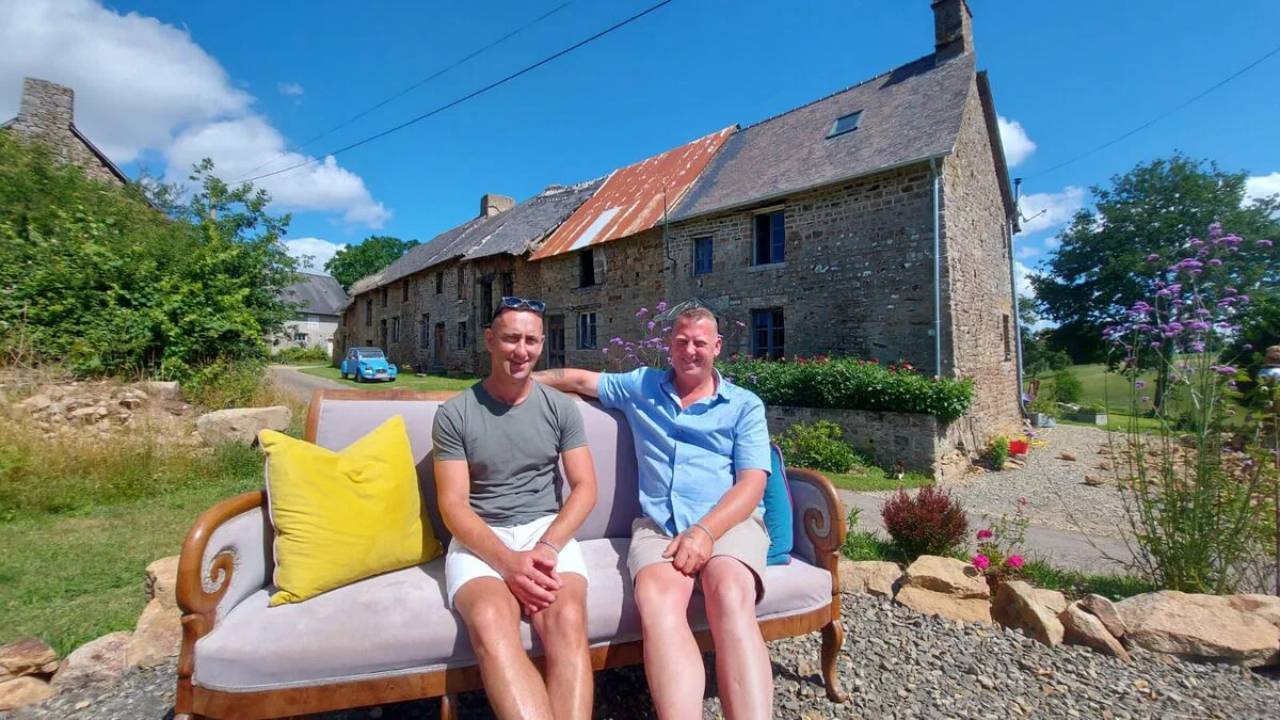
The spreadsheet didn't lie, though Paul Mappley wished it would.
Every Sunday night in Tunbridge Wells, Kent, the numbers sat on his laptop screen like an indictment. A three-bedroom semi-detached house within commuting distance of London hovered around £450,000. A modest 10% deposit meant scraping together £45,000 in liquid cash, before stamp duty, solicitor fees, and surveys bled another ten grand out of their savings. Even if Paul and his partner, Yip Ward, somehow cleared that hurdle, they would spend the next thirty years chained to a mortgage that swallowed half their take-home pay just to own four walls and a patch of damp grass the size of a postage stamp.
Trapped. That was the exact word for the feeling that settles into the ribs of an entire generation of British renters. You work, you save, you cut back on the small joys, and the finish line moves three paces backward for every two you take forward.
I know that specific brand of quiet panic intimately. Having spent years watching my own housing fund lose a rigged footrace against UK property inflation, I recognize the precise moment when financial prudence curdles into existential dread. You stop looking at Rightmove listings as future homes and start viewing them as museum exhibits—glass-cased artifacts from an era when ordinary wages actually bought dirt and brick.
So Paul and Yip did something that sounded, to everyone in their pub circle, completely unhinged. They closed the UK property portals, opened a map of rural Normandy, and bought an entire hamlet.
The £26,000 Gamble in the French Woods
Let’s look at the actual receipt, because the math is what makes your brain short-circuit.
In 2019, after months of scouring French rural listings, the couple found a cluster of stone buildings tucked into the undulating green countryside of Normandy, near the town of Sourdeval. It wasn't a cottage. It was a hameau—a miniature village consisting of six derelict cottages, two barns, a two-story workshop, a cider press, a bread oven, and three acres of overgrown woodland and pasture.
The asking price? £26,000.
Not per building. For the whole post-code.
To put that figure into brutal perspective, the average deposit for a first-time buyer in the UK sits well north of £50,000, and in the South East of England, £26,000 barely covers the stamp duty and legal fees on a starter flat. Paul and Yip didn't take out a crippling 35-year loan. They bought the entire settlement outright, debt-free, for less than the cost of a mid-range Volkswagen Golf.
Of course, there was a catch, and it arrived in the form of waist-high brambles, collapsed slate roofs, and zero running water.
When they first walked the boundary lines of their new estate, the place looked less like a rustic fairytale and more like a post-apocalyptic film set. Ivy had strangled the granite walls so thoroughly that windows had vanished. Trees were growing straight through the floorboards of the main farmhouse. There was no electricity, no septic system, and no heating—just centuries-old stonework slowly losing a war against the Normandy rain.
If you are picturing a glossy, sunlit renovation show where a cheerful couple picks out tile samples over espresso, erase that image immediately. Buying a derelict French hamlet for pocket change is the financial equivalent of adopting a wounded grizzly bear; the adoption fee is negligible, but the daily survival requires every ounce of grit you possess.
Why Rural France Is Practically Giving Away Stone
To understand how an entire village ends up costing less than a London parking space, you have to understand the quiet demographic earthquake reshaping the French countryside.
For decades, France has experienced a relentless migration from its agricultural heartland to its major cities—Paris, Lyon, Bordeaux. Young people leave family farms for urban jobs. When the elderly parents pass away, the properties are divided among multiple heirs under strict French inheritance laws. Suddenly, four cousins living in Lyon own a crumbling 18th-century farmhouse in Normandy that none of them want to maintain, heat, or pay property taxes on.
The result is thousands of ruines and abandoned farmsteads rotting quietly in the French countryside. Local mayors, desperate to stop their rural communes from turning into ghost towns, actively welcome foreign buyers willing to pour sweat and money into resurrecting dead stone.
Think of the UK and French property markets like two opposite ends of a seesaw. In Britain, land is artificially scarce, planning permission is a blood sport, and housing has morphed from shelter into a speculative financial asset. In rural France, land is abundant, the population density is a fraction of England’s, and old stone buildings are liabilities until someone breathes life back into them.
Paul and Yip stepped right onto the low end of that seesaw.
Living in a Caravan While Rebuilding a Village
The reality of what happened next strips away any romantic nonsense about "escaping to the country."
Moving to Normandy in early 2020—just weeks before global lockdowns slammed borders shut—Paul, a landscape gardener, and Yip, a set designer, parked a secondhand caravan on their three acres of mud and got to work. For months, that cramped tin box was their kitchen, bedroom, and refuge from the biting Norman wind.
There is a visceral, bone-deep exhaustion that comes with DIY restoration at this scale. You don't wake up and check emails; you wake up, put on steel-toed boots, and spend ten hours hauling tonnes of wet rubble out of a collapsing barn by hand. Your fingernails turn permanently black with mortar dust. You learn to read French plumbing diagrams by candlelight because the generator ran out of diesel.
Consider what happens when a roof beam rots through in the middle of a November storm. In a rented British flat, you send an irritated text to a letting agent. In your own French hamlet, you climb a ladder in sideways rain with a tarpaulin and a staple gun, praying the wind doesn't tear the sheet out of your hands.
Yet, building by building, the ghosts began to retreat.
Because Paul had years of construction and landscaping experience and Yip possessed a set designer's eye for spatial transformation, they didn't hire expensive contractors. They did almost everything themselves. They repointed ancient granite walls with traditional lime mortar—which lets old stone breathe rather than trapping damp like modern cement. They salvaged oak beams, re-slated roofs, wired electrics, and plumbed bathrooms.
And here is where the economics turn staggering.
By the time they transformed the main farmhouse into a warm, sunlit home and converted neighboring outbuildings into boutique holiday rentals—gîtes—their total expenditure, including the original £26,000 purchase price and every euro spent on timber, slate, insulation, and tools, hovered around £100,000.
Compare that ledger to the alternative they left behind in Kent:
- The UK Path: £450,000 purchase price + roughly £250,000 in mortgage interest over 30 years = £700,000 for one suburban semi-detached house.
- The Normandy Path: £26,000 purchase price + ~£74,000 renovation costs = £100,000 total for six buildings, three acres of land, zero mortgage, and an independent rental income stream.
Even looking solely at the upfront equity and saved housing costs, they easily pocketed well over £100,000 in net financial advantage—and freed themselves from thirty years of bank servitude in the process.
The Hidden Traps Nobody Mentions on Instagram
Before you start packing your bags and browsing French estate agents at two in the morning, we need to talk honestly about the landmines buried under those idyllic Normandy meadows. Because while the upside is intoxicating, jumping into rural French property without knowing the rules will chew you up alive.
First, there is Brexit and the 90-day wall. If you hold a UK passport and don't have European residency, you can no longer simply pack a van and stay indefinitely. You are legally restricted to 90 days in any 180-day period within the Schengen Area unless you secure a long-stay visa—which requires proving sufficient financial savings, private health insurance, and jumping through the famously labyrinthine French bureaucracy. Paul and Yip arrived just before the transition deadline closed, giving them residency rights that post-Brexit buyers must now fight much harder to obtain.
Second, meet the SAFER (Société d'Aménagement Foncier et d'Établissement Rural). If you buy a rural French property with more than a couple of acres of agricultural land attached, this government body has the legal right of first refusal. Even after you agree on a price with the seller and sign the initial contract, SAFER can step in for up to two months and buy the land out from under you to give it to a local farmer. If you don't structure the purchase through a notaire who knows how to separate the residential buildings from the agricultural acreage, your dream village can vanish before completion day.
Third, there is the fosse septique—the septic tank. Almost no rural French hamlet is connected to mains drainage. When you buy an old property, the local water authority inspects the septic system, and if it fails modern environmental standards—which 90% of old systems do—you are legally obligated to install a brand-new, compliant system within a year of purchase. That single requirement routinely costs between €8,000 and €15,000, a nasty surprise if you blew your entire budget on the purchase price.
And finally, there is the isolation. Living in a rural French commune means the nearest supermarket might be twenty minutes away, everything shuts tight on Sunday afternoons and for two hours at lunch, and if your French doesn't extend beyond ordering croissants, navigating builder merchants, tax offices, and local artisans becomes an exhausting daily puzzle.
I won't pretend that trade-off is easy. Trading the convenience of British city life for rural self-reliance requires rewiring your entire nervous system. You swap Uber Eats and high-speed fiber broadband for wood-burning stoves, septic maintenance, and neighbors whose closest relatives are dairy cows.
What You Actually Buy When You Escape the Mortgage Trap
Still, talk to anyone who has successfully crossed that bridge, and they rarely mention the money first. They talk about time.
A massive mortgage doesn't just cost you pounds or euros; it costs you optionality. When you owe a bank £350,000, you cannot easily walk away from a toxic boss. You cannot take six months off to learn a craft, raise your kids without rushing through bedtime, or pivot careers at forty. Every financial decision you make is filtered through the terror of missing next month's direct debit.
Debt is a quiet cage built out of polite monthly installments.
By walking away from the British housing ladder entirely, Paul and Yip didn't just acquire stone cottages and cider orchards. They bought back their own hours. With zero mortgage hanging over their heads and guests paying to stay in their converted stone gîtes during the summer months, their baseline cost of living collapsed. They traded a high-stress treadmill in Kent for a life where wealth isn't measured by house-price appreciation on an app, but by firewood stacked dry for winter, vegetables pulled from their own soil, and mornings that belong entirely to them.
Of course, not everyone can—or wants to—haul granite blocks out of the mud in northern France. If your career, family, or sanity requires being twenty minutes from central London or Manchester, a derelict barn in Normandy isn't a solution; it's a hallucination.
Yet their story exposes a crack in the lie most of us quietly accept without question: that there is only one respectable path to adulthood, and it requires mortgaging your entire youth for an overpriced brick box in a commuter belt.
Late one evening in Normandy, after the last wheelbarrow of rubble was emptied and the lime mortar had finally cured on the main farmhouse walls, Paul and Yip lit the woodstove in a room that had stood cold and abandoned for decades. Outside, wind moved through three acres of their own dark trees, and not a single penny of it belonged to a bank.