Most local crime clips give you thirty seconds of shaky bodycam footage, a siren, and zero context about why a routine property call turned deadly on the water. That's exactly what happened with the fatal police shootout involving a suspected sailboat thief in Rhode Island.
When law enforcement confronts an armed suspect on a vessel in Narragansett Bay or a coastal harbor, the tactical reality changes completely compared to a standard traffic stop on dry land. You don't have cover. You're dealing with tidal drift, unstable footing, and cramped cabin layouts where a suspect can ambush boarding officers in a split second.
Understanding this Rhode Island incident requires looking beyond the headline shock value. We need to look at how maritime law enforcement actually operates in New England, why marine theft has spiked across coastal marinas, and what happens legally when a harbor patrol or state police unit uses lethal force on the water.
Why Maritime Standoffs Escalate So Fast
People hear "sailboat theft" and picture a slow-motion chase at five knots. That's a massive misconception.
In reality, a sailboat sitting at a mooring or anchored in a cove isn't a moving target—it's a floating bunker. Once a suspect gets below deck, they have solid fiberglass or wood bulkheads between themselves and approaching officers, narrow companionways that act as fatal funnels, and often access to flares, flare guns, or firearms stored onboard.
Rhode Island's coastline makes this even trickier. Between Newport, Warwick, Bristol, and the countless coves feeding into Narragansett Bay, jurisdictional lines overlap constantly. A single marine call can pull in local harbor masters, municipal police marine units, the Rhode Island Department of Environmental Management (DEM) Division of Law Enforcement, and the U.S. Coast Guard.
When officers pull alongside a stolen vessel, they can't just step back behind a patrol cruiser engine block. Their own rigid-hull inflatable boat (RHIB) or patrol skiff is bobbing in the wake, exposed from every angle. If a suspect fires from a cabin hatch or points a weapon at approaching officers, police have nowhere to retreat except into the water—where heavy body armor and duty belts become an immediate drowning hazard.
What Actually Happened in the Rhode Island Sailboat Incident
Based on official law enforcement briefings and released video footage of the Rhode Island confrontation, the sequence followed a pattern marine officers dread.
Authorities responded to reports of a stolen sailboat in Rhode Island waters. When marine units located the vessel and attempted to make contact and take the suspect into custody, the encounter escalated into an armed standoff.
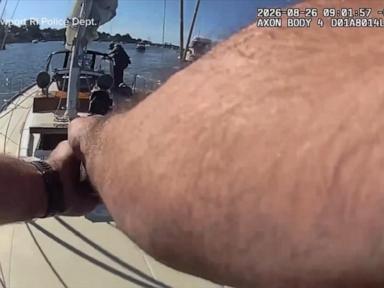
Body-worn camera and marine unit footage released after the shooting captured the tense moments leading up to the gunfire. Officers issued verbal commands attempting to get the suspect to surrender and exit the vessel safely. Instead of complying, the suspect presented a lethal threat, prompting officers on scene to open fire.
Emergency medical aid was rendered, and the suspect was pronounced dead following the exchange. As required under Rhode Island protocol for any officer-involved shooting resulting in death or serious injury, the Rhode Island Attorney General's Office and Rhode Island State Police immediately launched an independent investigation to review the use of force, ballistics, and bodycam recordings.
The Reality of Boat Theft Across New England Harbors
If you've spent any time around marinas in Rhode Island, Massachusetts, or Connecticut lately, you know boat theft isn't rare anymore. It's a growing headache for harbor masters and boat owners alike.
Why do thieves target sailboats and mid-sized cruisers?
- Weak physical security. Most sailboats have a simple padlock on the companionway hatch—or nothing at all—and ignition keys are frequently left hidden in the cockpit lockers.
- High resale and chop-shop value. Marine electronics like chartplotters, radar domes, and outboard motors can be stripped in twenty minutes and sold online with almost no serial-number tracking.
- Easy getaway routes. A thief can slip a mooring line at 2:00 AM without making a sound, drift out with the tide, and disappear into the fog before anyone notices the slip is empty.
- Overstretched harbor patrols. Many smaller Rhode Island towns rely on seasonal harbor masters who aren't sworn armed police officers, leaving gaps in overnight coverage.
Sometimes these thefts are organized rings targeting high-end center consoles with triple outboards. Other times, they're desperate individuals experiencing severe mental health crises or fleeing warrants who see a moored sailboat as a place to hide out for days. Those solo, unpredictable cases are honestly the ones marine cops worry about most.
How Rhode Island Investigates Police Shootings on the Water
Whenever a suspect is killed by police in Rhode Island, the public immediately wants answers—and rightfully so. Video clips circulating on social media rarely tell the whole story on their own.
Rhode Island operates under a strict statewide Use of Force reporting and investigation framework overseen by the Attorney General's Office. Under this protocol, the agency involved in the shooting doesn't grade its own homework.
Here is how that review process actually breaks down:
- Immediate scene preservation. In a maritime shooting, this is notoriously difficult. Investigators have to tow the vessel to a secure dock without disturbing shell casings, blood spatter, or weapon placement while dealing with wind and waves.
- Independent evidence collection. The Rhode Island State Police Major Crimes Unit and Forensic Services Unit process the boat, collect firearms, and download all body-worn camera, vessel-mounted camera, and marine radio dispatch audio.
- Attorney General review. Prosecutors from the Attorney General's Office review the complete evidentiary file to determine whether the officers' use of deadly force was legally justified under Rhode Island General Laws § 12-7-9, which governs when an officer may use lethal force to protect themselves or others from imminent death or serious bodily harm.
- Public release of footage. Following initial witness interviews and family notifications, Rhode Island authorities typically release relevant bodycam segments to provide transparency while the full grand jury or prosecutorial review continues.
What Boat Owners and Witnesses Should Know
Watching footage of a fatal police shooting in a quiet harbor is jarring, especially if you live or boat in the area. If you keep a boat in Rhode Island waters—or anywhere along the coast—there are practical steps you can take right now to protect your vessel and avoid putting first responders in impossible situations.
First, stop leaving keys on board. Take your ignition key with you every single time you leave the dock, and install a hidden battery cutoff switch or fuel shutoff valve. A thief who can't start the auxiliary diesel engine on a sailboat is much less likely to get off the mooring cleanly.
Second, upgrade your hatch hardware and add a cellular GPS tracker. Devices like Spot Trace or hidden marine cellular monitors ping your phone the second your boat moves outside a set geofence. The faster you report a stolen vessel to the Coast Guard on VHF Channel 16 and local police, the higher the chance officers can intercept the boat in open water before a barricade situation develops.
Third, if you ever spot someone suspicious boarding a neighbor's boat in a marina or mooring field, do not confront them yourself. Call 911 or hail the harbor master immediately, note the vessel's registration numbers and direction of travel, and keep your distance. As this Rhode Island shootout proves, you never know what someone hiding below deck is carrying—or how desperate they are when cornered.