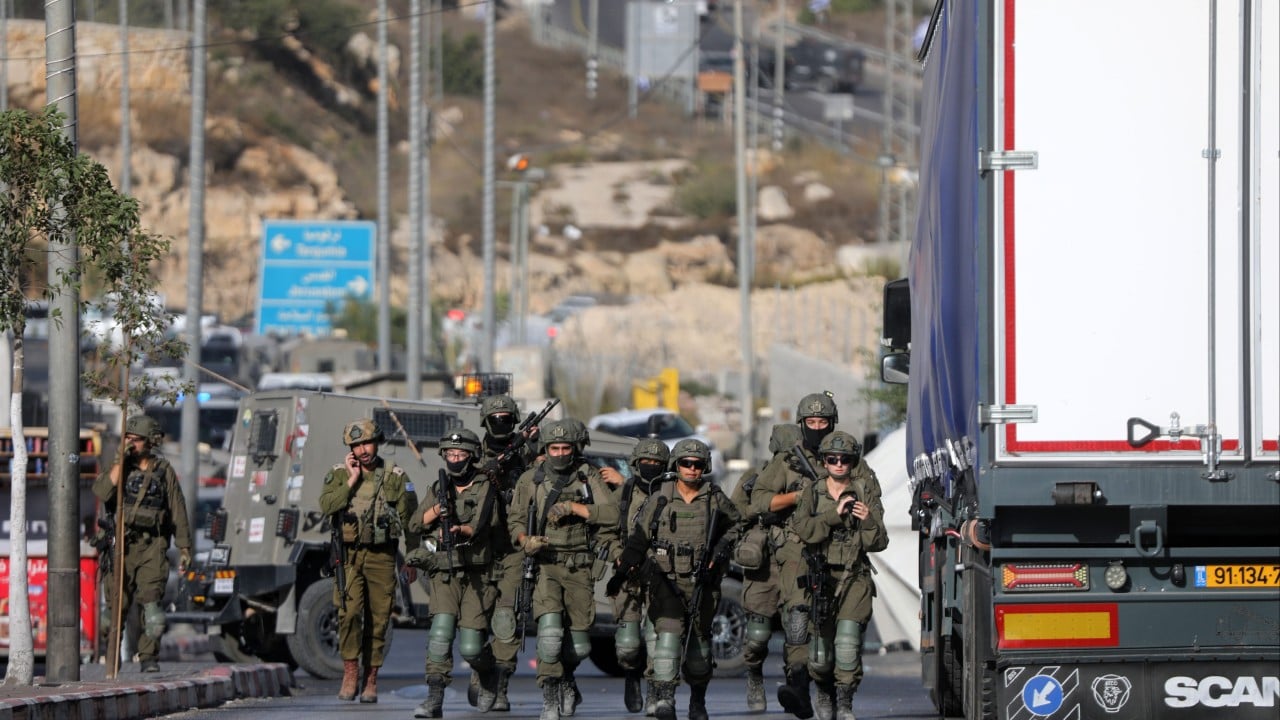
Two gunmen opened fire at an Israeli military checkpoint near Hebron on October 23, 2026. Two soldiers died, three others suffered light wounds, and troops killed both attackers at the scene. Within hours, the Israeli military sealed off the southern West Bank's largest city and forced thousands of Palestinian residents out of their homes.
Most breaking news reports frame the West Bank crackdown and Hebron displacement as a routine, temporary security sweep. They miss the bigger picture. Look closer at the timeline, the political calendar in Jerusalem, and the statements from Israeli leadership, and a different reality emerges. This wasn't just a tactical manhunt. It was a punitive neighborhood clearing designed to reshape facts on the ground right before a national election. Expanding on this idea, you can find more in: The Quiet Siege on Westminster and the Battle for Every Pound in Your Pocket.
How the Hebron Lockdown Unfolded
Hebron isn't an average West Bank town. Roughly 200,000 Palestinians live inside the city proper, with another 600,000 spread across the wider governorate. It's the economic engine of the southern West Bank, and it's the only Palestinian city with an Israeli settlement planted directly inside its historic urban core.
When the shooting happened on that Friday in late October, the military response moved faster and hit harder than usual. Troops didn't just set up flying checkpoints or raid a single suspect's house. They isolated the entire city. Analysts at Associated Press have also weighed in on this trend.
Ten major entry and exit points around Hebron were blocked with iron gates and earth mounds. Neighboring Halhul was sealed off right alongside it. Inside the city, selected army units pushed directly into residential districts, focusing heavily on the neighborhoods of Ein Deir Baha and Farsh Al-Hawa.
Residents got almost no warning. Families were ordered out of their apartments and houses while troops converted civilian homes into temporary military posts. By Saturday, October 24, Israeli Defense Minister Israel Katz openly confirmed on public broadcaster Kan that roughly 2,000 Palestinians had already been displaced.
It didn't stop there. By October 25, Palestinian Prime Minister Mohammad Mustafa put the number at over 2,670 people forced from their homes. By the time the lockdown stretched into its second week around October 30, nearly 5,000 residents had been uprooted.
The physical toll on the city was immediate:
- Property destruction: Hebron municipality officials reported that roughly 35 hectares of land and structures were either demolished or marked for demolition during the sweep.
- Mass detentions: According to the Palestinian Prisoners' Society, Israeli forces detained at least 110 people across the governorate within the first five days, including three women and seven children.
- Civic paralysis: Schools shut down, public transit ground to a halt, and basic municipal services like garbage collection stopped entirely because trucks couldn't move between sectors.
Israeli forces finally pulled back from the residential neighborhoods on the morning of November 2, allowing roughly 3,300 still-displaced residents to begin returning to damaged homes and businesses. Ten days of total paralysis left scars that won't heal anytime soon.
Why Politics Drove the Operation Longer Than the Military Wanted
If you want to understand why a checkpoint shooting turned into a ten-day mass displacement, look at the friction between Israel's military brass and its political leadership.
Usually, the Israel Defense Forces (IDF) prefer targeted, intelligence-driven raids. Clearing entire city blocks ties down elite units, drains resources, and creates massive international blowback. According to reporting in Haaretz, IDF Chief of Staff Eyal Zamir actually intended to wrap up the Hebron operation by October 24—just one day after the attack.
Prime Minister Benjamin Netanyahu and Defense Minister Israel Katz overruled that timeline. They pushed to keep the lockdown active and explicitly blocked families from returning home.
Why? Timing. The Hebron shooting occurred just four days before Israel's national election.
For months, Netanyahu's coalition had faced fierce criticism from its right-wing base over security in the occupied territories. When two soldiers were killed right before voters headed to the polls, the political pressure to project overwhelming force became immense.
Netanyahu didn't mince words. He promised to enter the neighborhoods where the attackers came from, evacuate the residents, go house to house, and destroy what he called terrorist infrastructure. Visiting the area, he went a step further, praising local Israeli settlers as heroes and promising to build over 100 new settlements and outposts across the territory.
Katz echoed that hardline stance on national radio. He didn't frame the displacement as an accidental byproduct of urban combat. He stated flatly that the 2,000 evicted residents would not be allowed back into their neighborhood until the military finished dealing with every Hamas issue in Hebron.
And just to tighten the screws further, Israeli authorities announced that all land crossings with the West Bank would be completely shut down on election day, extending the freeze across the entire territory.
The Legal Red Line Collective Punishment vs Security Necessity
Under international humanitarian law, an occupying power has the right—and the duty—to maintain public order and protect its personnel. Nobody serious disputes that investigating a fatal shooting at a checkpoint falls within standard security operations.
Where the Hebron crackdown crossed a bright legal line was its scope and stated intent.
Under the Fourth Geneva Convention, temporary evacuations of civilians are only lawful when the security of the population or imperative military reasons strictly demand it. Even then, displaced people must be housed properly and returned the instant hostilities in that specific sector end. Punishing an entire neighborhood for the actions of two dead gunmen is explicitly banned as collective punishment.
UN High Commissioner for Human Rights Volker Türk called this out directly on October 26. Pointing to the public statements made by Netanyahu and Katz, Türk noted that the measures were openly punitive and designed to instill fear in the civilian population. He warned that emptying and erasing entire neighborhoods raised serious concerns of ethnic cleansing and demanded that Israel provide compensation and reparations for unlawful demolitions.
Israeli human rights group B'Tselem issued a similar warning, arguing that the military was importing tactics used in the northern West Bank—specifically in refugee camps like Jenin and Tulkarm during Operation Iron Wall—directly into southern urban centers.
In January 2025, Operation Iron Wall had displaced over 40,000 Palestinians in the north, marking the fastest rate of displacement in the West Bank since 1967. Seeing bulldozers, mass evictions, and multi-day lockdowns arrive in Hebron signaled a major doctrinal shift. The military wasn't just raiding camps anymore; it was applying large-scale displacement tactics to major cities.
The Shadow War Settler Violence and the Olive Harvest
You can't separate what the military did in Hebron from what was happening on the surrounding hillsides that exact same weekend.
Late October is the peak of the Palestinian olive harvest. For tens of thousands of rural families around Hebron, Nablus, and Ramallah, those few weeks represent their primary annual income. It's also the most volatile season of the year.
While the IDF locked down Hebron's gates, settler attacks surged across the countryside. According to the UN Office for the Coordination of Humanitarian Affairs (OCHA), more than 2,000 settler attacks causing injuries or property damage had been logged since the start of 2026. That already surpassed every previous full year on record.
During the Hebron lockdown alone, armed settlers vandalized olive groves, beat farmers, and blocked villagers from reaching their land. In occupied East Jerusalem's Beit Hanina neighborhood, settlers entered at dawn and spray-painted racist slogans across Palestinian homes.
Because the IDF had sealed off major roads and diverted troops to enforce the Hebron closure, Palestinian farmers had zero protection and no way to transport harvested crops to market. For families already squeezed by a collapsing local economy, losing the harvest is a slow-motion displacement of its own. You don't need an eviction notice to lose your land if you can't safely farm it or leave your village to buy groceries.
What Everyone Gets Wrong About Palestinian Authority Control
A common misconception among casual observers is that the Palestinian Authority (PA) governs cities like Hebron and should be responsible for keeping the peace there.
On paper, under the 1990s Oslo Accords, Hebron was divided into two zones: H1, covering about 80 percent of the city under nominal PA civil and security control, and H2, covering the Old City and surrounding hills under direct Israeli military rule.
In practice, that division disappeared during the October crackdown. Israeli armored vehicles and infantry operated freely across H1 neighborhoods, detaining residents, seizing buildings, and locking down municipal infrastructure without PA involvement.
The PA itself is trapped in an impossible bind. Stripped of tax revenues withheld by Israel and battered by suspended international security aid, Ramallah can barely pay public sector salaries. When PA security forces tried to assert control in northern cities like Jenin earlier in 2025, they faced armed pushback from local militants while still getting sidelined by IDF raids.
In Hebron, PA officials were reduced to issuing statements from Ramallah—like Prime Minister Mohammad Mustafa's plea for international intervention—while watching Israeli bulldozers clear 35 hectares of city land unopposed.
How to Track and Verify West Bank Displacement Data
If you're following developments in the occupied territories—whether for policy analysis, journalism, or humanitarian work—relying solely on breaking wire headlines will leave you with an incomplete picture. Casualty and displacement figures often shift wildly in the first 72 hours of a military closure.
Here is how you can cross-check claims and get accurate data on the ground:
- Cross-reference UN OCHA protection updates: The UN Office for the Coordination of Humanitarian Affairs publishes weekly and flash situation reports for the occupied Palestinian territory. Their numbers on demolished structures, displaced households, and settler incidents are verified by field monitors rather than partisan press releases.
- Watch the gap between political statements and IDF briefings: In Israel, defense ministers and prime ministers frequently make sweeping promises on television to satisfy domestic voters. Compare those quotes against official IDF Spokesperson statements and reporting from Israeli defense correspondents in Haaretz or The Times of Israel to see what the military is actually doing on the ground.
- Monitor municipal and legal NGOs directly: Organizations like B'Tselem, Yesh Din, and the Palestinian Prisoners' Society document specific neighborhood-level closures, detention counts, and property seizures long before international diplomats weigh in.
The troops pulled back from Hebron's residential blocks on November 2, and thousands of exhausted families walked back into emptied apartments. Until the underlying political incentives driving mass closures and settlement expansion change, Hebron won't be the last West Bank city to see its neighborhoods cleared overnight.
For on-the-ground reporting showing how the initial evacuation orders and military closures affected residents across the city, watch Over 1,000 told to leave homes in Hebron, officials say | DW News.