The coffee in the thermos tastes of bitter chicory and diesel. It is five o’clock on a grey Tuesday in Mecklenburg-Western Pomerania, and the air off the Baltic Sea has teeth.
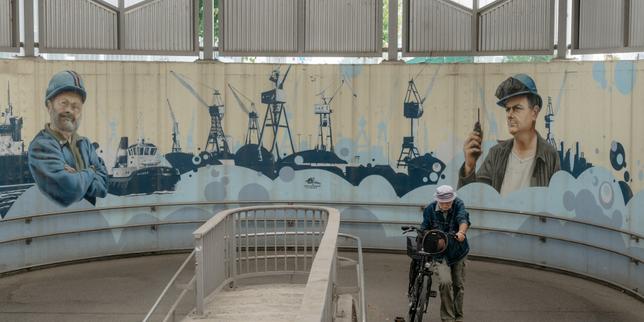
Stefan shifts his weight against the cold metal railing of the shipyard gate in Rostock. For thirty-two years, his boots have known these exact paving stones. He remembers when the yard hummed with the raw, rhythmic pulse of thirty thousand workers building vessels for a country that no longer exists on any current map. Today, the workforce is a fraction of that ghost army. Yet the skeletons of the gantry cranes still loom over the Warnow River like industrial crucifixes, watching over a city caught in the slow, grinding machinery of modern economic dislocation.
And something else is watching, too.
In the cavernous breakrooms where men and women share cigarettes under flickering fluorescent lights, the conversation has changed. It used to be about shift rotations, overtime pay, and the price of coal. Now, it is about who left, who is listening, and why the future feels like something being done to them, rather than by them.
This is the story of Rostock. Not the postcard Rostock of Gothic brick churches and picturesque university squares, but the working-class perimeter where the shipyard slipways meet the grey horizon. It is a place that used to belong entirely to the left—to the unions, to the social democrats, to the quiet confidence of collective bargaining.
Today, that political gravity is fracturing.
The Anatomy of a Broken Promise
To understand why a historic stronghold of organized labor is drifting toward the populist right, you have to look past the poll numbers and listen to the silence in the hallways of local union halls.
For decades, the social contract here was simple: you put in your forty hours under the sparks of an arc welder, and the state, mediated by traditional parties, guaranteed your dignity. Your kids went to school. Your hospital stayed open. Your town didn't feel like it was sliding off the edge of the map.
Then came the fractures. Deindustrialization did not arrive like a sudden storm; it was a slow leak. Jobs drifted eastward or vanished into automated efficiency metrics devised in offices hundreds of kilometers away in Frankfurt or Berlin. The local shipyard—once the beating heart of East German maritime might—survived through state rescues, private equity restructurings, and anxious contracts. Every time the ownership changed hands, a little more of the security vanished.
Stefan remembers the exact afternoon he realized the old world wasn't coming back. It was 2018 when another restructuring package was announced, paired with dry bureaucratic language about competitiveness and global market realities.
"Competitiveness," Stefan mutters, flicking his cigarette ash into the damp gravel. "That’s just a polite word for telling us our lives cost too much."
When people feel economically dispensable, they look for something to hold onto. When traditional left-wing parties—once the architects of workers' protections—began focusing heavily on abstract global transitions and cosmopolitan governance, many working-class communities felt abandoned. They felt that the people making the rules in Berlin had never held a heavy-duty wrench in their lives.
Enter the Alternative for Germany.
The Politics of the Grievance
The far right does not win in places like Rostock by offering detailed macroeconomic proposals. They win by offering a mirror.
They walk into the taverns and the neighborhood street fairs, not with complicated policy papers, but with a simple, potent message: You have been forgotten, and we know who did it. They channel the legitimate anxieties of people watching their neighborhoods change, their purchasing power shrink, and their children leave for Munich or Hamburg because there is nothing left for them on the Baltic coast.
It is a masterclass in political alchemy. They take the very real pain of working-class insecurity and fuse it with resentment toward outsiders, distrust of the media, and a nostalgic longing for an idealized past when borders were hard and futures were predictable.
For decades, Rostock was an anti-fascist sanctuary, a city that painfully confronted its darkest history and built a proud, open-minded culture. Walk through the student quarters near the University of Rostock, founded in 1419, and you still find that vibrant, progressive spirit alive in bookshops and cafes.
Cross the tracks toward the industrial harbor, however, and you are in a different universe.
Here, the posters on the kiosks look different. The conversations are sharper, laced with a fatigue that borders on cynicism. People will tell you they aren't necessarily ideologues; they are just tired of being told that their worries are secondary to bigger, more important global projects. They look at the political establishment and see a closed club of university-educated elites who speak a language designed to exclude them.
The Human Cost of Abstract Economics
Consider what happens when a community loses its anchor.
A shipyard is more than a workplace. It is an ecosystem of shared competence. Older mechanics teach apprentices how to read the subtle vibrations of a lathe. Stories are passed down through generations—about the strikes, the accidents, the launch days when champagne bottles shattered against steel hulls and the whole town cheered.
When that ecosystem shrinks, the social fabric frays. Young people leave. The average age in the neighborhoods surrounding the port creeps upward. Post offices close. Bakeries shut their doors. The local pub becomes a place where grievances pool and ferment.
It is easy for urban commentators miles away to dismiss the political shift in places like Rostock as moral failure or ignorance. That is not just arrogant; it is blind.
People do not vote out of anger alone. They vote out of a desperate desire to reclaim agency. When you feel like a passenger on a train hurtling toward a destination you never chose, you will grab at any brake lever you can reach—even if you suspect it might derail the carriage.
The Warning on the Horizon
The cranes in Rostock are still standing. Ships are still occasionally christened in the basins, their massive hulls sliding into the dark water with a roar that rattles the tea cups in nearby kitchens.
The struggle for the soul of this city is far from over. On the streets, local activists, union organizers, and community leaders are fighting back—not with abstract slogans, but by showing up, listening, and rebuilding the grassroots trust that the political mainstream let wither. They are organizing renters' unions, supporting youth centers, and proving that solidarity doesn't have to belong to the past.
But the warning is written plainly in the sea salt and the rust.
If the democratic center cannot figure out how to speak the language of dignity, security, and shared prosperity to the people who build things with their hands, then the edges will keep eating away at the center.
The wind off the Baltic picks up, rattling the corrugated iron of the shipyard fence. Stefan pulls his wool cap down tighter over his ears, checks his watch, and turns back toward the gate. The morning shift is about to begin. The machinery is waiting. And somewhere out there, in the quiet corridors of power, leaders are still wondering how they lost a place they never really bothered to see.