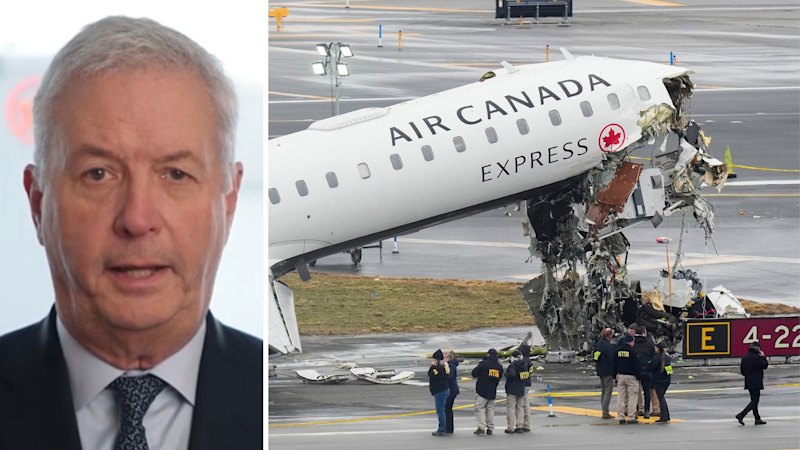
The departure of Air Canada’s chief executive marks a rare moment where a spreadsheet-driven corporate culture collided head-on with a public that is no longer willing to accept simulated grief. While the official line focuses on a planned transition, the timing tells a different story. The catalyst was a single, disastrous video response to a fatal crash—a moment of communication so detached and technically flawed that it stripped away the last layers of goodwill the airline had spent years eroding. This isn't just about one bad video. It is about a fundamental breakdown in how a national flag carrier views its passengers and its responsibilities in a moment of crisis.
Investors often tolerate coldness if it delivers dividends. Passengers tolerate mediocrity if it gets them to their destination on time. But when a tragedy occurs, the social contract requires something the current Air Canada leadership could not provide: genuine human accountability.
The Anatomy of a PR Suicide
The video in question was supposed to be a standard exercise in damage control. Following a catastrophic incident involving an Air Canada flight, the CEO appeared on screen to offer condolences. What followed was a masterclass in how to alienate an entire nation. The lighting was harsh, the script was clearly being read from a teleprompter with the emotional resonance of a quarterly earnings report, and—most damagingly—the CEO appeared to be smirking during a transition between segments.
Was it a smirk of malice? Unlikely. It was almost certainly a nervous tic or a technical glitch in the editing process. But in the world of high-stakes crisis management, perception is the only reality that matters. By the time the video was pulled, it had been viewed millions of times, becoming a symbol of a board room that had become far too insulated from the lives of the people who pay for its seats.
The backlash was instantaneous. It wasn’t just the grieving families who felt the sting; it was the thousands of employees who were forced to defend a leader who seemed to lack the basic hardware for empathy. When your front-line staff is embarrassed to wear the uniform because of a video their boss made, the leadership is already dead in the water.
Beyond the Video
To understand why this specific incident topped the scales, you have to look at the mounting pressure that preceded it. Air Canada has spent the better part of the last decade prioritizing cost-optimization over service reliability. The airline has faced a relentless stream of complaints regarding lost luggage, denied boarding, and a customer service apparatus that feels designed to exhaust the complainant rather than solve the problem.
The crash was the tragedy, but the video was the proof. It confirmed the darkest suspicions of the flying public: that the people at the top see passengers as data points on a moving map rather than human beings.
The Metrics of Mismanagement
Industry analysts have pointed to a widening gap between Air Canada's financial performance and its Net Promoter Score (NPS). While the airline was hitting its targets for load factors and revenue per available seat mile, its reputation among Canadians was cratering.
- Labor Relations: Chronic disputes with pilots and flight attendants created an internal culture of resentment.
- Regulatory Scrutiny: Increasing fines from the Canadian Transportation Agency (CTA) for violations of passenger rights.
- Operational Fragility: A hub-and-spoke system that proved incapable of handling even minor weather disruptions without total systemic collapse.
When a CEO steps down in the wake of a scandal, it’s rarely because of the scandal itself. It’s because the scandal made the underlying rot impossible to ignore. The board realized that they could no longer hide behind "industry-leading" profits when the brand itself had become radioactive.
The Myth of the Unsinkable Executive
There is a pervasive belief in Canadian corporate circles that certain leaders are "too big to fail" because of their political connections or their ability to navigate the complex regulatory environment of Ottawa. This CEO was a prime example. He had survived previous storms, including the chaotic post-pandemic restart and several high-profile service failures.
But there is a specific type of failure that the public does not forgive. You can survive being incompetent. You can even survive being greedy. You cannot survive being perceived as cruel.
The "condolence video" didn't just fail as a piece of communication; it failed as a piece of human interaction. It looked like a deepfake, not because of the technology, but because the emotion felt artificial. In a world where authenticity is the only currency that still holds value, appearing "fake" during a tragedy is a terminal offense for a public figure.
The Board’s Calculated Retreat
Don't be fooled by the "retirement" narrative. Behind closed doors, the discussions were likely brutal. Major institutional investors began expressing concern not just about the PR hit, but about the long-term viability of a brand that was becoming a punchline.
The airline’s board of directors is now tasked with finding a successor who can perform a delicate balancing act. They need someone who can maintain the financial discipline required by the markets while somehow convincing 30 million Canadians that the airline actually cares if they live or die. This is not an easy hire. Most executives who are good at the former are notoriously bad at the latter.
The Problem with Replacement
The danger here is that the board simply swaps one suit for another. If the new CEO comes from the same pool of "efficiency experts," nothing will change. Air Canada doesn't need a better teleprompter; it needs a fundamental shift in its operational philosophy.
- Restoring the Human Element: Empowering gate agents and cabin crew to make decisions based on common sense rather than rigid, often punitive, company policy.
- Infrastructure Investment: Moving away from the "lean" model that leaves no margin for error during peak travel periods.
- Accountability over Legalese: Admitting fault when things go wrong, rather than hiding behind a wall of lawyers and automated email responses.
The Canadian Monopoly Problem
Part of the reason leadership at Air Canada felt so untouchable for so long is the lack of real competition. In a more crowded market, a CEO who presided over such a spectacular fall from grace would have been gone years ago. But in Canada, where the options are limited, the airline has been able to treat customer loyalty as a hostage situation rather than something to be earned.
This lack of competition breeds a specific kind of arrogance. It leads to the belief that the public will always come back because they have nowhere else to go. The crash and the subsequent video shattered that illusion. It reminded the leadership that while Canadians might have to fly with them, they don't have to respect them, and the government—sensing the shift in public mood—will eventually be forced to intervene.
The Fallout for the Aviation Industry
This departure sends a tremor through the entire sector. Other airlines are now looking at their own crisis management protocols and realizing that the old way of doing things—relying on a "corporate voice" to handle human tragedy—is a liability.
The lesson is simple: if you are going to put your face on a screen to talk about death and loss, you had better be prepared to show some actual skin. The era of the "safe" corporate apology is over. People can smell the script from a mile away.
Fixing the Cultural Deficit
The next leader of Air Canada faces a massive "empathy debt." They are stepping into a role where the default setting from the public is hostility.
Success won't be measured by the stock price in the next two quarters. It will be measured by whether the airline can go through a single holiday season without a viral video of a passenger being mistreated or a bereaved family being ignored. It will be measured by the look on a flight attendant's face when they tell a passenger they are sorry for a delay—and actually meaning it.
The board has spent years focused on asset utilization and fuel hedging. They forgot that their most important asset is the trust of the person in 24B. Once that trust is gone, no amount of financial engineering can bring it back.
The departure of the CEO isn't the end of the crisis. It's merely the acknowledgment that the previous strategy of ignoring the human cost of business has reached its inevitable, ugly conclusion. To move forward, the airline must stop treating its passengers as cargo that complains and start treating them as the reason for its existence. Anything less is just a change in personnel, not a change in direction.
The industry is watching. The passengers are waiting. And the ghosts of the crashed flight demand a level of sincerity that a boardroom has yet to provide. Stop reading the prompter and start looking at the people.