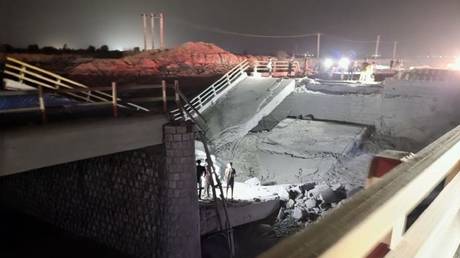
The tension in a suspension bridge is an invisible, mathematical marvel. Hundreds of steel cables, each no thicker than a finger, bind together to hold thousands of tons of concrete suspended in mid-air. For five years, engineers and local laborers in Karaj, just west of Tehran, lived by those mathematical equations. They worked through the dust, the biting winter winds, and the grinding weight of international economic sanctions to build the B1 suspension bridge. It was designed to soar 136 meters above the valley, a $400 million monument to what could be built when people looked upward.
Then, on a cool spring evening, the mathematics of the B1 bridge were rewritten by a pair of precision-guided munitions.
To understand the modern theater of war, one must look past the maps, the naval carrier groups, and the dry press releases issued from Washington and Tehran. The true cost of conflict is written in the sudden, violent destruction of the mundane structures that hold human lives together. When a bridge is destroyed, it is not merely concrete that falls into the gorge. It is the invisible tissue of a society—the daily commute, the transport of medicine, the quiet journeys of families visiting relatives on the other side of the river.
Now, those connections are being systematically severed.
The Anatomy of a Collapse
To grasp the human reality of this escalation, let us consider a hypothetical resident of Karaj. We will call him Reza. For years, Reza watched the B1 bridge creep across the sky. To him and his neighbors, it was not a military asset. It was a promise of a shorter commute, a symbol that their city was growing, modernizing, and moving forward despite the heavy political shadows hanging over the country.
On April 2, that symbol was split in half.
The first strike hit the center of the span with deafening force, sending a shockwave through the surrounding neighborhoods and cutting the newly completed structure in two. The impact shattered the delicate equilibrium of the tension cables, sending heavy steel whipping through the air like monofilament under immense strain.
But it was what happened next that truly revealed the brutal reality of modern targeted warfare.
As smoke rose from the broken concrete, local emergency crews, construction workers, and curious bystanders rushed toward the scene. They did what humans naturally do when disaster strikes: they ran toward the dust to help. Roughly an hour later, while rescue workers were frantically trying to pull survivors from the wreckage, a second missile struck the exact same spot.
This tactic, known in military parlance as a "double tap," is designed to maximize casualties among first responders. When the dust finally settled over the Karaj valley, eight people lay dead, and nearly a hundred others were wounded, their bodies torn by shrapnel from the very structure they had spent years building.
B1 BRIDGE LOSS: BY THE NUMBERS
----------------------------------------
Height Above Gorge:     136 Meters
Project Cost:          $400 Million
Fatalities:             8 Lives
Injured:                95 People
----------------------------------------
Soon after, footage of the collapse was broadcast globally, transformed into a piece of digital theater. Across the world, military analysts debated the tactical significance of the target. But on the ground, the destruction of the B1 bridge was felt as a deeply personal violation. It was a message written in broken stone and twisted rebar, sent to millions of ordinary citizens who had nothing to do with the decisions of their government.
The Squeeze on the Ground
The war has since expanded from the high suspension spans of the capital to the dry, dusty arterial roads of the south. Just recently, another vital link was severed when airstrikes hit the bridge connecting Bandar Abbas to Shiraz, plunging the surrounding area of Kahorstan into darkness and cutting off one of the region's most crucial commercial corridors.
Consider what happens next when a bridge like this is destroyed.
In the immediate aftermath, the local power grid fails. For families living in the sweltering heat of southern Iran, the loss of electricity means more than just dark rooms; it means spoiled food, silent air conditioners, and the sudden, terrifying isolation of dead phones. The trucks carrying fresh produce, water, and fuel are forced onto long, unpaved detours, driving up the cost of basic goods in a country already struggling under the weight of hyperinflation.
For those who have lived through the creeping paralysis of infrastructure warfare, the sensation is one of slow suffocation. It is the realization that the physical world around you is shrinking. The grocery store shelves empty a little faster. The hospital down the road runs out of oxygen cylinders because the delivery trucks are backed up for miles at a dry riverbed crossing.
This is the invisible leverage of the bridge campaign. It is designed to make daily survival so difficult, so exhausting, that the civilian population buckles under the strain.
But historical precedents suggest a different outcome. From the blitzed streets of mid-century Europe to the battered valleys of Southeast Asia, history shows us that targeting the foundations of daily life rarely forces a population to capitulate. Instead, it often fuses a deep, lingering resentment against the force pulling the trigger. Even those Iranians who harbor no love for their country's ruling regime find themselves united in anger when the target of a foreign bomb is the power plant that keeps their refrigerators running or the bridge their children cross to go to school.
The Regional Ledger
As the dust settles over the latest ruins in Kahorstan, the geopolitical ripples are expanding outward, threatening to drag the entire Middle East into a wider, more destructive conflagration.
The rhetoric from both sides has escalated to a fever pitch. In Washington, the administration has doubled down, warning that if negotiators do not return to the table, the target list will soon expand to include Iran's entire electrical grid and its oil infrastructure. "They better make a deal," the warning goes, "or you're not going to have anything left."
Tehran's response has been equally uncompromising. An adviser to the country's Supreme Leader warned that any further strikes on civilian infrastructure would result in the destruction of the "entire energy supply chain in the region." Already, reports indicate that regional proxy groups have been instructed to close key maritime choke points, including the Bab-el-Mandeb Strait, if the air campaign continues.
The stakes are no longer confined to the borders of Iran.
- The Global Oil Lifeline: A full blockade of the Strait of Hormuz has already sent global oil and gas prices surging, forcing everyday drivers around the world to feel the financial sting of a conflict taking place thousands of miles away.
- The Threat of Spillover: Drone and missile strikes have begun to rain down on refineries and ports across the Persian Gulf, transforming once-peaceful economic hubs into active combat zones.
- The Human Toll: Behind the macroeconomic statistics are the millions of families across the region who wake up each morning wondering if today is the day the conflict spills over their own borders, disrupting their lives just as it has in Karaj and Kahorstan.
REGIONAL IMPACT OF THE INFRASTRUCTURE WAR
====================================================================
Area Affected     Immediate Consequence         Long-Term Risk
--------------------------------------------------------------------
Tehran/Karaj      B1 Bridge severed             Transport paralysis
Kahorstan         Local blackouts               Supply chain collapse
Persian Gulf      Refineries targeted           Global energy crisis
====================================================================
The View from the Riverbed
If you were to stand today on the banks of the riverbed beneath the ruined span in southern Iran, you would not hear the speeches of politicians or the grand strategies of military generals. You would hear only the dry wind rustling through the scrubland, the occasional, distant hum of a generator, and the crunch of gravel as local residents gather to look at the gap where the road used to be.
They stand at the edge of the asphalt, looking across the void to the other side, wondering how they will get across tomorrow.
In the grand calculus of global geopolitics, a bridge is often viewed as a simple line on a map, a target to be crossed off a list to project strength and force a compromise. But to the people who live in its shadow, a bridge is an act of faith. It is a physical manifestation of the belief that two points, once divided by a chasm, can be joined together.
When the bombs fall, they do not just shatter concrete and steel. They shatter that faith, leaving behind a jagged, open wound in the earth, and a warning that in the game of nations, the heaviest price is always paid by those who merely wanted to reach the other side.