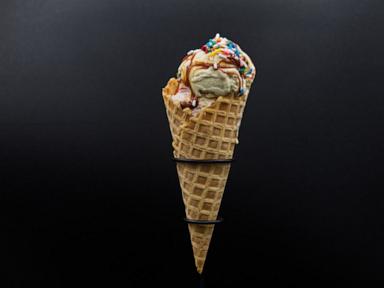
The Sticky Pavement
Heat does not merely descend upon a crowded city street; it occupies it. Asphalt grows soft beneath the soles of cheap shoes, and the air itself smells faintly of baked tar, exhaust, and the desperate optimism of melting sugar.
Picture a bustling concession stand at the turn of the twentieth century. The summer of 1904 in St. Louis was punishing, the kind of heat that turns collars limp and tempers short. Dust swirled off the packed dirt of the World’s Fairgrounds. People queued five deep, squinting against the glare, waiting for a single, fleeting mercy: a scoop of ice cream served in a little glass dish.
Those glass dishes were the bottleneck of joy. They required washing. They required hands that were already slick with cream and sweat to scrub them in lukewarm water under a counter, only to hand them right back out to the next trembling palm. And worse, they vanished. Children dropped them. Souvenir hunters pocketed them. The supply dwindled by the hour while the crowd swelled.
Behind one makeshift counter stood a man named Ernest Hamwi. He was a Syrian immigrant, a vendor of a crisp, wafer-like pastry known as zalabia, baked on a small waffle iron. He watched the chaos with a sharp, calculating eye. He watched the ice cream vendor next to him run frantically out of glassware, drowning in a tide of nickel-ready customers who were melting right alongside their treats.
Hamwi did not see a supply chain failure. He saw an empty space waiting to be filled.
The Geometry of Desperation
We often talk about invention as a flash of lightning, a solitary genius striking an anvil in a darkened room. Reality is far messier. It smells like scorching batter and desperation.
Hamwi rolled up one of his warm, pliable Persian pastries while it was still flexible straight off the hot iron. He shaped it into a cone. He handed it to his neighbor across the narrow aisle. Together, they dropped a cool sphere of cream right into the crisp, edible pocket.
It was an act born of immigrant ingenuity, forged in the crucible of a noisy, chaotic world’s fair where old-world traditions collided with American industrial speed.
Consider what happens next. The customer bites down. There is a sharp, satisfying crack—the sound of brittle pastry giving way to the velvet chill of cream. The cone does not shatter into useless shards; it holds its structural integrity against the encroaching warmth. It becomes both vessel and reward. By the end of the afternoon, the glass dishes are forgotten, relegated to the dusty corners of forgotten storehouses. A new architecture of consumption is born, held entirely in the palm of a hand.
We take this architecture for granted today. We grab a waffle cone at a roadside stand without a second thought to the physics holding it together. Yet every time a drip races down a thumb, we are participating in a century-old compact between a baker who wanted to help his neighbor and a culture hungry for something fast, mobile, and sweet.
The Weight of an Edible Vessel
History loves a tidy copyright, but it stumbles over collective urgency. In the sprawling lore of the ice-cream cone, several men laid claim to the spark. Italo Marchiony, an Italian immigrant operating a pushcart in New York, patented a mold for baking pastry cups as early as 1903. Arnold Fornachou and Charles Menches also claimed variants of the rolled-pastry technique around that same St. Louis summer.
Yet Hamwi’s story carries a distinct resonance because it highlights the immigrant experience at its most foundational: adaptation under duress.
Imagine leaving everything you know behind, crossing an ocean with a trunk of recipes and a head full of trade skills, only to find yourself standing in the midwestern dust of Missouri, trying to feed a family by selling a Middle Eastern dessert that Midwesterners could barely pronounce. You do not wait for ideal conditions. You look at the problem in front of you—a broken glass, a frustrated vendor, a line of thirsty children—and you bend your craft to fit the crisis.
The zalabia was traditionally eaten flat, drenched in syrup. But America in 1904 demanded speed. America wanted to walk while it ate. It wanted mobility. Hamwi listened to that unspoken cultural demand and reshaped his pastry into a funnel, transforming a stationary dessert into a portable handheld vehicle.
He didn't just invent a snack holder. He engineered freedom.
The Long Shadow of the Midway
Decades later, the factories took over. The delicate, hand-rolled crispness of Hamwi’s original Syrian pastry gave way to automated industrial baking lines churning out uniform, golden pyramids by the millions. The romantic haze of the World's Fair faded into sepia photographs and textbook footnotes.
Yet walk down any boardwalk on a humid August evening. Watch a toddler stare in wide-eyed terror as a rogue scoop begins to slide down a waffle wall, their tongue darting out with lightning speed to intercept the disaster.
The mechanics remain unchanged. The materials are simple: flour, sugar, butter, heat, and time. But the underlying human story persists beneath every crunch. It is the story of making do, of looking at a broken system and finding a structural shortcut that tastes like vanilla and butter.
The next time you hold that fragile, ridged spire against the summer heat, listen closely just before the first bite. You can hear the faint echo of a crowded fairground, the hiss of a hot iron against batter, and the quiet triumph of an immigrant who decided that nothing good should ever have to wait in a dirty glass dish.