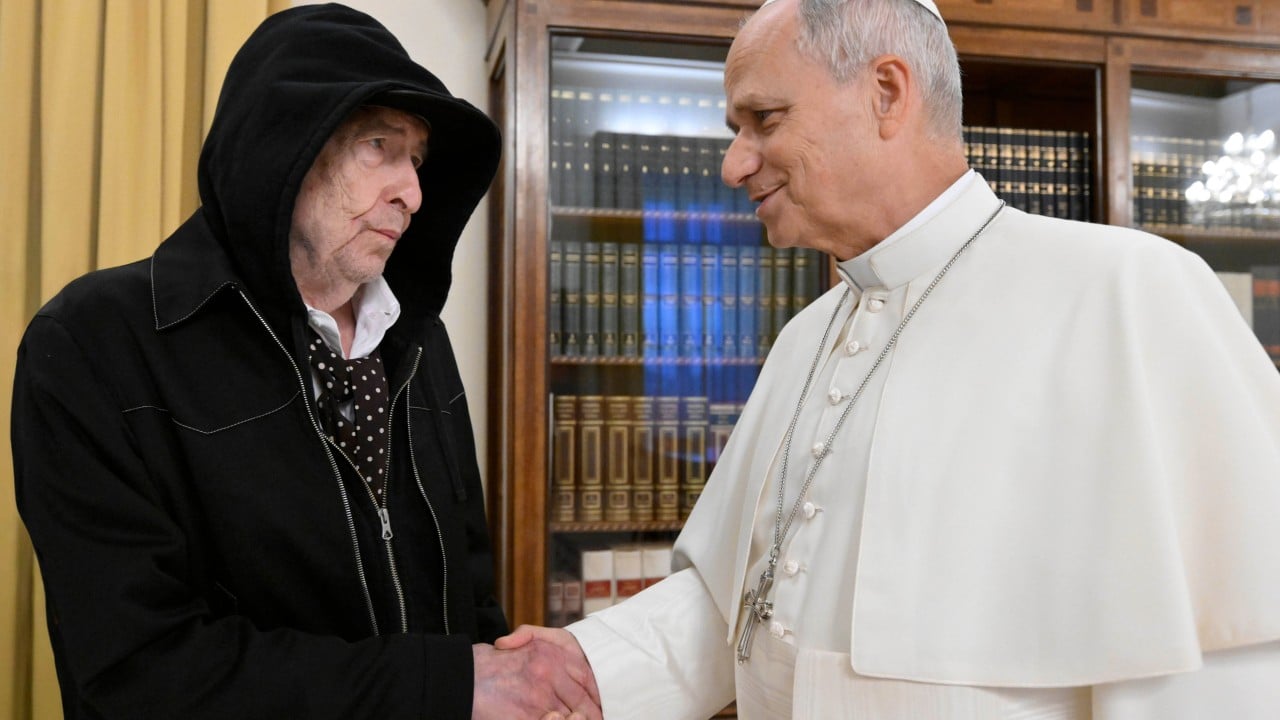
High-level diplomatic meetings between institutional religious leaders and secular cultural icons operate on an exchange of symbolic capital rather than formal policy negotiation. When Pope Leo XIV welcomed Bob Dylan to the Vatican, mainstream media coverage framed the encounter through nostalgic wordplay and surface-level celebrity observation. To understand the actual mechanics of this meeting, one must analyze the intersection of papal soft power, the theological trajectory of Dylan’s catalog, and the strategic positioning of the Catholic Church in an era of accelerating secularization.
The Architecture of Papal Soft Power
The Holy See lacks traditional hard power mechanisms such as military force or direct economic coercion, relying entirely on moral authority, diplomatic networks, and cultural resonance. Under Pope Leo XIV, the Vatican's public diplomacy apparatus has prioritized engagements that bridge the widening gap between institutional Catholicism and secular modernity.
Inviting Bob Dylan—a figure whose cultural footprint spans six decades and transcends national, generational, and ideological boundaries—serves a specific operational function for the Vatican. Unlike political heads of state, whose visits are bound by bilateral treaties and immediate geopolitical friction, artists provide a neutral conduit for ideological signaling. By hosting Dylan, Pope Leo XIV reinforces the Church’s historical role as a patron of the arts while simultaneously validating a mode of artistic inquiry that wrestles openly with doubt, sin, and redemption.
This strategy relies on three distinct mechanisms of cultural diplomacy:
- Audience Cross-Pollination: The Vatican gains immediate algorithmic and editorial visibility within demographic segments that routinely ignore encyclicals or curial appointments. Coverage shifts from specialized religious desks to mainstream cultural outlets.
- Doctrinal Framing Without Dogma: Dylan’s extensive use of biblical imagery allows the papacy to align itself with Christian themes—judgment, grace, mortality—without delivering a didactic sermon that might alienate secular observers.
- Institutional Continuity: The meeting echoes the 1997 Bologna Eucharistic Congress, where Dylan performed for Pope John Paul II. By replicating this archetype nearly three decades later, Leo XIV establishes visual and historical continuity with his predecessors while stamping his own pontificate with contemporary cultural relevance.
Deconstructing the Subject's Theological Utility
Standard entertainment journalism treats Dylan’s appearance at the Vatican as a curious juxtaposition of rock-and-roll rebellion and ancient hierarchy. This framing misses the fundamental alignment between Dylan’s lyrical methodology and Catholic intellectual tradition.
Since his late-1970s conversion period—marked by albums such as Slow Train Coming and Saved—and continuing through his later secular-mystical works like Time Out of Mind and Rough and Rowdy Ways, Dylan’s writing has functioned as an extended meditation on eschatology and human fallibility. Even when operating outside explicit Christian orthodoxy, his catalog rejects the progressive optimism of modern secularism in favor of a fallen-world anthropology. Humans, in Dylan’s framework, are flawed actors navigating a morally consequential universe.
For a pontiff seeking to articulate a traditional moral anthropology to a skeptical public, Dylan is an ideal interlocutor. His 2016 Nobel Prize in Literature codified his status as a canonical poet, elevating his lyrics from pop ephemera to permanent literary artifacts. When Pope Leo XIV engages with Dylan, the Vatican is not merely courting a musician; it is engaging with a recognized literary authority whose body of work validates the persistence of religious questions in a post-religious age.
The Asymmetry of Mutual Benefit
While the diplomatic exchange appears reciprocal, the utility derived by each party is fundamentally asymmetrical.
For the Vatican, the return on investment is immediate and quantifiable in media impressions, diplomatic signaling, and soft-power reinforcement. The Holy See absorbs Dylan’s countercultural credibility, softening its institutional image without conceding a single point of doctrine.
For Dylan, whose career has been defined by strategic elusiveness and a refusal to submit to external categorization, the institutional validation of the papacy offers diminishing returns in terms of commercial or artistic standing. His participation instead reflects a late-career alignment with permanent institutions. Having already accepted the Nobel Prize and the Presidential Medal of Freedom, a papal audience represents one of the few remaining global stages commensurate with his historical stature. It places his work within a multi-century timeline rather than the fleeting cycle of the music industry.
Historical Precedent and Shifting Papal Strategies
To evaluate the significance of Leo XIV’s gesture, one must contrast it with the 1997 Bologna encounter under John Paul II. In 1997, John Paul II utilized the performance of "Knockin' on Heaven's Door" as a direct homiletic tool, explicitly interpreting Dylan’s lyrics for an audience of 300,000 young Catholics to argue that the "door" in question was Christ. That interaction was explicitly pastoral and evangelistic, occurring within a massive public liturgy.
Pope Leo XIV’s reception of Dylan operates under a different diplomatic model. Moving away from mass-spectacle evangelization, this encounter emphasizes dialogue, artistic recognition, and elite cultural engagement. The shift reflects a broader recalibration in Vatican communications:
- From Mass Mobilization to Targeted Resonance: Rather than relying on stadium-sized gatherings to demonstrate relevance, the current strategy prioritizes high-symbolism, intimate encounters that generate sustained media analysis.
- Ambiguity as an Asset: Where John Paul II imposed a definitive theological interpretation onto Dylan’s text, Leo XIV allows the juxtaposition itself to carry the communicative weight. In a fragmented media environment, open-ended symbolism travels further than explicit doctrinal commentary.
- Institutional Humility: Receiving an artist as a peer in cultural dialogue rather than a performer at a Church rally signals an openness to listening, a core theme of contemporary synodal governance.
Analytical Limitations and Execution Risks
Treating celebrity diplomacy as an unqualified success overlooks inherent structural vulnerabilities. Cultural engagements carry distinct reputational and strategic risks that limit their long-term efficacy.
First, symbolic inflation erodes the impact of high-profile audiences. If the papacy frequently hosts prominent entertainers, actors, and musicians, the scarcity value of a papal audience declines. What begins as a strategic intervention risks collapsing into routine public relations, indistinguishable from a standard celebrity press tour.
Second, theological ambiguity cuts both ways. By embracing an artist whose personal life, political statements, and lyrical catalog contain elements starkly at odds with Catholic moral teaching, the Vatican invites critique from doctrinal traditionalists. Without clear framing, secular observers may interpret the meeting as institutional endorsement of relativism, while conservative factions within the Church view it as a dilution of prophetic clarity.
Third, media ephemerality restricts the conversion of soft power into tangible institutional support. Viral headlines about Dylan knocking on the pope's door generate momentary attention, yet there is no causal mechanism linking positive entertainment coverage to increased Mass attendance, vocations, or adherence to Catholic social teaching. Attention is not adherence.
Strategic Imperatives for Vatican Cultural Engagement
To maximize the institutional return of high-profile cultural encounters like the Dylan audience without succumbing to superficial publicity, the Vatican’s Dicastery for Culture and Education must enforce strict operational discipline. Future engagements should move beyond isolated photo opportunities and integrate into long-term intellectual initiatives.
Specifically, the Holy See must anchor secular artistic visits to substantive academic symposiums, archival exhibitions, or charitable endowments that outlast the 48-hour news cycle. By requiring cultural figures to engage with Catholic intellectual history in structured, documented forums rather than brief ceremonial greetings, the papacy can convert fleeting celebrity visibility into durable philosophical capital.


