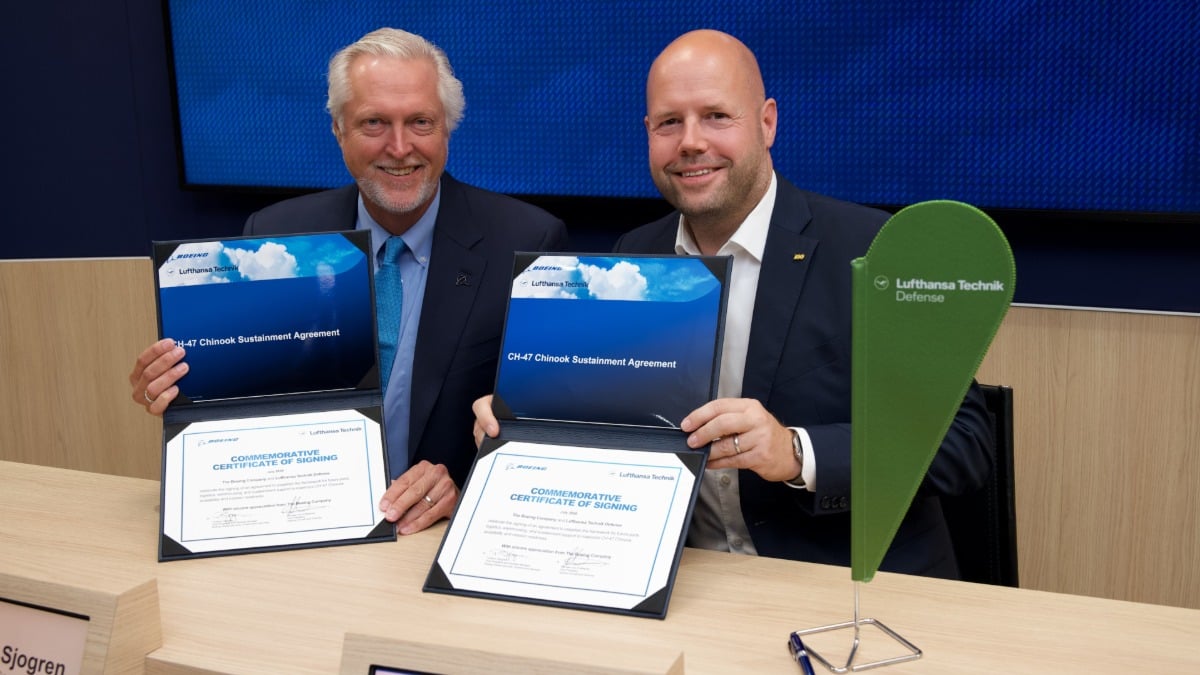
Press releases in defense procurement are exercises in performative optimism. When Boeing and Lufthansa Technik announced their teaming agreement to support Germany’s incoming fleet of 60 CH-47F Block II Chinook helicopters, the defense establishment applauded on cue. Industry analysts praised the contract as a masterclass in transatlantic cooperation. Politicians in Berlin celebrated domestic job creation. Military brass smiled for the photo ops in front of pristine mockups.
They are lying to themselves.
I have spent two decades sitting in defense acquisition meetings, reading the classified failure reports, and watching multi-billion-dollar maintenance contracts implode. I have seen military fleets grounded not by enemy fire, but by corporate lawyers arguing over technical data rights and supply chain markup structures.
The deal between Boeing and Lufthansa Technik is not a victory for German defense readiness. It is a predictable disaster wrapped in political expediency. It trades actual operational availability for local industrial pork. By shoehorning a commercial airline MRO (Maintenance, Repair, and Overhaul) titan into the operational core of military rotorcraft sustainment, Berlin and Seattle have constructed a sluggish, friction-heavy bureaucracy that will guarantee lower mission-capable rates at double the expected cost.
Here is why the consensus is dead wrong, and why this partnership will haunt the Bundeswehr for the next thirty years.
Commercial MROs Do Not Understand Combat Helicopters
The primary defense for this deal rests on a fundamental misconception: that repairing an Airbus A350 at Frankfurt Airport equips an organization to maintain a heavy-lift combat helicopter operating out of dirty, high-vibration military airfields.
It does not. Commercial MRO and military rotary-wing sustainment share almost nothing in common beyond the fact that both involve things that fly.
Commercial airline maintenance operates on predictable flight schedules, standardized routes, and smooth flight profiles. Airliners fly long distances at high altitudes with minimal airframe stress. Maintenance schedules are fixed years in advance. Parts consumption follows strict, linear statistical models. Commercial MROs excel at high-volume, repetitive depot tasks where work orders never change and component life limits are absolute.
Military rotary-wing operations are the exact opposite:
- Non-linear airframe stress: Heavy-lift transport helicopters operate in low-altitude, high-vibration, high-torque environments. Sand, dust, low-level flying, and maximum gross weight troop transport destroy components in ways that look nothing like airline flight hours.
- Unscheduled maintenance spikes: A Chinook does not break down on a scheduled calendar. Transmission gearboxes, main rotor head assemblies, and drive shafts degrade unpredictably based on harsh flight maneuvers and environmental exposure.
- Depot agility versus fixed procedures: Military maintenance requires rapid field-level repairs, cannibalization of parts when supply lines snap, and field modifications. Commercial MRO cultures are built around strict civil aviation authority compliance (EASA/FAA), where unauthorized deviation from a factory manual halts work for weeks.
When you drop a commercial giant like Lufthansa Technik into this ecosystem, you introduce a massive cultural conflict. Their business model depends on long lead times, predictable supply chains, and steady-state maintenance lines. Military rotorcraft demand dirty, improvisational, high-velocity maintenance execution.
I have watched commercial aviation contractors try to run military flight lines before. The result is always the same: technicians standing around waiting for corporate engineering dispositions while airframes sit jacked up in hangers, missing mission windows because nobody has the authority to sign off on a field repair that falls outside standard airline documentation.
The Industrial Offset Tax Destroying Military Budgets
To understand why this deal happened, you have to follow the money, not the military logic.
Germany’s 100-billion-euro Sondervermögen (special defense fund) created an immediate political problem for Berlin. Spending tens of billions of euros on American military hardware like the F-35 and the CH-47F Chinook was a bitter pill for European defense contractors to swallow. German politicians needed a way to keep tax dollars inside German borders.
Enter the industrial offset strategy.
By forcing Boeing to partner with Lufthansa Technik and local German suppliers, Berlin ensured that a slice of the lifetime sustainment budget stays in Germany. It sounds sensible to a politician looking for votes in North Rhine-Westphalia or Bavaria. To a military commander responsible for fleet readiness, it is an administrative tax that degrades military power.
Imagine a scenario where a critical transmission component fails on a German Chinook stationed at Holzdorf Air Base.
In a streamlined Foreign Military Sales (FMS) sustainment model, the German air force would pull a replacement gearbox directly from the US Army’s centralized logistics depot in Pennsylvania. The part flies across the Atlantic on a military transport, gets bolted into the airframe by uniformed military technicians or direct OEM field representatives, and the aircraft flies the next morning.
Under the Boeing-Lufthansa Technik hybrid arrangement, that simple exchange turns into a bureaucratic nightmare:
- The part must be routed through Lufthansa Technik’s domestic German procurement structure to fulfill local content quotas.
- Technical data for the component must be cleared by Boeing lawyers to ensure compliance with export laws.
- German technicians must perform localized inspection and recertification to satisfy domestic contractual mandates.
- The part sits in a warehouse waiting for cross-organizational sign-offs.
Every layer of local participation adds a markup fee, an administrative checkpoint, and a potential delay. You are not paying for better maintenance; you are paying a surcharge to keep domestic German aerospace workers employed under the guise of national security. Industry leaders call it "domestic industrial participation." In reality, it is a operational efficiency tax paid directly out of the military's fight-tonight readiness budget.
ITAR and the Illusion of Sovereign Control
German defense planners like to argue that partnering with domestic firms gives Germany "sovereignty" over its maintenance operations. They claim that relying entirely on Boeing or the US Government would leave the Bundeswehr vulnerable to Washington’s geopolitical whims.
This argument reveals a total ignorance of how International Traffic in Arms Regulations (ITAR) actually work.
Lufthansa Technik can build all the maintenance hangars it wants on German soil. It can put German flags on the coveralls of every mechanic in the building. But the intellectual property, the technical data packages, the flight-control software source codes, and the primary component manufacturing rights for the CH-47F Block II belong to Boeing and the United States Government.
Germany does not get "sovereignty" by inserting a domestic middleman into an ITAR-controlled pipeline.
If Washington decides to delay a critical component, withhold a software patch, or restrict technical data access during an international crisis, Lufthansa Technik is completely helpless. They cannot legally manufacture a replacement main rotor blade or reverse-engineer a Honeywell T55 engine part without violating international law and triggering crippling sanctions from the US State Department.
All this partnership creates is the illusion of sovereignty.
It creates a complex, dual-layered management structure where German managers at Lufthansa Technik must constantly clear every maintenance protocol through Boeing’s export compliance offices in St. Louis. Instead of true independence, Germany gets the worst of both worlds: complete dependence on US intellectual property combined with the slow execution of a domestic corporate bureaucracy.
The Split Accountability Trap
When defense programs fail, the primary cause is almost always split accountability. When one organization owns the platform, another owns the maintenance, and a third operates the aircraft, failure becomes orphan child that nobody claims.
Look at the structural split in this Boeing-Lufthansa Technik arrangement:
- Boeing holds the design authority, the manufacturing lines, and the primary US supply chain ties.
- Lufthansa Technik holds the domestic maintenance facilities, the local labor contracts, and the depot-level execution responsibilities.
- The Luftwaffe (German Air Force) operates the helicopters and bears the ultimate operational risk.
What happens when mission-capable rates drop to 30 percent—a figure that has plagued European military helicopter fleets for decades?
The blame game begins immediately:
Boeing will claim they supplied the technical data and parts according to the baseline contract, pointing their fingers at Lufthansa Technik’s technicians for slow turnaround times and improper execution.
Lufthansa Technik will claim that Boeing failed to deliver technical data updates on time, delayed spare parts shipments, or provided inadequate factory training for German mechanics.
The German Defense Ministry will issue stern press releases, launch parliamentary inquiries, and hire expensive management consultants to audit the contract.
Meanwhile, 40 out of 60 Chinooks will sit grounded on the tarmac, gathering dust because no single corporate entity has sole responsibility for keeping those rotor blades spinning.
We saw this exact tragedy play out with the NH90 helicopter program across Europe. Multiple countries, split industrial share, divided maintenance authorities, and endless finger-pointing. The result? France, Australia, and Norway eventually grounded or retired their fleets early because the sustainment architecture was completely unworkable.
Germany is repeating the exact same structural mistake with the Chinook, only this time they are doing it with an American platform.
What Germany Should Have Done Instead
Dismantling a bad strategy requires offering a hard, pragmatic alternative. If this joint venture is a trap, how should Germany have structured its CH-47F sustainment?
They should have abandoned political posturing and chosen one of two clean, uncompromising paths:
Path A: Total Foreign Military Sales Integration
If the goal is maximum readiness at the lowest cost, Germany should have opted for a pure, unadulterated US Army FMS sustainment model. Plug directly into the US Army’s global Chinook supply chain. Pay the US Government to handle depot-level overhauls in existing, fully optimized US facilities. Keep German maintenance strictly at the field unit level, run entirely by uniformed Luftwaffe personnel.
Yes, German aerospace companies would get zero maintenance euros. But the Luftwaffe would achieve 70+ percent fleet availability rates at half the cost, leveraging the massive economies of scale generated by the US military's hundreds of active Chinooks.
Path B: Full Domestic Technology Transfer and Native Depot Creation
If the goal is true national defense sovereignty, Germany should have demanded complete, unrestricted transfer of manufacturing and repair rights as a condition of buying the aircraft. They should have built a state-owned, military-run depot facility, forcing Boeing to hand over every blue-print, software code, and manufacturing license necessary to build and repair parts domestically without US oversight.
Yes, this option would have cost twice as much upfront and triggered intense diplomatic fights with Washington over ITAR exemptions. But it would have produced genuine strategic autonomy.
Instead, Germany chose the political compromise option: a watered-down hybrid model designed by corporate marketers and political advisors. They chose the option that guarantees maximum financial bloat, zero true strategic sovereignty, and a nightmare of corporate division.
The Hard Reality Coming for Berlin
Defense procurement decisions made in quiet boardrooms take five to ten years to show their poison. Right now, the ink on the press releases is fresh, executives are shaking hands, and politicians are bragging about aerospace jobs in Germany.
The bill will come due when the first squadron of CH-47F Block II Chinooks reaches full operational status at Holzdorf.
When the flight hours pile up, airframe fatigue sets in, and unscheduled maintenance events spike, the operational machinery will grind to a halt. German pilots will sit in ready rooms waiting for aircraft that are stuck in maintenance bay purgatory, trapped between Boeing’s legal department and Lufthansa Technik’s commercial workflow manuals.
The defense media will act surprised. They will call it an unexpected supply chain crisis or a temporary teething issue for a new platform.
It will be neither. It will be the direct, inevitable result of prioritizing domestic industrial politics over military realities. You cannot build a combat-ready force on a foundation of political compromises and commercial maintenance cultures.
The Boeing-Lufthansa Technik deal isn't a modern breakthrough in military logistics. It is a cautionary tale in the making.

/https://i.s3.glbimg.com/v1/AUTH_e84042ef78cb4708aeebdf1c68c6cbd6/internal_photos/bs/2026/g/B/3vpkvHQKizRKAfzDxjXA/vini-jr-antes-e-depois.jpg)