The fluorescent lights in the back room of the currency exchange in downtown Tehran hum with a low, persistent vibration that seems to rattle right behind your teeth. It is a sound you never forget once you have stood in those lines, clutching a thick brick of rapidly devaluing rials, watching the digital board above the teller flicker upward like a slot machine rigged against the house.
Every two years, around the crisp chill of November, a strange fever sweeps through that line.
People begin to whisper about Iowa. They trade rumors about Pennsylvania senate races, suburban turnout in Michigan, and the fragile, shifting margins of the United States House of Representatives. They stare at their phones, refreshing news feeds from Washington, praying that a sudden flip in congressional power will magically loosen the vise gripping their throats. They believe that a blue wave or a red wave thousands of miles away will somehow lower the price of cooking oil on Valiasr Street.
They are wrong.
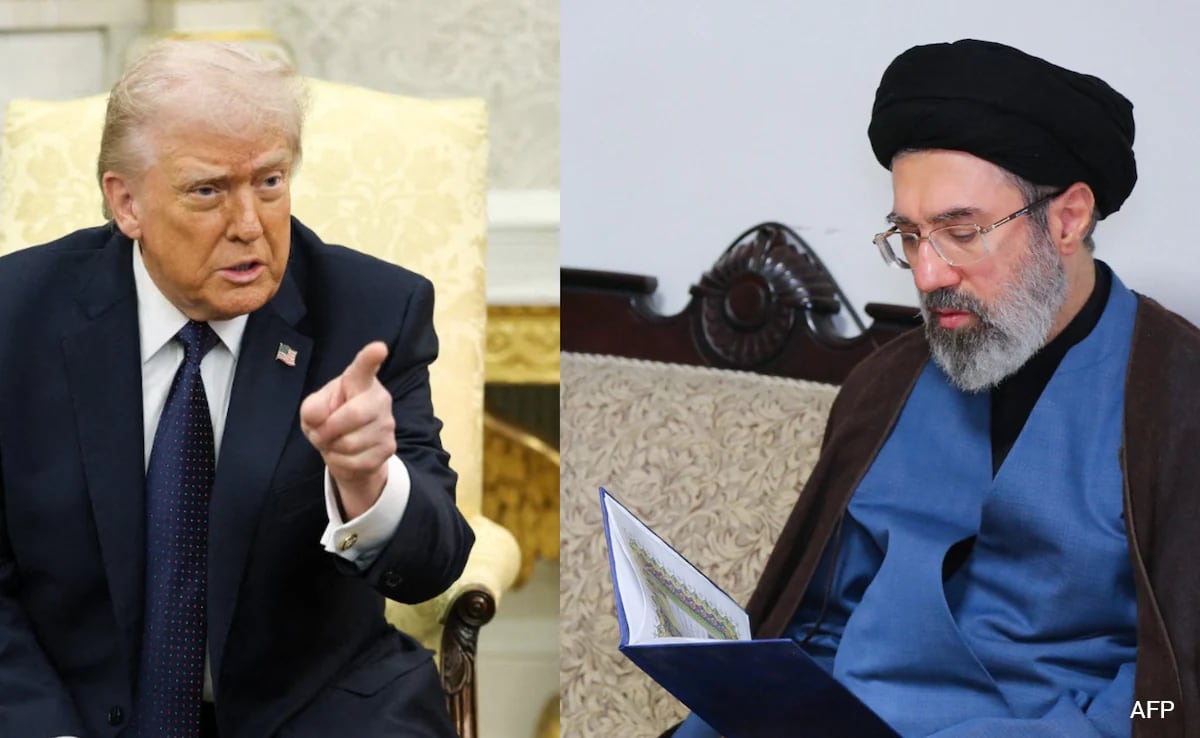
And if you listen closely to the cold, unsentimental calculus coming out of the highest echelons of power in Tehran, even the architects of the Islamic Republic are tired of watching people bet their survival on a political mirage. When Mojtaba Khamenei—a figure whose influence operates largely in the shadows of succession and state security—voices the assessment that those expecting a shift in American foreign policy after the midterm elections are "mistaken," it is not mere ideological posturing. It is a rare moment of brutal, unfiltered clarity.
Wait.
Let that sink in for a second. Think about what it means when the very leadership locked in a forty-year blood feud with Washington looks at the American electoral circus and tells the world, in effect, do not hold your breath.
To understand why this matters—not just to diplomats in Geneva or analysts in think tanks, but to every single person trying to navigate an increasingly volatile global economy—we have to peel back the comforting lie we tell ourselves about how democracies work. We like to believe that elections are hard resets. We treat every November ballot box like a magic wand that can instantly rewrite decades of entrenched geopolitical momentum.
The Architecture of a False Hope
Consider a hypothetical character to make this real. Let us call him Darius. Darius is forty-two, owns a small auto-parts manufacturing workshop on the outskirts of Karaj, and employs fourteen men who rely on him to feed their families.
For the past six months, Darius has delayed buying a new German-made lathe he desperately needs to keep his production line running. Why? Because the spare parts for his current machines are trapped behind layers of secondary sanctions, banking blacklists, and terrified European shipping insurers. Every time his floor manager asks when they can place the order, Darius points to a calendar on his office wall, specifically to the first Tuesday after the first Monday in November. "Wait until the Americans vote," Darius says, his voice tight with a mixture of exhaustion and stubborn optimism. "Once the opposition takes control of Congress, the gridlock will force the White House to negotiate. The pressure will ease."
Darius is a smart man. He reads the international headlines. He understands supply chains and profit margins. Yet, in that cramped office smelling of machine oil and stale tea, Darius is falling into one of the oldest traps in modern statecraft.
He is mistaking domestic political theater for structural foreign policy change.
In the American system, the midterms are a referendum on the sitting president, almost always driven by the price of eggs, local crime rates, cultural flashpoints, and voter fatigue. They are rarely, if ever, a mandate to dismantle the foundational pillars of national security doctrine. Even when control of the House or the Senate flips—historically, the president's party loses an average of around twenty-eight House seats and four Senate seats in midterm cycles—the machinery of foreign policy remains firmly bolted to the floor of the Oval Office.
The President of the United States holds near-monopolistic control over diplomacy, executive orders, sanctions enforcement, and military posture. Congress can hold loud, televised hearings. Senators can write fiery letters and stall ambassadorial confirmations. They can throw sand into the gears of legislative funding. What they cannot do is unilaterally pick up the phone in the Situation Room and rewrite the terms of engagement with Tehran, Beijing, or Moscow.
The Bipartisan Concrete
If you have ever walked the corridors of Capitol Hill during a shift in congressional power, you quickly realize a sobering truth: the rhetoric changes volume, not direction.
When one party holds the gavel, they accuse the administration of dangerous weakness, of appeasing adversaries and abandoning allies. When the opposition seizes that same gavel the following January, they suddenly discover the intoxicating utility of maximum pressure. Nobody in Washington ever lost an election by looking too tough on Iran. Nobody ever won a swing district by campaigning on the nuanced removal of financial sanctions.
This creates what political scientists call a structural ratchet. Every crisis, every drone strike, every stalled nuclear inspection clicks the ratchet one notch tighter. Once sanctions are codified into law—layers upon layers of statutes passed overwhelmingly by both Democrats and Republicans over decades—unwinding them requires a level of political capital that no midterm-bruised president possesses.
Think of American foreign policy toward the Middle East not as a speedboat that can turn on a dime whenever a new navigator steps aboard, but as a fully loaded supertanker cutting through dark water. You can spin the wheel frantically on the bridge. You can shout orders into the intercom. For miles, the bow will continue plowing straight ahead along the exact trajectory set years before.
When Mojtaba Khamenei dismisses the notion of a post-midterm shift as a delusion, he is reading the physics of that supertanker far more accurately than the hopeful pundits on cable news. From the perspective of Tehran's inner circle, the American political system is not a pendulum swinging between hostility and accommodation. It is a single, continuous apparatus of containment, merely wearing different jerseys every couple of years.
What History Whispers to Those Who Listen
We do not need to guess how this plays out because we have watched this exact movie several times over the last thirty years.
Go back to 2006. The United States was bogged down in Iraq, public exhaustion with foreign intervention was at a boiling point, and Democrats swept both chambers of Congress in a massive midterm rebuke of the Bush administration. Across the Middle East, there was a palpable expectation that Washington's posture would immediately soften, that a new era of diplomatic pragmatism was dawning. Instead, within months, the administration launched a troop surge, tightened financial restrictions on Iranian banks, and escalated regional containment.
Fast forward to 2010. A historic wave swept Republicans into the House, paralyzing the domestic agenda of a president who had promised to extend an unclenched fist to adversaries. Did the pressure on Tehran ease? Quite the opposite. Over the next two years, driven by bipartisan congressional consensus, the United States assembled the most crippling multilateral sanctions regime in modern history, targeting oil exports and central bank transactions with surgical precision.
Look again at 2018. Democrats reclaimed the House of Representatives in the middle of a turbulent administration that had just torn up the 2015 nuclear accord. Observers in European capitals and nervous traders in Dubai assumed a Democratic House would act as a brake on the "maximum pressure" campaign. They were wrong. The executive branch continued ratcheting up designations, blacklisting entire sectors of the economy, while Congress proved either unwilling or unable to override the executive's constitutional primacy in foreign affairs.
Pattern recognition is a ruthless teacher. It strips away our wishful thinking and leaves us staring at cold, hard precedent.
The Invisible Tax of Waiting
Why does this misconception persist, season after season, cycle after cycle? Because hope is a psychological survival mechanism. When you are trapped inside a stagnant economy or an intractable geopolitical standoff, admitting that the cavalry is not coming over the hill in November feels like surrendering to despair.
Yet, clinging to false timelines carries a devastating hidden cost.
Return for a moment to our hypothetical workshop owner, Darius, in Karaj. Because he delayed buying that lathe until after the American elections, he lost six months of productivity. By the time November passes and he realizes that Washington's posture has not budged an inch—that the banking channels remain frozen and the shipping insurers are still terrified of Treasury Department fines—the exchange rate has slipped another fifteen percent. The lathe he could have barely afforded in the spring is now completely out of his reach. Two of his fourteen workers have to be let go before winter sets in.
This is the quiet tragedy of geopolitical illusions. They paralyze action in the present by promising salvation in the future.
Governments do it, too. Negotiators stall at the table in Vienna or Muscat, dragging out technical discussions over centrifuge cascades and verification protocols, hoping that a changing political map in Washington will yield a softer negotiating partner. By the time the dust settles after the election, the window for compromise has often slammed shut entirely, hardened by new domestic pressures on both sides.
When a senior figure inside the Iranian establishment publicly warns against expecting a post-midterm thaw, he is also sending an unmistakable message inward to his own factions. He is telling the pragmatists, the merchants, and the restless public that there will be no external rescue. He is consolidating the narrative of self-reliance—what Tehran calls the "resistance economy"—by systematically dismantling the expectation that relief can be imported from an American ballot box.
The Real Engine of Change
If we want to understand what actually shifts the tectonic plates between nations, we have to stop staring at midterm polling averages and start looking at leverage, pain thresholds, and raw strategic necessity.
Foreign policy rarely changes because a few thousand suburban voters in a swing state decided they were unhappy with inflation. It changes when the cost of maintaining the status quo becomes unbearably high for the people holding the levers of power.
It shifts when energy markets tighten to the point where global supply shocks threaten domestic stability. It shifts when regional escalations spiral close enough to the brink of full-scale war that neither side can control the fallout. It shifts when quiet, unglamorous backchannel diplomacy—often conducted far away from television cameras and electoral calendars—finds a narrow corridor of mutual self-interest.
Think about the moments in modern history when seemingly permanent enmities suddenly cracked open. Nixon did not go to China because of a midterm shift; he went because the strategic triangle between Washington, Beijing, and Moscow demanded a radical realignment. The secret Oslo channels did not open because of a congressional wave; they opened because decades of attrition had exhausted the immediate alternatives.
I remember sitting in a cramped café in Istanbul a few years ago, talking with an Iranian journalist who had spent his entire career covering the endless cycle of talks, sanctions, and breakdowns. He stirred his tea slowly, watching the rain streak the windowpane, and said something that has stayed with me ever since. "We spend all our energy watching the weather in Washington," he murmured, "forgetting that we are living in a house with no roof."
His point was brutally simple. You cannot control the storms brewing across the ocean. You can only decide whether you are going to spend your time praying for sunshine or reinforcing the walls around you.
Stripping Away the Noise
This realization is uncomfortable. It forces us to confront a world that is far less responsive to our preferences than we want it to be. It admits that the grand narratives we consume every two years—the breathless countdowns, the electoral maps glowing red and blue, the endless panels dissecting margin-of-error shifts—often amount to sound and fury signifying very little for the fundamental trajectory of global power.
There is a strange kind of liberation, however, in dropping the illusion.
When you stop waiting for a midterm miracle, you begin to see the chessboard as it actually exists. You stop making life-altering financial decisions, business investments, or diplomatic calculations based on campaign promises made to voters three thousand miles away. You start pricing in the reality of prolonged friction. You build redundancies into supply chains. You look for local solutions to structural bottlenecks.
And if you are an observer trying to make sense of the world, you stop getting whiplash every two Novembers. You learn to distinguish between the noise of partisan combat and the deep, slow-moving currents of national interest.
Mojtaba Khamenei's blunt dismissal of post-midterm expectations is not a prophecy of eternal conflict, nor is it an endorsement of fatalism. It is a cold splash of water in the face of anyone still dreaming of an easy exit ramp. The rivalries shaping this decade are rooted in deep structural contradictions—competing visions of regional order, nuclear deterrence, and sovereign autonomy—that cannot be voted away in a single Tuesday afternoon.
Outside that currency exchange in downtown Tehran, the evening traffic roars past, headlights cutting through the diesel haze. Inside, the digital board above the teller flickers once more, adjusting to the merciless arithmetic of the open market, entirely indifferent to who won the third congressional district in Ohio.


