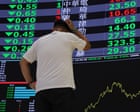
At 9:31 a.m. Eastern Time on a crisp Wednesday morning, Arthur Pendelton—a hypothetical composite of millions of ordinary Americans staring down the barrel of retirement—did something he had sworn to his financial advisor he would never do. He opened his brokerage app before finishing his coffee.
Red.
Not the gentle, fluctuating blush of a normal trading day, nor the minor correction that pundits dismiss as healthy profit-taking. This was a crimson cliff. Within sixty seconds of the opening bell, thousands of dollars had evaporated from Arthur’s target-date fund, dragged down by an invisible tether connecting his quiet kitchen table in Ohio to the server farms of Silicon Valley and the marble halls of Capitol Hill.
The headlines called it a global sell-off triggered by artificial intelligence slowdown fears following a Democratic midterm victory. To a machine, that is a tidy string of causality. Political shift equals regulatory friction; regulatory friction equals slower capital expenditure; slower expenditure equals lower valuations. Sell.
To Arthur, standing in his socks on cold linoleum, it felt like the floor giving way.
I have spent twenty years watching markets react to ghosts, and if there is one truth etched into the scar tissue of every veteran trader, it is this: Wall Street hates uncertainty far more than it hates bad news. You can price in a disaster. You can build a spreadsheet around a recession, hedge against an interest rate hike, or short a failing retail chain. What you cannot easily model is a sudden rewrite of the rules in the middle of the game.
The Architecture of a Panic
To understand why a ballot cast in Pennsylvania or Arizona can send a semiconductor stock in Taiwan tumbling before breakfast, we have to look at the fragile marriage that has propped up the global economy for the past three years.
Call it the Great Silicon Bet.
For months, a handful of mega-cap technology companies acted as the Atlas of the financial world, holding up entire stock indices on the promise that generative artificial intelligence would rewrite human productivity. Pension funds, sovereign wealth managers, and everyday savers poured trillions into this thesis. They weren't just buying software companies; they were buying the future tense. Whenever the broader economy sputtered—when manufacturing slowed or consumer credit tightened—investors retreated into the comforting arms of AI infrastructure. Data centers were the new railroads, and the companies building the chips were selling picks and shovels in a gold rush that seemed immune to gravity.
Then came Tuesday night.
When the electoral map shifted blue, the math on those spreadsheets didn't just change; it fractured. A Democratic triumph in the midterms immediately altered the legislative weather forecast in Washington. Suddenly, the frictionless highway that tech giants had enjoyed—marked by light-touch oversight, permissive merger environments, and generous corporate tax structures—acquired speed bumps.
Wall Street didn't wait for a single bill to be drafted. Markets are forward-looking discounting machines, which is a polite way of saying they panic in advance. Institutional investors immediately began asking uncomfortable questions. Would a newly empowered Democratic majority push harder for algorithmic transparency and safety guardrails? Would antitrust enforcers regain their teeth, slowing down the strategic partnerships between cloud providers and AI startups? Would corporate tax adjustments eat into the massive free cash flows required to buy billions of dollars' worth of graphics processing units?
The Dominoes Across the Ocean
Consider what happens next when a single assumption breaks inside a high-frequency trading algorithm.
Think of the global stock market not as a collection of independent businesses, but as a tightly strung suspension bridge. When a heavy truck hits a pothole on the American side, the cables vibrate all the way to Tokyo and Frankfurt. Because modern exchange-traded funds bundle the largest tech names together, selling one forces the automatic liquidation of dozens of others.
By midday, the contagion had jumped the Atlantic and the Pacific. European tech indices slumped as investors questioned whether American enterprise spending on cloud computing would freeze until the political dust settled. In Asia, the suppliers who manufacture the microscopic silicon wafers—the physical heartbeats of the digital age—saw their shares battered. If Silicon Valley slows its pace of data center construction by even ten percent to wait out regulatory clarity, the shockwave hits factories in Hsinchu and Seoul six months later.
We often talk about the stock market as if it were an abstract scoreboard flashing numbers above Times Square. It isn't. It is a psychological barometer of collective human confidence, amplified by machines that execute trades in microseconds.
I remember sitting on a trading desk during the dot-com bust of 2000, listening to the physical hum of CRT monitors and the frantic yelling of brokers trying to offload telecommunications stocks that had been considered invincible forty-eight hours earlier. The technology today is infinitely faster, the screens are flat, and the rooms are eerily quiet, yet the human emotion driving the sell buttons hasn't evolved a millimeter. Fear is still fear. Greed is still greed.
Separating Political Theater from Technological Reality
Let’s pause and admit something that financial television anchors rarely say out loud because nuance kills ratings: nobody actually knows how much a midterm election changes the trajectory of artificial intelligence.
History offers a sobering counterweight to the panic. Look back at past political shifts—whether it was the regulatory pushback against big banks after 2008, the pharmaceutical pricing scares of 2016, or the antitrust hearings targeting social media giants in 2020. In almost every instance, the initial market reaction was violent, emotional, and largely overblown. Washington moves with the speed of a glacier, whereas software evolves at the speed of light.
Why, then, did global stocks plunge with such ferocity?
Because valuations had left zero room for error. When a stock trades at forty or fifty times its expected earnings, it isn't priced for a good year; it is priced for perfection. It assumes the skies will remain clear forever, interest rates will behave, supply chains will never tangle, and politicians will never interfere. The midterm results didn't break the technology. Large language models didn't suddenly become less intelligent on Wednesday morning. Hospitals didn't cancel their diagnostic software, and logistics companies didn't abandon automated routing.
What broke was the illusion of invincibility.
To use an analogy from aviation, the global market had been flying at high altitude on a single engine—the AI boom—while ignoring the sputtering of traditional sectors like housing and retail. When political turbulence hit that one engine, the cabin lost pressure, and the oxygen masks dropped. Investors realized, all at once, that they had crowded onto the same side of the boat.
What Happens When the Dust Settles
If you are sitting where Arthur Pendelton was sitting this morning, staring at a red balance and wondering whether to pull your money out and stuff it under a mattress, take a breath. Selling into a politically driven panic is the financial equivalent of jumping out of a building because someone pulled the fire alarm before checking for smoke.
Smart capital doesn't disappear during a sell-off; it migrates.
Look closely beneath the surface of the plunging indices, and you will see a fascinating rotation already underway. While high-flying semiconductor and software names took the brunt of the beating, money began quietly flowing into sectors that benefit from a Democratic legislative agenda—renewable energy infrastructure, domestic manufacturing, healthcare providers, and municipal bonds. The market isn't dying; it is recalibrating its bets.
More importantly, the fundamental economic engine of artificial intelligence is driven by competitive survival, not political convenience. No major corporation can afford to pause its technological adoption simply because congressional committees might hold more hearings next spring. If a bank in New York slows down its automation efforts, a competitor in London or Singapore will eat its lunch. Capital expenditure might become more selective—shifting away from speculative science projects toward tools that prove immediate return on investment—but the structural shift itself is irreversible.
The Quiet Lesson in the Noise
By 3:45 p.m., fifteen minutes before the closing bell, the frantic selling had exhausted itself. Bargain hunters—the quiet institutional buyers who keep cash on the sidelines specifically for days when headlines scream disaster—began nibbling at beaten-down shares. The losses narrowed, though the day still ended bruised.
Arthur closed his laptop, walked out to his porch, and looked down the street at the autumn leaves gathering in the gutter. Nothing in his neighborhood had changed since yesterday. The trucks were still delivering packages, the local hospital was still running, and his neighbors were still going to work.
The numbers on his screen had simply reminded him of an old, uncomfortable bargain we all make when we invest our savings in the modern economy. We hand our hard-earned capital over to a vast, interconnected machine capable of generating extraordinary wealth, and in exchange, we agree to endure the days when the machine catches a cold from a headline three thousand miles away.
Arthur left his portfolio untouched, poured a fresh cup of coffee, and went back inside to let the algorithms argue with themselves until morning.