The rain in the tropics does not merely fall; it arrives with the weight of an ocean suspended in the air.
Somchai remembers the exact hour the sound on his corrugated tin roof changed from a rhythmic drumming to a deafening roar. For thirty years, he has run a small motorcycle repair shop tucked into a narrow alleyway in Lat Phrao, one of the fifty districts that make up the sprawling circulatory system of Bangkok. He knows the rhythm of the city by heart: the pre-dawn hiss of street-vendor woks, the mid-morning shriek of commuter rail lines, and the lazy hum of afternoon heat. But October brought a different cadence. It brought silence, followed by the insidious, bubbling gurgle of water rising through the floorboards. Meanwhile, you can read related events here: Why The Obsession With Daily Missile Strikes Misses The Entire War.
When the Bangkok Metropolitan Administration officially declared a state of disaster across all fifty districts, the bureaucratic announcement sounded clean, contained, and clinical on evening news broadcasts. On the ground, it smelled of stagnant canal water, decaying garbage, and the electric panic of short-circuiting fuse boxes.
To understand what happened to a metropolis of over eleven million residents, you have to look beyond the dry administrative decrees and down at street level, where the Chao Phraya River, swollen by relentless seasonal monsoon rains and surging high tides from the Gulf of Thailand, simply ran out of places to go. To see the bigger picture, check out the detailed article by USA Today.
Bangkok is a city built on a delta, a vast, flat marshland historically sustained by a complex, pulsating web of canals known locally as khlongs. For generations, these waterways served as the city's lungs and veins, draining water out to sea with the shifting tides. But progress is a heavy architect. In the relentless rush to pave over wetlands, construct towering glass monoliths, and lay down asphalt grids for millions of motorbikes and cars, concrete choked the earth. The natural sponges disappeared. The ground, already sinking at a rate of several centimeters a year due to excessive groundwater extraction, became a bowl waiting to fill.
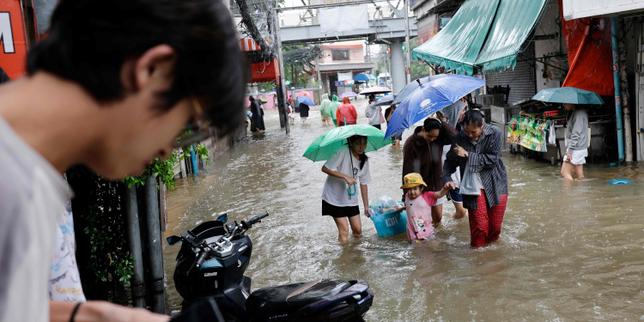
By the time the state of emergency was declared, the water was no longer a minor inconvenience. It was a creeping tide that erased the boundary between the sidewalk and the street, turning major thoroughfares into opaque, brown rivers where debris floated past stalled commuter buses.
Consider the plight of Mali, a university student living in a rented room in Bang Khen. Her life on any ordinary Tuesday involves navigating a labyrinth of elevated walkways, crowded metro stations, and crowded noodle stalls. On the day the district warnings peaked, her journey home transformed into a desperate navigation exercise. The skytrain stations were bottlenecks of anxious humanity, commuters packed shoulder-to-shoulder, staring at phones displaying real-time flood maps that glowed in ominous shades of red and orange.
When Mali finally stepped off her elevated transit line, she found herself staring at knee-deep water reflecting the neon sign of a convenience store. To reach her apartment building, she had to wade through water that felt suspiciously thick, carrying the runoff of overflowing drainage systems. Every step was an act of faith. Was that a submerged curb or an open manhole cover? Was the current too strong to maintain balance? In that moment, the abstract concept of municipal infrastructure failure became intensely personal, measured in the height of the water against her jeans and the rising panic in her chest.
This is the hidden cost of urban geography meeting climate volatility. Bangkok's predicament is not an isolated catastrophe born of a single bad storm. It is a slow-motion collision between twentieth-century drainage capabilities and twenty-first-century weather extremes. The city's massive flood walls, massive drainage tunnels, and fleet of industrial-sized pumps worked around the clock, pushing millions of cubic meters of water away from the inner commercial core. Yet, when torrential downpours coincide with seasonal king tides—when the Gulf of Thailand swells and pushes back against the river's mouth—even the most powerful pumps are fighting a losing battle against physics.
The response from authorities was swift, yet fraught with the heavy reality of logistical nightmares. Sandbags became the city's primary currency. In neighborhoods like Phra Khanong and Thonburi, shopkeepers and homeowners spent sleepless nights stacking woven bags filled with sand, building makeshift barricades across doorways in a desperate bid to keep the murky tide at bay. The air echoed with the harsh, rattling clatter of gasoline-powered pumps chugging away on street corners, spewing gray water back into the very canals that had just spilled over.
Yet, amid the distress, a profound human resilience emerged. In Somchai’s alley, neighbors who barely exchanged more than a nod during daily commutes suddenly found themselves coordinating rescue efforts. A young man with a modified long-tail boat ferried elderly residents to higher ground, charging nothing. Women on the second floors of shophouses lowered plastic baskets tied to ropes, hauling up bottled water, instant noodles, and dry clothes for those stranded below.
When the state of disaster was declared, it did more than mobilize emergency funds and deploy military personnel to clear blocked drainage grates. It forced a city perpetually obsessed with economic speed and commercial hustle to collectively pause and look down at the water lapping against its foundations.
The waters eventually receded, leaving behind a thick layer of slick, gray silt that coated asphalt, covered shop floors, and clung to the roots of rain-drenched trees. Somchai stood outside his shop with a broom and a hose, washing away the remnants of a week that tested the endurance of concrete and character alike. The motorcycles are running again. The street vendors are back, coaxing blue flames from gas burners under bubbling pots of tom yum soup.
Yet, beneath the revived hum of daily life, a quiet unease remains. The city has dried its streets, but the horizon still holds the heavy, purple-gray clouds of an unpredictable season. Bangkok continues to breathe, sitting precariously between the land and the sea, waiting for the next tide, and hoping the lessons written in the mud will hold when the rain returns.