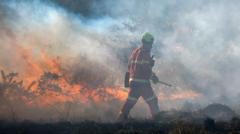
The air in the Scottish Highlands is supposed to smell of damp earth, peat, and cold rain. It is a scent so reliable it feels written into the geology of the place. But on a deceptively beautiful afternoon in late spring, the wind carrying across the hills above Aviemore carries something else entirely.
It is dry. It is hot. It smells faintly of toasted dust.
For most people, this kind of weather is an unmitigated triumph. It is the rare Scottish weekend where the waterproofs stay stuffed at the bottom of the rucksack, and the sun feels like a genuine gift rather than a brief mistake in the cloud cover. Hikers unpack their cars, dust off their walking boots, and head into the hills.
But for someone like Calum—a retained firefighter who spent his morning checking the pressure gauges on an all-terrain water unit—this sudden, glorious heatwave feels less like a holiday and more like a ticking clock.
To understand why Scotland is suddenly on high alert, you have to look closely at what covers these hills. It is not just grass. It is heather, bracken, and gorse. Underneath that vegetation lies peat, a dense, ancient organic matter that has spent thousands of years decomposing in waterlogged conditions. When it is wet, peat is a massive carbon sink, a natural sponge that holds the landscape together.
When it dries out, it becomes something else. Fuel.
The Illusion of Green
We tend to associate devastating wildfires with the sun-baked hills of Southern California or the eucalyptus forests of southeastern Australia. We picture towering walls of orange flame consuming pine trees under a searing, cloudless sky. It is easy to look at the rolling green hills of Inverness-shire or the gentle slopes of the Borders and assume we are safe here.
That is a dangerous illusion.
In early spring and summer, Scotland undergoes a quiet transformation. The dead vegetation from the previous winter—dormant grasses, dried-out bracken, and dead heather stems—remains on the ground. This material is known to fire scientists as "fine fuels." Because it is dead, it cannot draw moisture from the soil. Its water content is entirely at the mercy of the air around it.
When a dry wind blows from the east, it acts like a giant hair dryer. Within hours, the moisture levels in these fine fuels plummet to single digits. The green you see on the hillsides is often just a thin veneer over a massive bed of highly flammable tinder.
Consider a hypothetical scenario that plays out dozens of times every year.
A family finds a beautiful spot beside a shimmering loch. They want to make the most of the rare sunshine, so they set up a disposable barbecue. They place it on what looks like damp, dark soil. They grill their food, enjoy the afternoon, and even pour a bottle of water over the coals before they pack up to leave. They feel responsible. They believe they have done everything right.
But beneath that dark soil lies a layer of dry peat.
The heat from the bottom of the cheap metal tray has already transferred through the thin layer of dirt. Long after the family has driven away, a slow, oxygen-starved smolder begins beneath the surface. It does not produce bright flames or thick black smoke. It just eats away at the dry organic matter, tunneling horizontally under the earth.
Three days later, the wind picks up. The underground smolder reaches a pocket of dry air near the roots of a gorse bush.
Poof.
In a matter of minutes, a hillside is screaming with fire.
The Anatomy of a Modern Blaze
The Scottish Fire and Rescue Service does not issue its "very high" wildfire danger warnings lightly. These alerts are calculated using sophisticated meteorological data that tracks temperature, wind speed, relative humidity, and fuel dryness. When those variables align in a certain way, the fire service knows that any ignition will quickly outpace the ability of local crews to contain it.
What makes these fires particularly brutal to fight is the terrain.
Standard fire engines are designed for tarmac. They are heavy, cumbersome, and useless when a fire is crowning across a pathless ridge three miles from the nearest road. When a call comes in, crews have to rely on argocats—small, six-wheeled vehicles—or simply hike in on foot carrying heavy equipment.
Imagine walking up a one-in-four slope carrying thirty kilograms of gear, wearing heavy, fire-resistant tunic and trousers, while the ambient temperature is already pushing twenty-five degrees. Your breath catches in your throat, not just from the exertion, but from the smoke.
Then there is the tool of choice for a moorland fire. It isn't a high-pressure hose. Often, it is a fire flapper—a long pole with a heavy piece of industrial rubber on the end.
You stand in the heat, swinging this heavy rubber mat down onto the burning heather, trying to smother the flames by cutting off their oxygen. It is backbreaking, exhausting, soul-destroying work. You extinguish one patch, move five yards, and the wind whips up behind you, reigniting the area you just spent twenty minutes clearing.
"People think we just hook up to a hydrant and spray water," Calum says, his hands calloused and stained with carbon. "Out on the hills, there are no hydrants. If we run out of water in our portable tanks, we are fighting it with our hands, beating the ground until our shoulders scream. You go home, wash the soot out of your hair, and you can still smell the burning earth in your lungs two days later."
The Hidden Ecological Bill
When a forest burns in a tropical region, the loss of biodiversity is immediate and visible. In Scotland, the damage is more insidious.
Much of the country's upland areas are designated as protected habitats. They are home to ground-nesting birds like the curlew, the golden plover, and the rare black grouse. Late spring and early summer is the height of the breeding season. When a wildfire sweeps across a moor, it doesn't just destroy the vegetation; it incinerates nests, eggs, and chicks.
The recovery timeline for these ecosystems is measured in decades, not seasons.
Then there is the carbon cost. Scotland has set ambitious targets to reach net-zero emissions. A key part of that strategy involves restoring peatlands to keep carbon locked in the ground. A single major wildfire can release thousands of tonnes of stored carbon back into the atmosphere in a single afternoon, undoing years of hard-won restoration work.
The ground itself changes after a intense fire. The heat can make the soil hydrophobic—meaning it literally repels water. When the inevitable autumn rains finally return, the water cannot penetrate the baked earth. Instead, it sheets off the hillsides, carrying tons of ash and topsoil down into the rivers. This silts up the spawning gravels used by wild Atlantic salmon, choking the life out of the water systems miles away from where the first spark caught.
Everything is connected. The smoke on the hill is just the first chapter in a long, quiet disaster.
The Burden of Vigilance
The fire service is not asking people to stay indoors. Nobody wants to lock the gates to the countryside. The Right to Roam is a cherished part of Scottish culture, a hard-won freedom that allows people to connect with some of the most spectacular wild spaces in Europe.
But freedom comes with a quiet contract.
Right now, that contract requires a level of awareness that goes beyond the ordinary. It means recognizing that the ground under your feet is not as damp and resilient as it looks.
It means leaving the disposable barbecues at home. Entirely. There is no safe way to use them on dry grass or peat.
It means thinking twice before discarding a cigarette butt from a car window, or even leaving a glass bottle lying on the forest floor, where it can act as a magnifying lens under the midday sun.
It means watching the horizon. If you see smoke in the hills, do not assume someone else has called it in. Report it immediately. Give the emergency services a precise location using modern mapping apps. A ten-minute delay can be the difference between a one-acre burn and a five-mile disaster that shuts down major trunk roads and threatens rural communities.
As the sun begins to dip behind the western ridges, casting long, dramatic shadows across the heather, the wind finally begins to drop. For now, the hills are quiet. But the ground remains dry, waiting for the heat of tomorrow.
We are all temporary custodians of these spaces. The beauty of the Highlands is ours to enjoy, but its survival depends entirely on our willingness to look at a warm, sunny day and see the fragility hidden just beneath the green.