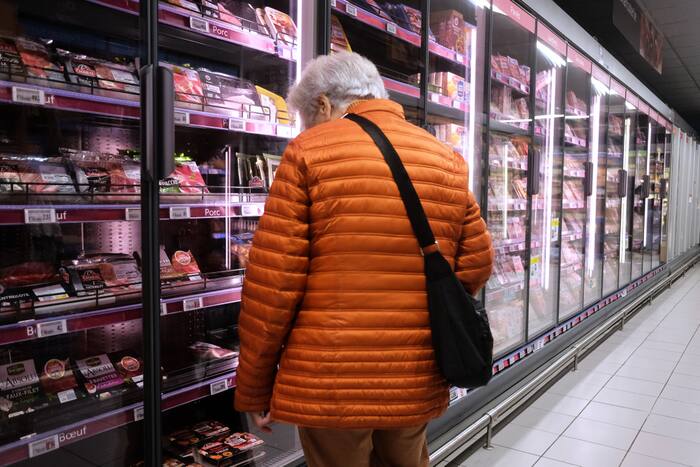
Silence.
That is the first thing you notice when a grocery store dies, not the dark, because emergency lights always flick on with a cheap, humming buzz, but the sudden absence of the low, mechanical thrum that keeps twenty tons of butter, raw poultry, and insulin from turning into poison.
I learned that sound in my twenties, working the night shift stocking dairy in a mid-sized regional market just outside Lyon, where the compressors behind the milk wall vibrated so steadily you felt them in your molars until the night a blown transformer killed the grid and the whole building exhaled into an eerie, sweating stillness. Within four hours, the plastic jugs began to bloat. Within six, the smell of souring cream crept past the swinging double doors into the dry goods aisle, thick and sweet and vaguely terrifying, because you suddenly realized how thin the wall really is between a normal Tuesday and a localized food emergency.
Now imagine that silence happening without a storm, without a blown transformer, and without a single wire being cut.
In a formal diplomatic attribution, French authorities publicly accused state-linked actors operating out of Iran of orchestrating a coordinated series of cyber intrusions targeting the industrial refrigeration systems of major French supermarkets. On the surface, the headline reads like a punchline from a bizarre dystopian sitcom—hackers from Tehran going after Brie and frozen peas. People laughed on social media when the news broke. They made jokes about geopolitical warfare over yogurt.
They stopped laughing when cybersecurity analysts and French officials laid out what actually happened inside the digital plumbing of the modern food supply.
The Invisible Door Behind the Yogurt
To understand why a foreign intelligence apparatus would bother breaking into a supermarket freezer, you have to stop thinking of a refrigerator as a white box plugged into a kitchen wall.
A modern hypermarket is a sprawling, hyper-connected industrial plant disguised as a retail store. Behind the bright fluorescent aisles and cheerful promotional banners sits a web of programmable logic controllers, internet-connected thermostats, automated defrosting valves, and remote maintenance portals managed by third-party contractors. In the industry, we call this operational technology—the hardware and software that directly controls physical machines.
Consider a hypothetical scenario based on the exact vulnerabilities French investigators uncovered. Picture a regional maintenance technician named Laurent, sitting at a desk in a suburb of Nantes, responsible for monitoring the cooling units across forty different stores. Because driving to forty stores every morning is impossible, Laurent uses a remote access portal connected to the open internet to check compressor pressures and adjust temperature thresholds. It is convenient, cheap, and efficient.
It is also an unlocked back door into the physical world.
When state-sponsored intruders scan the internet for exposed industrial control systems, they are not looking for credit card numbers or emails to leak to the press. They are looking for unpatched remote access terminals, default vendor passwords, and flat networks where a compromised temperature sensor sits on the exact same digital highway as a store's central power management and inventory servers.
Once inside, the attacker does not need to write brilliant, Hollywood-style code. They simply turn off an alarm. Then they nudge a setpoint upward by twelve degrees.
Why Target Cold Storage Instead of Banks
For decades, we assumed cyber warfare would look like an explosion. We expected fighter jets falling from the sky, stock exchanges freezing mid-trade, or nuclear centrifuges spinning themselves into scrap metal—the kind of dramatic, cinematic sabotage that makes headlines and triggers immediate military retaliation.
Iranian cyber doctrine, forged under years of intense economic sanctions and asymmetric conflict with Western powers, operates on a much quieter, far more psychological calculus.
If you attack a major European bank or a national power grid, you cross a bright red line. You invite massive diplomatic sanctions, retaliatory cyberstrikes, and unified international outrage. Your target knows immediately that it is at war.
Supermarket refrigeration sits squarely in the gray zone—that murky, frustrating space below the threshold of conventional warfare where plausible deniability thrives and the psychological toll falls directly on ordinary citizens.
Think about what happens when a national grocery chain loses its cold chain across dozens of locations simultaneously during a warm week in late spring. Millions of euros in perishable inventory spoil overnight. Supply chains built on just-in-time delivery suddenly seize up, because warehouses cannot ship fresh meat or dairy to stores that have nowhere cold to put them.
Parents walk into their neighborhood market to buy baby formula or fresh milk and find empty shelves taped off with yellow caution ribbon. Shoppers wonder if the food in the remaining coolers is safe to eat. Rumors spread faster than official press releases. Was it a power failure? Is there a shortage? Should I buy extra cans of soup just in case?
Fear does not require a missile to enter a kitchen. Sometimes all it takes is a warm carton of milk and an empty meat counter.
The Architecture of Fragility
I will be honest with you: when I first began investigating how deeply our everyday food infrastructure is wired into the public internet, the sheer casualness of it made me uneasy. We like to believe that the systems keeping our societies fed and warm are guarded by digital fortresses, monitored twenty-four hours a day by elite engineers in dark rooms.
The reality is far messier, and far more human.
Most supermarket chains operate on razor-thin profit margins, often hovering between one and three percent. Every euro spent on cybersecurity is a euro that does not go toward lowering prices, paying staff, or keeping the lights on. Consequently, security is frequently outsourced to the lowest bidder, while the refrigeration units themselves are maintained by small HVAC companies whose expertise lies in copper piping and refrigerant gases, not cryptographic authentication.
Cybersecurity researchers have documented thousands of internet-facing building management systems across Europe and North America that can be accessed with minimal effort. Many run on legacy software written fifteen years ago, long before anyone imagined that a geopolitical adversary in the Middle East might take an interest in a French hypermarket's compressor array.
But the real problem lies elsewhere—not in the machines themselves, but in our stubborn refusal to treat mundane infrastructure as national security.
We spend billions defending fighter jets and intelligence satellites while leaving the digital switches that control our water treatment plants, grain silos, and cold storage warehouses hanging off standard broadband connections with basic passwords. We built a hyper-efficient world optimized for convenience, and in doing so, we handed anyone with an internet connection and a grudge a lever to pull on our daily lives.
How France Connected the Digital Fingerprints
Attribution in cyberspace is notoriously treacherous, a hall of mirrors where attackers routinely route traffic through compromised home routers in Brazil, rented servers in Germany, and stolen credentials from Eastern Europe to disguise their true origin. When a government stands up and names another nation-state, it is rarely a guess.
French cyber defense authorities—specifically the National Cybersecurity Agency of France, known as ANSSI—spent months tracing the intrusions back through layers of obfuscated infrastructure. What gave the operation away was not a single smoking gun, but a distinct behavioral signature.
State-aligned groups do not behave like common ransomware gangs. A criminal syndicate breaks into a supermarket network, encrypts the servers, and immediately drops a ransom note demanding cryptocurrency within seventy-two hours. They want noise, panic, and a quick payout.
The intruders inside the French refrigeration networks did the opposite. They moved slowly, patiently mapping the internal architecture of the stores, harvesting credentials from maintenance vendors, and testing their ability to manipulate physical environmental controls without triggering immediate shutdowns. Their tools, command-and-control servers, and operational hours aligned with known Iranian state-affiliated clusters—groups historically tied to Tehran's security apparatus that have increasingly shifted toward disruptive, low-cost operations against European targets in response to diplomatic tensions over nuclear negotiations, regional proxies, and sanctions.
By going public with the accusation, Paris broke a long-standing unwritten rule of European diplomacy, which historically preferred quiet behind-the-scenes warnings over public naming and shaming. French officials realized that secrecy was protecting the attacker, not the public. As long as businesses treated these incidents as embarrassing technical glitches rather than acts of foreign interference, nobody would fix the locks.
What Actually Happens When the Cold Chain Breaks
To appreciate the stakes, walk through the lifecycle of a cold-chain failure from the loading dock to the dinner table.
Fresh food is a race against biology. Bacteria like Listeria and Salmonella do not care about geopolitics, diplomatic cables, or firewall configurations; they care only about temperature. Once chilled poultry or unpasteurized cheese climbs above four degrees Celsius for an extended window, microbial growth accelerates exponentially.
In a typical cyber intrusion targeting industrial coolers, attackers exploit what engineers call "gradual drift" or alarm suppression. Instead of crashing the system outright—which immediately alerts a store manager via an audible siren—the malicious command alters the sensor reporting so the central dashboard continues to display a safe, steady two degrees Celsius while the actual compressors sit idle.
By the time a stock clerk notices condensation pooling on the floor or feels lukewarm air brushing their ankles in the dairy aisle, the damage is already irreversible. Food safety regulations in France and across the European Union are strict for good reason: once the cold chain is compromised for an unverified duration, the entire batch must be destroyed. You cannot simply turn the chillers back on and refreeze the inventory.
Multiply that loss across fifty stores in a single weekend. You are looking at hundreds of tons of wasted food, emergency disposal logistics, insurance disputes over whether a state-sponsored cyberattack constitutes an "act of war" excluded from standard commercial policies, and empty shelves in neighborhoods where elderly residents rely on walking to their local market every morning.
Consider what happens next if that same technique is applied not to a retail store, but to a regional pharmaceutical distribution hub storing temperature-sensitive biologics, or a central slaughterhouse supplying half a province. The blueprint is identical. Only the target changes.
Securing the Mundane World
If this sounds overwhelming, it helps to remember that the vulnerability is not magic. It is an engineering problem with clear, proven fixes—provided organizations stop treating operational technology as an afterthought.
The first and most decisive barrier is true network segmentation. A store's public Wi-Fi, point-of-sale registers, corporate email, and refrigeration controllers should never share a path. If an attacker compromises a vendor's laptop or an office computer, they should hit a dead end long before they reach a single compressor valve.
Second, remote access for third-party technicians must abandon simple passwords in favor of multi-factor authentication and zero-trust gateways that grant temporary, strictly monitored access only to the specific unit requiring repair. Convenience can no longer outweigh basic hygiene.
Third, physical fail-safes matter. Modern facilities are increasingly installing independent, analog temperature alarms—hardwired circuits completely disconnected from the internet—that trigger a local siren the moment a freezer warms past a critical threshold, regardless of what the hacked software dashboard claims. Sometimes the smartest defense against a sophisticated digital adversary is a piece of dumb, unhackable copper wire.
Finally, governments and private companies have to share threat intelligence in real time. When a grocery chain in Bordeaux sees an unusual login attempt on its HVAC portal, a competitor in Lille needs to know about it within minutes, not months after a parliamentary inquiry.
The Hum We Take for Granted
We tend to measure national security in dramatic terms—aircraft carriers gliding through contested straits, missile batteries pointed at the horizon, diplomats trading stern warnings under crystal chandeliers.
Yet modern life actually rests on a much quieter foundation. It rests on millions of small, unseen machines humming steadily in the background of our days, keeping water clean, traffic lights synchronized, and food cold while we sleep. For most of human history, keeping food from spoiling required salt, ice harvested from winter lakes, and daily trips to local farms. We traded that labor for a complex, invisible web of sensors and software that works so smoothly we forget it exists until the moment it stops.
Somewhere tonight, in the back room of a neighborhood market, a compressor kicks on with a low, familiar vibration, pushing cold air across rows of milk cartons and fresh greens while a technician checks a screen miles away. Listen closely the next time you walk down the dairy aisle and hear that steady, mechanical hum behind the glass. It is the sound of a fragile truce between convenience and vulnerability—and a reminder that in the twenty-first century, the front line of global conflict runs right past the yogurt.