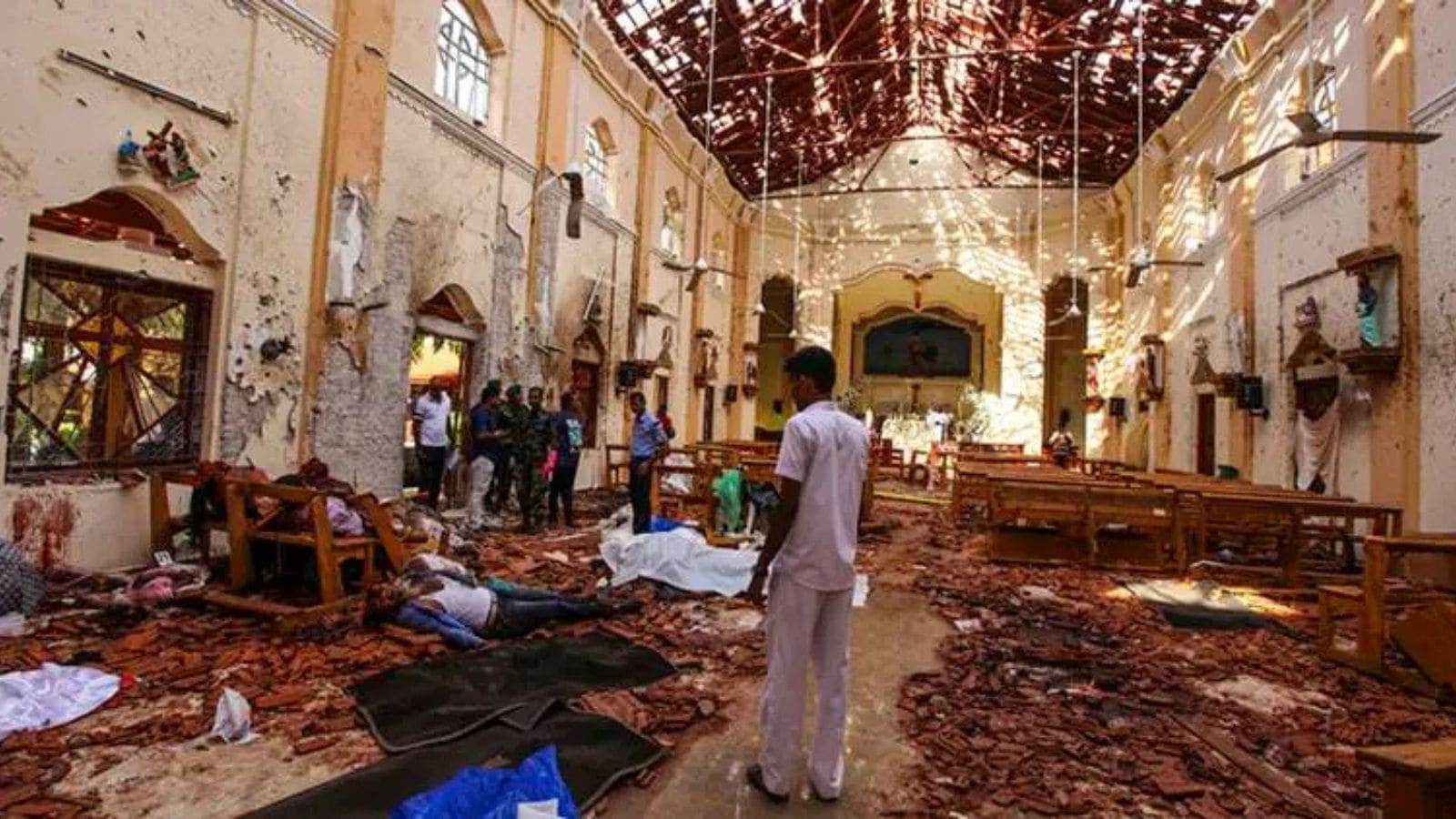
The convergence of intelligence networks and state-level political transitions frequently reveals a structural vulnerability where institutional design becomes decoupled from public security. The formal accusation delivered in parliament by Public Security Minister Ananda Wijepala against retired Major General Tuan Suresh Sallay underscores a systemic breakdown within Sri Lanka’s security architecture. Rather than treating the 2019 Easter Sunday bombings—which resulted in 279 fatalities—as an isolated infiltration by ideological extremists, an objective analysis requires assessing the event through the lens of asymmetric warfare management, institutional capture, and deliberate intelligence steering.
The state's current legal thesis posits that the former head of the State Intelligence Service (SIS) did not merely experience an operational oversight; he actively managed the logistical lifecycle of the National Thowheeth Jama'ath (NTJ) assets. This shift from an omission-based framework (negligence) to a commission-based framework (direction) transforms the understanding of the 2019 security crisis. Understanding the anatomy of this intelligence architecture requires dissecting the specific operational mechanisms, structural incentives, and structural limitations governing Sri Lanka's deep state matrix.
The Tri-Partite Operational Framework of Institutional Capture
The mechanics of state-directed or state-tolerated asymmetric warfare rely on three distinct operational layers. When intelligence architectures interact with radicalized domestic actors, they operate through a defined hierarchy of command, target selection, and information isolation.
+--------------------------------------------------------+
|               Operational Layer 1                      |
|         Strategic Direction & Asset Shielding          |
+--------------------------------------------------------+
                           |
                           v
+--------------------------------------------------------+
|               Operational Layer 2                      |
|         Target Selection & Vulnerability Mapping       |
+--------------------------------------------------------+
                           |
                           v
+--------------------------------------------------------+
|               Operational Layer 3                      |
|         Compartmentalization & Information Laundering  |
+--------------------------------------------------------+
Strategic Direction and Asset Shielding
The first layer requires the creation of an operational buffer zone between the state apparatus and the kinetic actors. The parliamentary investigation indicates that Sallay, while leading military intelligence prior to his formal elevation to the civilian SIS, maintained an active communication loop with local Islamist extremists. Under this model, the state intelligence actor functions as an external advisor.
By meeting with operational field commanders three weeks before the execution date, the intelligence handler stabilizes the cell's internal dynamics, ensuring that local law enforcement interventions are suppressed. The mechanism here is simple: intelligence agencies possess the structural authority to override local police investigations by classifying active terrorist cells as "deep-cover state assets" or "informants," thereby shielding them from premature disruption.
Target Selection and Vulnerability Mapping
The second layer involves optimizing the kinetic impact of the non-state actor. Left to their own devices, decentralized extremist networks frequently choose sub-optimal targets due to resource constraints or poor tactical visibility.
The ministerial brief specifically alleges that the intelligence apparatus identified a primary Roman Catholic church target, mapping congregation densities and assessing local physical security vulnerabilities. This mechanism matches structural military expertise with raw, ideological expendability. The state actor provides the high-value reconnaissance data; the radicalized cell provides the human delivery system.
Compartmentalization and Information Laundering
The final layer depends on blocking internal institutional feedback loops. A modern state security apparatus is multi-layered, consisting of military intelligence, judicial police (such as the Criminal Investigation Department), and foreign signals intelligence. To allow a domestic strike to proceed, a coordinating actor must exploit structural silos. Information regarding impending threats is deliberately isolated:
- Incoming external alerts—such as the precise, real-time telemetry provided by India's Research and Analysis Wing (RAW) prior to April 21, 2019—are intentionally downgraded in priority.
- The dissemination of actionable data to tactical units is delayed through administrative friction.
- Internal investigations targeting the kinetic cell are defunded, rerouted, or closed under the guise of bureaucratic reorganization.
The Political Economy of Managed Crisis
The structural incentives driving the exploitation of asymmetric threats are fundamentally rooted in the political economy of national security branding. The transition of power within highly polarized states often relies on a manufactured demand for centralized authority.
The Security Deficit Function
A democratic state operates under a shifting equilibrium where civil liberties and state expenditure fluctuate based on perceived risk. When a population experiences a prolonged period of relative stability, the political value of a security-first platform depreciates. To engineer a rapid realignment of voter priorities, an artificial "security deficit" must be generated.
$$\text{Security Deficit} = \text{Perceived Threat Level} - \text{Existing Institutional Capacity}$$
When the Perceived Threat Level spikes violently due to a mass-casualty event, the Existing Institutional Capacity is instantly rendered inadequate by the public. This structural deficit can only be closed by a radical expansion of executive authority, increased defense allocations, and the installation of a hardline political regime. The timing of the 2019 attacks—occurring months before a pivotal presidential election—directly matches this model. The immediate deployment of a campaign centered on the total eradication of Islamist extremism by Gotabaya Rajapaksa illustrates how a security deficit can be leveraged into a decisive electoral mandate.
Electoral Return on Kinetic Chaos
The strategic utility of domestic terrorism within an electoral cycle can be mapped through a multi-stage feedback loop:
- De-stabilization: Coordinated strikes on high-value economic and religious targets (luxury hotels and churches) destroy the public's confidence in the ruling civilian administration's capacity to protect the state.
- Polarization: The identity of the perpetrators triggers immediate ethno-religious polarization, marginalizing moderate political voices and centralizing public discourse around tribal security.
- The Savior Synthesis: A political actor embedded within the traditional military establishment presents a pre-engineered solution to the exact vulnerability that was allowed to manifest.
Methodological Limitations and Investigative Bottlenecks
While the parliamentary declarations by Minister Wijepala represent a significant shift in official state narrative, a rigorous analytical assessment must identify the systemic limitations embedded within the current judicial and investigative frameworks. The present state apparatus operates under real-world constraints that introduce significant noise into the evidentiary chain.
| Investigative Dimension | Structural Bottleneck | Systemic Risk |
|---|---|---|
| Evidentiary Integrity | Reliance on historical whistleblower testimonies (e.g., the 2023 Channel 4 disclosures) rather than contemporaneous digital forensics. | Political politicization of state evidence files depending on which faction controls the Ministry of Public Security. |
| Legal Framework | Operational deployment of the Prevention of Terrorism Act (PTA) to detain key intelligence figures like Sallay. | The use of extraordinary detention powers can incentivize false confessions or invite challenges regarding human rights compliance. |
| Institutional Resistance | Deeply entrenched networks within the SIS and military intelligence loyal to the former command structure. | Sabotage of internal document repositories, erasure of communication logs, and intimidation of judicial police investigators. |
| Geopolitical Exposure | Intersecting intelligence layers involving regional actors (India, Pakistan) and transnational networks (ISIS core). | Diplomatic pressure to suppress specific cross-border financing links to maintain regional stability. |
The ongoing hunger strike initiated by Sallay following his arrest under the PTA introduces an acute tactical complication for the state. By shifting the conflict into the domain of medical distress and alleged state-sponsored torture—currently under review by a five-member panel of judicial medical experts—the defense aims to delegitimize the state’s investigative process. This dynamic shifts public focus away from empirical forensics and toward procedural human rights violations, a standard counter-measure employed by high-tier intelligence operators when compromised by their own domestic legal systems.
The Structural Realignment of the State Security Apparatus
The current judicial containment strategy executed by the Sri Lankan state—marked by the domestic travel ban imposed on former President Gotabaya Rajapaksa and the deep-tier interrogation of his primary intelligence architect—is not merely punitive. It represents a fundamental structural realignment aimed at neutralizing parallel command structures within the state.
To permanently insulate a state apparatus from internal intelligence manipulation, a specific set of structural counter-measures must be implemented:
- Decoupling Military and Civilian Intelligence: The structural pipeline that allows military intelligence officers to seamlessly transition into civilian domestic intelligence leadership (such as the SIS) must be permanently closed. Military intelligence operates under a wartime doctrine of deception and asset manipulation; civilian intelligence must operate under a constitutional framework of law enforcement integration.
- Independent Oversight Channels: The creation of a permanently staffed, politically insulated Special Prosecutor's Office with unhindered security clearance to audit active intelligence logs in real-time. This directly addresses the institutional demands raised by civil society and religious leadership, such as the Centre for Society and Religion.
- Algorithmic Threat Classification: Removing the human element from primary threat-alert dissemination. When an external partner agency transmits an actionable threat matrix, the data must automatically populate across all defensive tiers simultaneously via encrypted protocols, eliminating the capacity of a single intelligence director to suppress or isolate high-priority warnings.
The survival of the current reformist administration depends on its ability to transition this process from a series of sensational parliamentary disclosures into a transparent, forensic prosecution. If the state fails to produce verified financial, telemetric, and documentary links connecting Sallay to the NTJ cell leaders, the entire investigation risks being dismissed as a political purge. Conversely, if the prosecution successfully substantiates the mechanics of this internal manipulation, it will provide a critical case study in how modern states must defend their intelligence architectures from internal political capture.