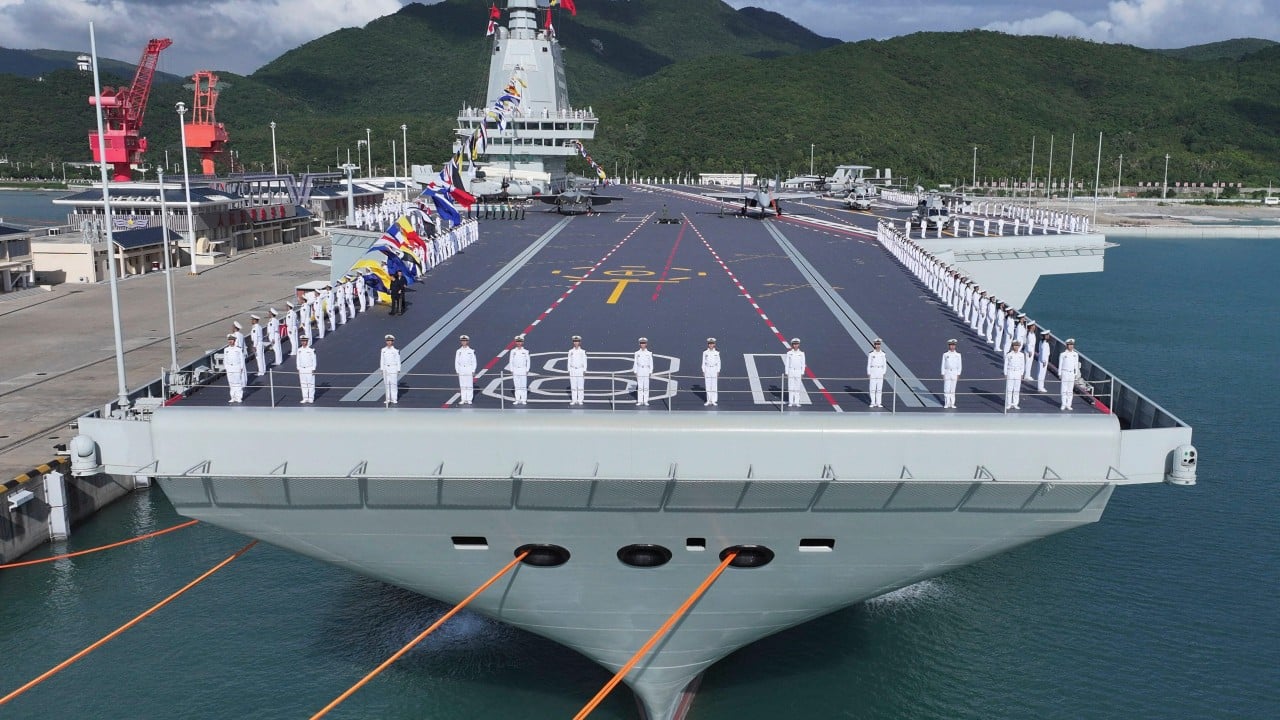
China has established a three-carrier fleet, anchoring its maritime ambitions at the southern tip of Hainan Island. The commissioning of the Type 003 Fujian at the Yulin Naval Base in Sanya solidifies the tropical island as the center of gravity for the People's Liberation Army Navy (PLAN). For years, Western analysts focused heavily on the northern shipyards of Dalian and Jiangnan, viewing them as the birthplace of Chinese naval power. However, building a flattop is entirely different from keeping it alive, supplied, and combat-ready. Hainan Island is the geographical anchor that transforms China’s carriers from vulnerable prestige assets into a sustainable blue-water threat.
The Tyranny of Geography and Geography’s Solution
A modern aircraft carrier requires deep water to operate effectively. The Yellow Sea and the Taiwan Strait are treacherous, shallow choke points. They restrict maneuverability and expose massive hulls to advanced submarine tracking and anti-ship missile batteries.
Hainan offers immediate access to the deep waters of the South China Sea. Just off the coast of Sanya, the seafloor drops sharply into oceanic depths exceeding several thousand meters. This underwater topography allows aircraft carriers like the Shandong and the newly arrived Fujian to clear port and submerge their escorting attack submarines almost instantly into protective deep-water trenches.
This geography provides crucial defensive advantages. By operating from Hainan, a carrier strike group avoids the dangerous transit through narrow passages during a crisis. It positions the fleet directly on the doorstep of the Western Pacific and the critical sea lines of communication running through the Malacca Strait.
Hardened Infrastructure Under the Mountain
The true significance of Hainan extends far beyond its concrete piers. The Longpo and Yulin naval complexes house one of the most sophisticated military infrastructure networks on earth, explicitly engineered to withstand a first-strike scenario.
Subterranean submarine tunnels carved directly into the granite hillsides allow nuclear-powered ballistic missile and attack submarines to enter and exit underwater pens completely hidden from overhead satellite surveillance. This underground network shields the vital underwater escort layer of a carrier strike group from pre-emptive precision strikes.
Logistical capacity on the island has expanded rapidly to match this subterranean protection. Satellite observations confirmed the construction and deployment of a massive, 375-meter-long dry dock at Yulin. The Shandong recently utilized this facility for comprehensive hull maintenance and flight-deck resurfacing.
Historically, a PLAN carrier requiring heavy maintenance had to make the long voyage back north to the Dalian shipyard, leaving a massive operational gap in the south. The operationalization of the Hainan dry dock solves this vulnerability. The PLAN can now maintain, repair, and cycle its capital ships directly within their primary theater of operations.
Sustaining the Catapult Age
The arrival of the Fujian introduces a major technological shift that demands the specialized logistics Hainan is built to provide. Unlike the ski-jump decks of the Liaoning and Shandong, the Fujian utilizes an advanced, medium-voltage direct-current electromagnetic catapult system (EMALS).
[STOBAR: Ski-Jump] -> Limited Max Takeoff Weight (Shandong, Liaoning)
[CATOBAR: EMALS]   -> Maximum Fuel & Payload + Heavy AWACS (Fujian)
This system allows the ship to launch heavier aircraft, including the fifth-generation J-35 stealth fighter and the KJ-600 airborne early warning plane. However, these electromagnetic catapults require an immense amount of power, highly specialized technical oversight, and a continuous supply of high-end components.
Hainan has transformed from a mere forward staging post into an industrial maintenance ecosystem capable of supporting these complex systems. The island hosts massive ammunition depots, specialized aviation fuel storage facilities, and advanced engineering workshops designed to service the intricate electronics of EMALS and modern carrier-borne aircraft.
The Double-Edged Sword of Southern Isolation
Concentrating China's primary naval strike assets on a single island creates distinct tactical vulnerabilities. Hainan is connected to the mainland via the Qiongzhou Strait, relying heavily on rail ferries and civilian transport infrastructure for its fundamental supply lines.
During a high-intensity conflict, an adversary would prioritize isolating the island. Targeting the transport ferries, bridges, and regional electrical grids on the mainland could disrupt the flow of aviation fuel, spare parts, and munitions required to keep a carrier strike group fighting.
The PLAN recognizes this threat. It has aggressively stockpiled long-term reserves within hardened, underground storage facilities across Hainan. The island is also heavily defended by an overlapping network of HQ-9 surface-to-air missile batteries, anti-ship cruise missile sites, and coastal defense fortifications, turning the entire landmass into a heavily armed bastion.
This concentrated defense strategy allows the PLAN to project power effectively across the South China Sea, forcing opposing forces to operate further away from the Chinese mainland. By securing this southern bastion, China ensures its carrier fleet can survive initial hostilities and maintain an operational presence in contested waters.


