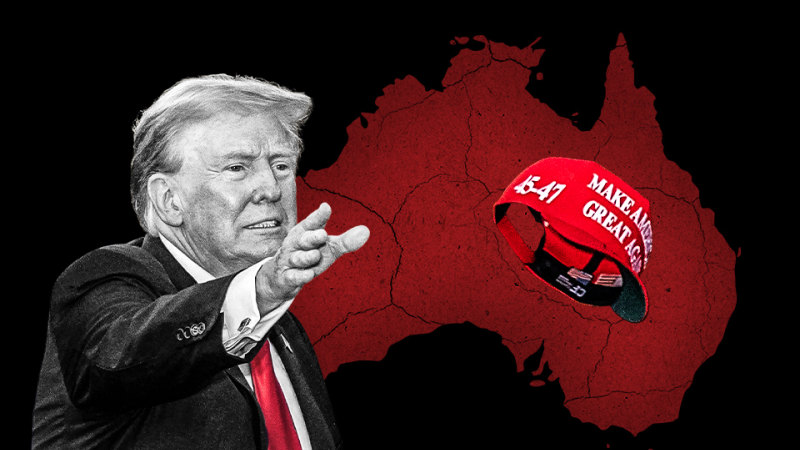
A profound shift is fracturing America's most reliable alliance in the Pacific, and Washington seems completely blind to it. Fresh global data from the Pew Research Center and the Lowy Institute reveals that Australian public opinion toward the United States and President Donald Trump has plummeted to unprecedented lows, with a staggering drop in the percentage of Australians who view the United States as a reliable international partner. For the first time in modern polling history, a majority of Australians now openly declare that their economic and strategic relationship with China carries more weight than their historical ties to Washington. This is not a temporary dip in sentiment. It is a fundamental decoupling of public trust.
For three-quarters of a century, the ANZUS treaty stood as an unshakeable pillar of American geopolitical strategy. Australian troops fought alongside American soldiers in every major conflict since the First World War, creating an institutional bond that policymakers in Washington took for granted. That assumption was a mistake.
The erosion is driven by a deep-seated domestic realization that America's internal political instability and its increasingly transactional approach to foreign policy pose a direct threat to Australian national security. The public is looking across the Pacific and no longer seeing a beacon of stable democracy, but rather an erratic superpower prone to abrupt policy reversals.
The Numbers Behind the Sudden Realignment
The data leaves little room for spin. According to the June 2026 Pew Research Center Global Attitudes Survey, public confidence in the American president to handle world affairs has dropped to a dismal low in Australia, placing the nation among the most skeptical of American leadership globally. Only a tiny fraction of the Australian population expresses faith in the current administration’s foreign policy decisions. More alarming for Washington is the collapse in broader metrics regarding American civil liberties. The share of Australians who believe the United States government respects the personal freedoms of its own citizens has hit its lowest level since tracking began, mirroring a broader international disillusionment with the state of American democracy.
The domestic numbers from Sydney’s Lowy Institute paint an even starker picture of strategic drift. Consider these data points from their recent national audits.
- The China Pivot: Over 51 percent of surveyed Australians now view the relationship with Beijing as more vital to their national interest than the alliance with Washington. This represents a massive eight-point swing in a single year.
- The Trust Gap: Less than a third of the Australian public trusts the United States to act responsibly on the global stage.
- The Alliance Decay: While 73 percent still acknowledge the ANZUS alliance as important for defense, this number reflects a historic, multi-year ten-point drop, marking the sharpest sustained decline in the poll's history.
This is a remarkable turnaround for a country that historically prided itself on being the ultimate ally. The shift is not occurring in a vacuum. It is the direct consequence of how Australia has been forced to navigate the growing cold war between its primary security guarantor and its primary trading partner.
The Friction of a Dual Existence
Australia's entire modern economy was built on a simple, highly profitable contradiction. The country relied on the American security umbrella to protect its borders and trade routes while simultaneously generating trillions of dollars in domestic wealth by feeding China’s insatiable appetite for iron ore, coal, and liquefied natural gas. For decades, Australian politicians repeated the comfortable mantra that Canberra did not have to choose between its history and its geography.
That political luxury has evaporated. As Washington escalated its trade restrictions and technological blocks against Beijing, Australia found itself caught in the crossfire. When Canberra previously called for an international investigation into the origins of COVID-19, Beijing retaliated with a series of brutal, unofficial trade sanctions on Australian wine, barley, beef, and coal.
The lesson Canberra took away from that economic coercion was not what Washington expected. Instead of rushing deeper into the arms of the United States, Australian businesses and working-class citizens realized just how exposed they were. The promised American alternative markets never materialized. When Australian wine producers were cut off from Chinese consumers, American exporters quietly stepped in to fill the void in China, leaving their southern ally holding an empty bag.
The AUKUS Double Standard
Nothing exemplifies the growing elite-public divide in Australia quite like the AUKUS defense pact. Signed with immense fanfare by Washington, London, and Canberra, the agreement binds Australia to a decades-long, multi-hundred-billion-dollar commitment to acquire American Virginia-class nuclear-powered submarines. On paper, elite political support for the pact remains steady at around 68 percent.
Beneath the surface of that consensus lies a profound financial and strategic anxiety that is fueling public resentment. The deal requires Australia to send billions of dollars directly to American shipyards in Virginia and Connecticut to subsidize the expansion of US manufacturing capacity, all while domestic Australian infrastructure, healthcare, and housing sectors face severe funding shortages.
Worse still is the growing realization among Australian defense analysts that the deal strips the nation of its strategic autonomy. If a conflict breaks out over Taiwan, it is functionally impossible for Australia to withhold these submarines from an American-led coalition. The public recognizes this trap. They see a massive transfer of sovereign wealth to a volatile Washington establishment in exchange for military hardware that may not be delivered for another decade, if at all, given America’s own domestic shipbuilding delays.
The Internal Decay of the Superpower Model
The cynicism toward the United States is not merely a reaction to foreign policy choices. It is deeply rooted in a profound cultural rejection of modern American societal norms. For generations, the American lifestyle was exported to Australia as something to emulate. Today, the view from down under is one of profound alarm.
Australians look at the chronic gun violence epidemic, the hyper-polarized media landscape, the rollback of established judicial precedents, and the overt attempts to subvert democratic elections in the United States, and they recoil. The average Australian values a strong social safety net, compulsory voting, and strict gun control laws. The political circus dominating Washington is viewed not as a model of freedom, but as a cautionary tale of institutional collapse.
This cultural alienation directly undermines the soft power that once gave America an edge over autocracies. When the United States lectures the Indo-Pacific region about the rules-based international order and the preservation of democratic values, the rhetoric falls flat. The public increasingly views these pronouncements as hypocritical cover for a desperate superpower attempting to maintain its global hegemony at any cost.
The Independent Path Forward
The strategic community in Canberra is quietly adjusting to this new reality, even if the public rhetoric remains rigidly pro-Washington. A new generation of Australian diplomats and defense thinkers is openly advocating for what they call strategic patience or qualified alignment. They recognize that blindly following Washington into a containment strategy against China is a recipe for economic suicide and potential military ruin.
The path forward for Australia is no longer about choosing between superpowers, but about building a middle-power coalition. Canberra is rapidly expanding its security ties with Japan, India, Indonesia, and America's European partners to create a network of relationships that do not depend on the whims of a volatile electorate in the American Midwest.
Washington must understand that the old era of automatic compliance from its allies is dead. If the United States wishes to regain the trust of the Australian public, it must demonstrate that it can govern itself effectively at home, honor its economic commitments abroad, and treat its partners as sovereign equals rather than convenient staging grounds for its global rivalries. The shift in Australian sentiment is a clear warning sign that the current trajectory is unsustainable. The alliance will not survive on nostalgia alone.


