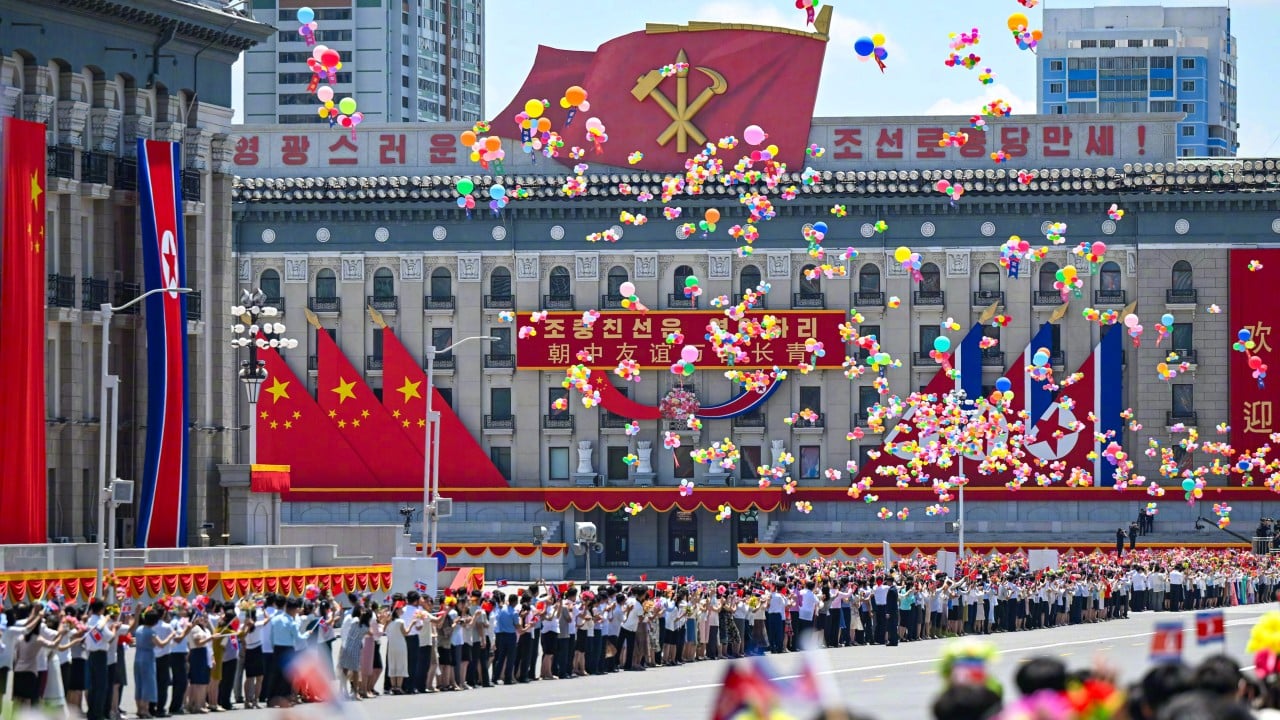
The foreign policy establishment is having another collective meltdown. Chinese President Xi Jinping lands in Pyongyang, Kim Yo-jong releases a blistering statement calling denuclearization an "anachronistic dream," and the Western press corps reacts with predictable shock. The lazy consensus dominating the headlines is that denuclearization is "off the table" for this summit.
Here is the uncomfortable truth: you cannot take something off a table it hasn't sat on for over a decade.
The mainstream narrative surrounding Xi’s visit clings to a fundamentally flawed premise. Analysts treat denuclearization as a viable policy goal that is suddenly being derailed by regional friction or North Korea’s growing defense alignment with Russia. This is a complete misreading of reality. Denuclearization is not a pending negotiation point; it is a dead diplomatic fiction preserved only to save face in Washington and Seoul. By treating it as a live issue, Western commentators miss the actual mechanics of the Beijing-Pyongyang axis. Xi is not traveling to North Korea to debate warheads. He is there to manage a cold, transactional hedge against a shifting global order.
The Myth of Shared Sino-American Goals
For years, the State Department has pushed the line that Washington and Beijing share a foundational interest in a denuclearized Korean Peninsula. We saw it again recently when American officials claimed that the US-China summit in Beijing reconfirmed this joint commitment. It is a comforting bedtime story for liberal internationalists. It is also entirely false.
China does not fear a nuclear North Korea half as much as it fears a collapsed North Korea.
I have watched diplomatic circles dance around this reality for a generation. Beijing's primary objective in Northeast Asia is the preservation of a strategic buffer zone. A nuclear-armed Kim Jong-un is an annoyance to Xi; a collapsed regime that brings a unified, US-aligned, democratic Korea right to the Yalu River is an existential security threat.
When the US claims China agrees on "denuclearization," they are conflating China's polite diplomatic rhetoric with its actual policy. China pays lip service to non-proliferation at the United Nations to avoid secondary sanctions and maintain global trade access. But look at what they do, not what they say. Beijing systematically dilutes UN Security Council sanctions, looks the other way on ship-to-ship oil transfers in the Yellow Sea, and ensures food and fuel continue to flow across the border.
Kim Yo-jong’s weekend press release blasting Washington's "daydream" was ostensibly an attack on the US, but the timing was a calculated message delivered straight to Xi’s advancing delegation. Pyongyang was laying down a hard boundary: Do not use our arsenal as a bargaining chip in your trade negotiations with Donald Trump. Xi knows this. He isn't arriving in Pyongyang to play the Western enforcer. He is arriving as the ultimate realist.
The Russia Factor and the Illusion of Chinese Control
Another rampant misconception is that China possesses absolute leverage over North Korea, and that Kim's recent pivot toward Vladimir Putin is a sign of Chinese failure. This view fundamentally misunderstands how Pyongyang plays great powers against each other.
For the past two years, North Korea has reaped massive rewards by supplying conventional munitions and engineering troops to support Russia's war effort. In return, Moscow has provided the Kim regime with advanced military technology, space launch assistance, and a veto on the UN Security Council that effectively paralyzed the UN sanctions monitoring panel.
The Western commentary machine looked at this and concluded China was losing its grip. That is wishful thinking. Xi’s state visit—his first in seven years—is a direct response to this shifting dynamic, but not for the reasons the experts think.
Imagine a scenario where a corporate monopoly suddenly faces a scrappy, aggressive competitor offering cheaper raw materials to its top client. The monopoly doesn't try to shut the client down; it repositions itself as the indispensable premium partner.
China remains North Korea's largest trading partner and economic lifeline. Rice, fertilizer, and consumer goods do not come from a cash-strapped Russia; they come from China. Xi is in Pyongyang to rebalance the scales. He wants to ensure that while Kim enjoys his temporary courtship with Moscow, Pyongyang remembers who holds the keys to its long-term survival. This is about sphere-of-management, not disarmament. Xi will likely offer expanded joint economic zones, agricultural aid, and a resumption of Chinese group tourism. He will do this while completely ignoring the nuclear production plants Kim just flaunted to the state media.
The Price of Realism
Admitting that denuclearization is a dead letter comes with a distinct downside. It means acknowledging that the international non-proliferation regime has failed in Northeast Asia. It means accepting that North Korea is, and will remain, a permanent nuclear weapons state.
This is a bitter pill for Western policymakers because it destroys the entire framework of strategic patience and economic coercion that has dictated US policy for thirty years. If sanctions cannot force denuclearization, then the entire sanctions architecture looks less like a policy and more like a permanent, ineffective tantrum.
But continuing to analyze summits through the lens of a fictional denuclearization goal leads to disastrous strategic blindness. It causes Western leaders to miscalculate how China and North Korea interact. They expect China to act as a responsible global stakeholder by squeezing Kim's nuclear program, and then they are caught flat-footed when Beijing does the exact opposite by deepening economic ties.
Stop Asking the Wrong Question
The media keeps asking: Will Xi convince Kim to return to the negotiating table? This is the wrong question. The real question we should be asking is: What does a normalized, Chinese-backed nuclear North Korea look like in a multipolar world?
In the joint statements coming out of Beijing and Moscow over the last month, the phrase "denuclearization" has conspicuously vanished. Instead, they talk about opposing "hegemonism" and building an "orderly multipolar world." That is the real agenda. Xi’s visit is about integrating North Korea into a broader, anti-Western coalition designed to counter US deterrence strategies in the Indo-Pacific.
While Western analysts wait for a breakthrough on a defunct treaty, the geopolitical landscape is shifting beneath their feet. North Korea is expanding its missile production capacity by 2.5 times under its current five-year plan. It is building 10,000-ton naval destroyers. It is solidifying its status as a permanent nuclear state with the tacit protection of the world's second-largest economy.
Stop looking for denuclearization on the agenda. It was never there. The summit in Pyongyang isn't a failure of diplomacy; it is the formal registration of a new reality. The West can either adapt to a permanently nuclear North Korea anchored firmly within China's orbit, or it can keep chasing anachronistic dreams while its adversaries rewrite the rules of global security.