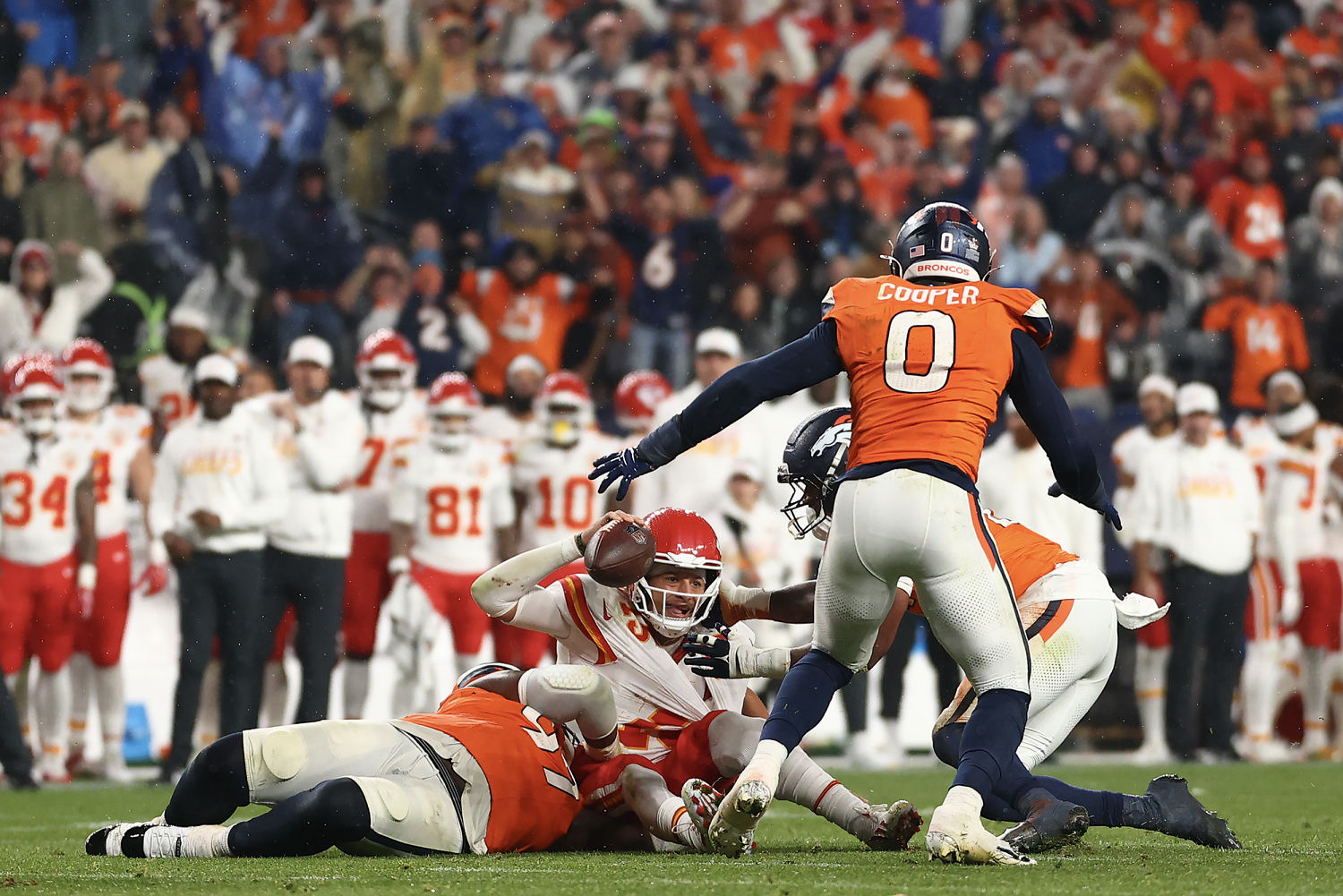
For the better part of a decade, trailing the Kansas City Chiefs in the final two minutes of a football game meant waiting for the inevitable. You watched the clock bleed down, you watched Patrick Mahomes buy three extra seconds in a collapsing pocket, and you watched a tight end or a slot receiver find an inexplicable pocket of grass across the middle. That script has broken down against the Denver Broncos. Denver has stopped relying on luck to survive late-game chaos against Kansas City, instead dismantling the structural assumptions that allow Mahomes to operate when the margin for error disappears.
Most coverage of these AFC West nail-biters reduces the outcome to a coin flip or a sudden lapse in Kansas City execution. That is lazy analysis. When a team repeatedly neutralizes the most dangerous two-minute quarterback of his generation, the explanation lives on the coaching tape, in the salary cap allocation of the defensive front, and in the specific spatial geometry of late-down coverage.
The Myth of Unstoppable Late-Game Improvisation
Every league executive talks about containing Mahomes, yet almost every defensive coordinator panics when the fourth quarter hits the two-minute warning. The standard NFL response to a trailing Kansas City offense is a conservative shell defense designed to prevent the explosive touchdown pass. Coordinators drop seven or eight defenders into zone coverage, rush three or four linemen with lane discipline, and pray the clock runs out before Mahomes reaches the red zone.
Denver recognized a fundamental flaw in that orthodoxy. Passive rush lanes do not contain Mahomes; they give him an unobstructed runway to extend plays until secondary defenders lose their landmarks. Defensive backs cannot cover NFL receivers for six seconds. No scheme in football survives that duration.
Instead of retreating into a soft prevent shell, the Broncos maintained structural aggression at the line of scrimmage while altering the depth of their intermediate zones. By forcing Mahomes to make his initial read before he can drift outside the tackle box, Denver turned his greatest asset—off-schedule creativity—into a liability. When a quarterback expects to have time to improvise and suddenly faces interior pressure inside 2.3 seconds, internal clocks speed up. Footwork gets sloppy. Throws sail high or arrive a fraction of a second late into tightening windows.
Interior Disruption Over Edge Speed
To understand why Denver succeeds where other contenders fail, look at where the pressure originates. Edge rushers rarely bother Mahomes in crucial moments. He senses outside speed, steps up into the pocket, and either scrambles for a first down or delivers a sidearm dart while moving forward.
Interior pressure is different. A defensive tackle collapsing the A-gap eliminates the quarterback's escape hatch. You cannot step up into a 310-pound lineman driving your center backward into your shins.
Denver built its defensive front specifically to win those interior matchups on passing downs. Rather than selling out for pure sack numbers on the perimeter, the Broncos prioritized stout, high-motor interior defenders capable of executing late twists and stunts. When the clock ticks under three minutes and the offense goes empty-backfield, Kansas City's interior offensive line has to pass off looping defenders while communication becomes nearly impossible in a deafening stadium.
The result is rarely a clean, highlight-reel sack. More often, it is a hurried throw off the back foot, a batted pass at the line of scrimmage, or a checkdown thrown two yards short of the sticks. Those micro-wins decide one-score games. In the NFL, forcing an offense to settle for a long field goal attempt—or forcing a fourth-and-long punt—carries the exact same mathematical weight as a turnover.
Disguising the Post-Snap Picture
Mahomes processes pre-snap coverage faster than almost anyone in the sport. If you show him two high safeties before the snap and stay in two high safeties after the snap, he already knows where the ball is going before the center touches it.
Denver stopped giving him free answers at the line of scrimmage.
The Broncos mastered the art of late rotation, holding a single-high safety look until the exact moment the ball is snapped, then spinning into split-field coverages—or vice versa. This forces Mahomes to read the defense post-snap while dealing with immediate interior push. The half-second required to verify whether a cornerback is bailing into a deep third or squatting on an out-route is all the defensive line needs to close the pocket.
Cutting Off the Scramble Drill
When a play breaks down, Kansas City receivers do not stop running. They immediately transition into the scramble drill, working back toward the quarterback or finding dead spots along the sideline. Most defenses lose track of receivers during this phase because defenders watch the quarterback's eyes instead of maintaining leverage on their assigned man.
Denver drilled their secondary relentlessly on plaster coverage—the discipline of sticking to a receiver's hip pocket once the quarterback leaves the tackle box, completely ignoring the backfield until the ball is in the air. By refusing to bite on Mahomes' pump fakes and look-offs, Broncos defensive backs erased the easy 15-yard gains that usually rescue stalled Kansas City drives.
The Hidden Variable of Clock and Field Position
Games are rarely lost on the final play, even when the final play makes the highlight reels. They are lost four possessions earlier in how a coaching staff manages tempo and risk.
Against Kansas City, opponents historically fall into the trap of snapping the ball with fifteen seconds left on the play clock, terrified of falling behind and inadvertently gifting Mahomes two extra possessions in the fourth quarter. Denver flipped that script. By leaning into a methodical, ball-control offensive approach—even when trailing by a field goal—the Broncos compressed the game.
Fewer total possessions increase variance. When a game has twelve possessions per team, the superior offense almost always wins out over sixty minutes. When a game is shortened to eight or nine possessions through sustained drives, third-down conversions, and bleeding the play clock down to one second, every single mistake becomes magnified.
A dropped pass on second down or a false start penalty in the third quarter suddenly carries massive leverage. Kansas City found itself playing in a compressed environment where one stalled drive meant watching the opponent burn six minutes off the clock.
Special Teams as a Decisive Weapon
When two division rivals play within a margin of three points, special teams stops being a background phase of the game and becomes the primary battleground.
In tight AFC West matchups, the difference between winning and losing often comes down to thirty yards of hidden field position and execution on high-leverage kicks. Denver treated special teams with the same tactical obsession as third-down defense. Directional punting that pinned Kansas City inside its own 15-yard line meant Mahomes had to march 85 yards against a fresh pass rush rather than 55 yards against a tired one.
And when the game came down to blocking a kick or hitting a pressure-packed field goal in thin air, Denver's investment in specialized personnel paid off. You cannot manufacture composure in the final ten seconds of a tie game. You build it through repetition in August so that when a snap comes slightly low or an edge rusher gets a hand up in November, the unit does not flinch.
Why the AFC West Dynamic Has Permanently Shifted
For years, the narrative surrounding the division was simple: Kansas City owned the crown, and everyone else was playing for a wild-card spot. That psychological edge alone won the Chiefs half a dozen games a season. Opponents tightened up in the fourth quarter, expecting something to go wrong, and fulfilled their own prophecy.
Denver's ability to close out tight games against Kansas City stripped away that aura of invincibility. Once a locker room proves to itself that it can survive Mahomes' best punch in the final two minutes and walk off the field with a win, the fear evaporates.
This does not mean Kansas City's era of contention is over, nor does it mean Denver has solved Mahomes permanently. Great quarterbacks and great offensive minds adapt. Andy Reid will adjust his protection schemes, lean heavier on quick-game concepts, and find new ways to isolate linebackers in space.
What has changed is the baseline expectation. Winning a close game against the Chiefs no longer requires a miracle bounce or a referee's flag. Denver provided the blueprint for the rest of the league: collapse the interior pocket, disguise the post-snap shell, plaster receivers when the play breaks down, and shorten the game until every single snap feels like fourth down.