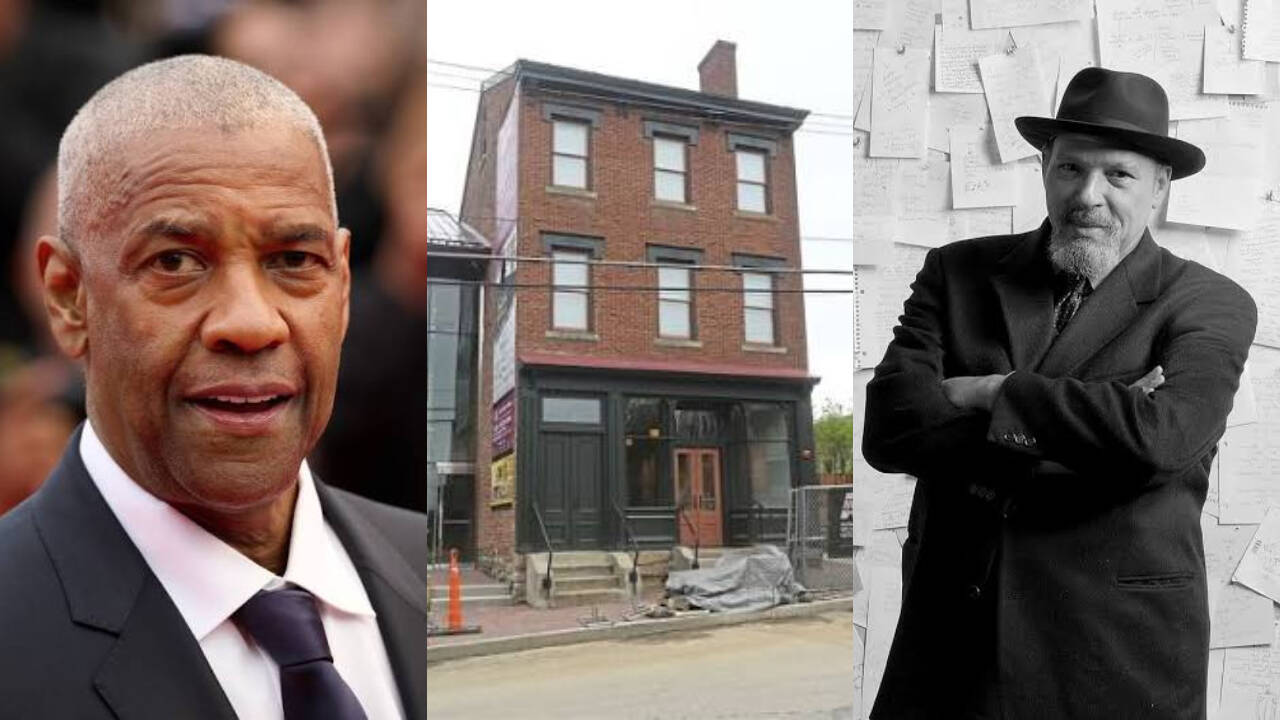
Most celebrity charity projects amount to a photo op, a ribbon cutting, and a press release nobody reads twice. That isn't what happened in Pittsburgh's Hill District. When Denzel Washington stepped up to help rescue August Wilson’s childhood home at 1727 Bedford Avenue, he wasn't just tossing spare cash at a crumbling brick building—he was protecting the physical heartbeat of American theater.
The house looked like a lost cause for decades. Honestly, by the late 2000s, the two-story brick structure where the two-time Pulitzer Prize-winning playwright grew up was rotting from the inside out. The roof had collapsed in sections, weeds choked the yard, and the city of Pittsburgh had it slated for potential demolition. If you walked past it back then, you wouldn't have guessed that this exact building inspired some of the greatest dialogue ever written for the stage.
Today, that same address operates as the August Wilson House, a thriving arts and culture center run by the Daisy Wilson Artist Community. It's a rare victory in historic preservation, and the story of how Washington, local activists, and theater legends pulled it off reveals a lot about what it actually takes to keep cultural history alive.
What Most People Miss About 1727 Bedford Avenue
If you only know August Wilson from the big-screen adaptations of Fences or Ma Rainey’s Black Bottom, you might think of 1727 Bedford Avenue as just another celebrity birthplace. It isn't. For Wilson, this house was his primary classroom.
Born Frederick August Kittel in 1945, Wilson lived in a cramped, cold-water apartment behind a grocery store on Bedford Avenue with his mother, Daisy Wilson, and his five siblings. They didn't have hot running water. They didn't have central heating. What they did have was a front-row seat to the daily rhythms, arguments, heartbreak, and humor of Pittsburgh’s Hill District—a historically Black neighborhood that was once a booming center for jazz and Black business before disastrous "urban renewal" projects tore it apart in the 1950s.
Wilson dropped out of high school at 15 after a teacher accused him of plagiarizing a 20-page paper on Napoleon because the work was "too good" for a Black student. Instead of giving up, he educated himself at the Carnegie Library of Pittsburgh and spent hours listening to the older men talking at Pat’s Place, a local cigar store just down the street from his house.
Everything he absorbed on Bedford Avenue ended up in his American Century Cycle—ten plays, each set in a different decade of the 20th century, chronicling the African American experience. Almost all of them take place in the Hill District. When you read Seven Guitars or King Hedley II, you're basically looking out the windows of 1727 Bedford Avenue. Letting that building fall down would have been like burning the original manuscripts.
How Denzel Washington Actually Got Involved
Denzel Washington didn't wake up one morning and randomly decide to buy real estate in Pennsylvania. His connection to August Wilson is deeply personal, forged in the trenches of Broadway rehearsals and film sets.
Washington first starred in the 2010 Broadway revival of Fences alongside Viola Davis, playing Troy Maxson—a bitter, complex former Negro League baseball player struggling to provide for his family in 1950s Pittsburgh. That production won Washington a Tony Award, and it kicked off a massive personal mission. In 2015, Washington announced a multi-year deal with HBO (later shifting to Netflix) to bring all ten plays of Wilson’s American Century Cycle to the screen as either a producer or director.
Around that same time, Wilson’s niece, Paul Ellis, was fighting an uphill battle in Pittsburgh. Ellis had founded the Daisy Wilson Artist Community—named after August’s mother—with a clear goal. He wanted to buy the decaying house at 1727 Bedford Avenue, stabilize it, and turn it into a hub for local artists and community programs.
The problem? Money. Lots of it. Historic restoration isn't like flipping a suburban house on HGTV. You're dealing with strict preservation codes, structural instability, asbestos, and decades of water damage. Estimates to fully restore the building climbed well past the million-dollar mark.
Washington didn't just write a check and walk away. He lent his name, his fundraising muscle, and significant personal capital to the campaign. Alongside other heavyweights from the Wilson universe—including director Kenny Leon, actor Samuel L. Jackson, and Wilson’s widow, Constanza Romero—Washington helped headline major fundraising pushes that finally gave the project the financial credibility it needed to attract institutional grants.
The Numbers Behind the Rescue
People love a clean Hollywood ending, so the popular narrative often makes it sound like Denzel Washington swooped in with a giant check and fixed everything overnight. That’s simply not true. Preserving the August Wilson House took over a decade of grinding, unglamorous work.
- 2007: The building is officially nominated for historic designation by the City of Pittsburgh, preventing immediate demolition while plans are drawn up.
- 2013: Restoration work begins in earnest, though funding gaps repeatedly slow down physical construction on the site.
- 2016: Washington directs and stars in the film adaptation of Fences, shooting on location in the Hill District. Having a major Hollywood production filming blocks away brings massive international attention—and fresh donations—to the Bedford Avenue project.
- August 2022: After roughly $5 million in total fundraising and painstaking structural reconstruction, the August Wilson House officially opens to the public.
The final price tag wasn't covered by one movie star. It took a coalition of the Richard King Mellon Foundation, the Heinz Endowments, state grants, individual theater fans, and Washington’s high-profile backing. Without Washington amplifying the cause during his Fences press tours, though, raising that kind of money for a single rowhouse in a struggling neighborhood would have been exponentially harder.
Inside the Restored August Wilson House Today
If you visit 1727 Bedford Avenue today, you aren't walking into a dusty museum filled with velvet ropes and "Do Not Touch" signs. August Wilson hated static monuments, and the people running the center made sure it stayed true to his spirit.
The restored property blends historical authenticity with working creative spaces. Architects managed to save much of the original brickwork and layout of the Wilson family’s apartment while upgrading the structure to modern safety and accessibility standards. You can still see the footprint of the small rooms where Daisy Wilson raised her six children, reminding visitors just how tight their living quarters actually were.
More importantly, the building functions as a living incubator for the neighborhood. The center hosts:
- Artist Residencies: Visual artists, playwrights, and musicians from Pittsburgh and across the country receive stipends and studio space to create new work right in the Hill District.
- Youth Arts Education: Local students participate in free writing workshops, theater intensives, and mentorship programs designed to give them the creative outlets Wilson had to fight for on his own.
- Community Gatherings and Performances: The backyard and adjacent lot—which the organization also acquired—now feature an outdoor performance pavilion where local theater companies stage readings, live jazz sets, and community festivals.
It’s a working arts campus. Instead of gentrifying the block with luxury condos, the restoration anchored the street with a resource that directly serves the people who live there.
Why Celebrity Preservation Projects Usually Fail (And Why This One Worked)
Let's be honest about how this usually goes. A famous actor buys a historic landmark, puts their name on a plaque, and five years later the building is shuttered because nobody budgeted for electricity, insurance, or full-time staff. Raising money to build something is easy; raising money to maintain it is brutal.
The August Wilson House avoided that trap because the leadership didn't rely solely on celebrity star power. Paul Ellis and his board built local roots first. They partnered with Pittsburgh foundations, embedded the center into the neighborhood's existing arts ecosystem, and focused on operational sustainability before cutting the ribbon.
Washington understood his role perfectly. He knew he wasn't a community organizer in Pittsburgh, and he didn't try to micromanage the day-to-day operations. He used his platform to open doors that would otherwise stay locked for a small neighborhood nonprofit, then stepped back and let the local team run the show.
That balance is rare. Too often, high-profile donors demand creative control or vanity branding that alienates the exact community the project is supposed to help. By keeping the focus squarely on August Wilson’s mother, Daisy, and the residents of the Hill District, the project earned genuine local buy-in.
How You Can Experience Wilson’s Pittsburgh Yourself
Reading about 1727 Bedford Avenue is one thing, but seeing the geography of Wilson’s plays in person changes how you understand his writing. The Hill District sits on a steep incline overlooking downtown Pittsburgh—you can literally see the gleaming corporate skyscrapers down the hill while standing on streets that still bear the scars of mid-century disinvestment. That visual contrast is the central tension of almost every play Wilson wrote.
If you're planning a trip to Pittsburgh or just want to engage with the work being done at the house, skip the generic tourist bus tours and do it properly:
- Book a guided tour at the August Wilson House: Check the official August Wilson House website before you go. Because it's an active arts center and not a traditional museum, tours and public events run on specific schedules.
- Walk the Hill District self-guided trail: Start at 1727 Bedford Avenue and walk down toward Centre Avenue. You'll pass the sites that inspired the settings for Jitney, Two Trains Running, and The Piano Lesson.
- Visit the August Wilson African American Cultural Center: Located downtown at 980 Liberty Avenue, this separate, massive cultural institution regularly stages productions of Wilson’s plays and hosts exhibitions on Black history in western Pennsylvania.
- Support the residency fund: Small arts centers live and die by recurring donations. Even a modest contribution to the Daisy Wilson Artist Community directly funds supplies and stipends for emerging writers in Pittsburgh.
Denzel Washington could have easily limited his tribute to August Wilson to winning awards on stage and screen. By helping save a crumbling brick house on Bedford Avenue, he made sure the next generation of writers has a place to stand where the master first found his voice.