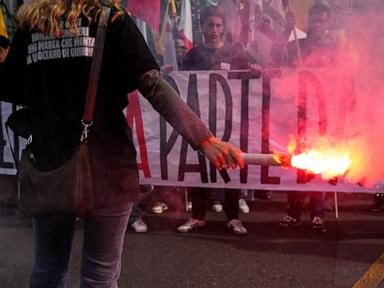
Mainstream coverage of European unrest follows a predictable script. Protesters fill the boulevards, windows shatter, and governments deploy troops to restore order. Legacy outlets frame this as a routine clash between angry citizens and firm state authority.
They are missing the actual story.
Putting hundreds of soldiers onto the streets of Milan is not a display of strength. It is an admission of total institutional bankruptcy. When a modern European democracy has to use military uniforms to guard train stations and public squares during civil demonstrations, the state has already lost the psychological war.
I have spent fifteen years advising municipal risk teams and corporate security directors across Western Europe. I have watched governments burn billions of euros on surface-level deterrence while ignoring the structural rot beneath their feet. The deployment of troops in Italy—mirroring similar knee-jerk reactions from Paris to Brussels—is political theater designed to soothe anxious voters on the evening news. On the ground, it achieves the exact opposite of stability.
The Myth of the Military Deterrent
The lazy consensus among cable news pundits is simple: visible force equals safety. Put armed soldiers in camouflage near sensitive infrastructure, and agitators will think twice before throwing a brick.
Anyone who has actually managed crowd dynamics knows this is nonsense.
Regular infantry soldiers are trained for kinetic warfare, territorial defense, and high-intensity combat. They are not trained in the subtle, high-friction psychology of domestic crowd control. Unlike specialized riot police—such as Italy's Reparti Mobili or France's CRS—standard army personnel lack the legal framework, the non-lethal tactical repertoire, and the de-escalation conditioning required to manage angry civilians without triggering a catastrophe.
When you place soldiers in the middle of a volatile political march, you introduce a rigid, binary variable into a fluid situation. A soldier cannot easily retreat without humiliating the state. A soldier cannot easily engage without risking disproportionate force.
The Escalation Trap
In security circles, we refer to this as the hardening paradox. By hardening the visible perimeter with military personnel, the state signals to radicalized factions that their grievances have reached the level of an existential threat. You validate their narrative. You turn a localized protest over economic stagnation, energy costs, or foreign policy into an insurgency in the minds of the participants.
Consider what happens when a demonstration turns violent in a city center:
- The Target Shifts: Protesters stop shouting at empty ministry buildings and start testing the resolve of the uniform standing ten feet away.
- The Optics Invert: The moment a uniformed soldier shoves a citizen, smartphone cameras capture an image that looks indistinguishable from martial law. That single clip does more to recruit new protesters than a thousand manifestos.
- Police Morale Drops: Civil law enforcement officers view military deployments on domestic soil as a vote of no confidence in their own capabilities.
Italy actually has a long-running precedent for this exact mistake. Launched in 2008, Operazione Strade Sicure (Operation Safe Streets) was sold to the public as a temporary measure to assist local police with urban crime and counter-terrorism. Nearly two decades later, thousands of Italian soldiers remain permanently stationed at metro exits, embassies, and monuments.
Temporary emergency measures never expire. They simply become permanent crutches for underfunded, demoralized police departments.
Why European Protests Are Fundamentally Different Now
To understand why the Milan deployment is a strategic blunder, you have to look at how European street mobilization has mutated over the past decade.
Traditional protests were vertical. A labor union, a political party, or a student federation organized a march. They negotiated a route with the Questura (the local police headquarters). They provided their own marshals to keep the crowd in line. If things got out of hand, the police knew exactly whose phone number to call to cool the temperature.
Today, European protests are horizontal, leaderless, and algorithmic.
From the Gilets Jaunes in France to the farmer blockades in the Netherlands and the sprawling anti-austerity marches across Italy, modern unrest has no central command structure. There is no union boss to strike a backroom deal with the Interior Minister. Mobilization happens in encrypted messaging groups and hyper-local social feeds, coalescing in hours and dispersing just as fast.
Deploying battalion-sized formations to counter a decentralized network is like trying to swat mosquitoes with a sledgehammer. You make a lot of noise, break the furniture, and miss the target entirely.
The Economics of Street Anger
Media coverage loves to focus on the immediate spark—a new tax, a transit strike, a geopolitical flashpoint. Focusing on the spark allows politicians to pretend the fire is an isolated incident.
The fuel is structural economic compression. Across the Eurozone, real wages have struggled to keep pace with the compounding shock of housing inflation, energy transition costs, and stagnant industrial output. Northern Italy—with Milan as its financial engine—has long carried the fiscal weight of the Italian peninsula. When the middle class in Lombardy feels its purchasing power eroding while municipal costs skyrocket, the resulting anger is not ideological. It is survivalist.
You cannot intimidate economic desperation with a rifle sling. People who believe they have nothing left to lose do not care whether the person blocking the piazza wears a blue police tunic or green army fatigues.
Dismantling the Public Safety Illusion
When news breaks that troops are heading into a major European city, search engines light up with variations of the same anxious questions. Let us strip away the official spin and answer them directly.
Does sending in the army actually make a city safer during protests?
No. It shifts risk rather than reducing it. While a military presence may deter opportunistic petty theft around the specific perimeter of a train station or luxury shopping district like the Quadrilatero della Moda, it pushes volatile crowds into unguarded residential neighborhoods. Worse, it strips experienced police commanders of unified command-and-control, creating friction between military officers and civil authorities over rules of engagement.
Are European governments preparing for widespread civil collapse?
They are not preparing for collapse; they are managing their own political panic. Modern European coalitions are fragile, often held together by razor-thin majorities and populist pressures from both flanks. A single weekend of burning cars in Milan or Paris can tank a prime minister's approval ratings by five points overnight. Sending in the military is a PR reflex designed to project decisiveness to voters who watch television, not a serious tactical solution for the people living in the streets.
Why do local police forces need military backup in the first place?
Because European states hollowed out their domestic policing capacity over twenty years of austerity while simultaneously expanding the list of non-violent speech and administrative infractions police are expected to enforce. Officers are buried under bureaucratic paperwork, retiring early in record numbers, and struggling to recruit replacements. The army is being used as cheap, disciplined labor to plug staffing holes that politicians refuse to fund properly.
The Counter-Intuitive Blueprint for Real Urban Stability
If putting boots on the ground is a trap, what does an effective security doctrine actually look like?
During my years consulting on high-risk urban events, the most stable outcomes never came from overwhelming visual force. They came from asymmetric intelligence, radical restraint, and structural decompression.
Imagine a scenario where a major European capital faces forty-eight hours of coordinated, multi-front protests. The conventional playbook floods the downtown core with armored vans and soldiers. Within three hours, the city center is locked down, commerce halts, and pitched battles erupt at every barricade.
Now look at the contrarian playbook that actually works:
- Keep the Heavy Force Invisible: Keep tactical units staged in reserve out of sight—inside underground garages, side alleys, and staging depots—rather than lining the avenues. Visual provocation is the primary accelerant of crowd violence. When protesters see a wall of shields and rifles, they prepare for a fight. When they see open streets monitored discreetly, the adrenaline drops.
- Invest in Plainclothes Liaison Teams: The Dutch and Scandinavian policing models have proven that specialized, non-confrontational dialogue officers moving inside crowds can isolate violent agitators far more effectively than perimeter guards. When mainstream protesters see the police facilitating their right to march rather than boxing them in, the crowd polices its own radicals.
- Target Logistics, Not Crowds: Violent black-bloc factions rely on pre-positioned caches of projectiles, masks, and incendiary materials, alongside real-time digital coordination. Disrupting those supply lines twelve hours before a march begins neutralizes the threat without a single baton strike in front of the cameras.
- Restore Municipal Sovereignty: Stop treating every local grievance as a national security crisis. When local mayors and police chiefs are allowed to negotiate directly with community leaders without interference from national ministries seeking soundbites, tensions defuse before a single soldier needs to lace up a boot.
The Brutal Trade-Off Nobody Wants to Admit
There is a catch to this approach, and it is the exact reason politicians refuse to adopt it.
Restraint looks weak on a twenty-four-hour news cycle.
If a government holds the military back, keeps riot squads out of sight, and relies on intelligence-led containment, there is always a statistical risk that a fringe group will smash a bank window or spray-paint a monument before plainclothes units can box them in. Opposition politicians will immediately scream that the government has abandoned the city to anarchy. Cable pundits will demand blood.
Deploying hundreds of soldiers to Milan eliminates that political critique instantly. The Interior Minister gets to stand at a podium, point to the troop transports, and claim they took tough action. The trade-off is that they have normalized the militarization of civilian life, degraded the combat readiness of their armed forces, and taught an entire generation of European citizens that the state views them as enemy combatants rather than constituents.
Every time a European democracy calls out the army to handle a domestic protest, it burns a piece of its own legitimacy that it can never buy back.
Stop applauding the uniforms on the street corner. Start asking why the people in charge can no longer govern without them.