The air in Cairo does not merely sit upon your skin; it presses down with the heavy, ancient authority of a city that has watched empires rise, crumble into dust, and get built over by concrete and neon. Stand by the Nile at dusk, and you can smell the damp earth mixing with the exhaust of a million taxis, a scent as old as trade itself.
Down in the commercial district, away from the postcard views of the pyramids, the shopkeepers know a different kind of history. They know it in the price of imported steel, the shifting value of a bank note, and the sudden appearance of heavy machinery bearing unfamiliar logos. They live at the intersection of a quiet, relentless shift in global gravity. You might also find this related article interesting: Stop Sending Helicopters To Nepal And Admit Our Disaster Relief Model Is Broken.
We talk about foreign policy as if it were played on a sterile board with plastic pieces. We draw arrows on maps, talk about billions of dollars in trade deficits, and measure power in aircraft carriers and tariff rates. But power is rarely felt that way on the ground. Power is felt when a harbor crane arrives from halfway across the world, when a bridge spans a river that once divided a nation, or when a quiet diplomatic visit changes the rhythm of a morning commute.
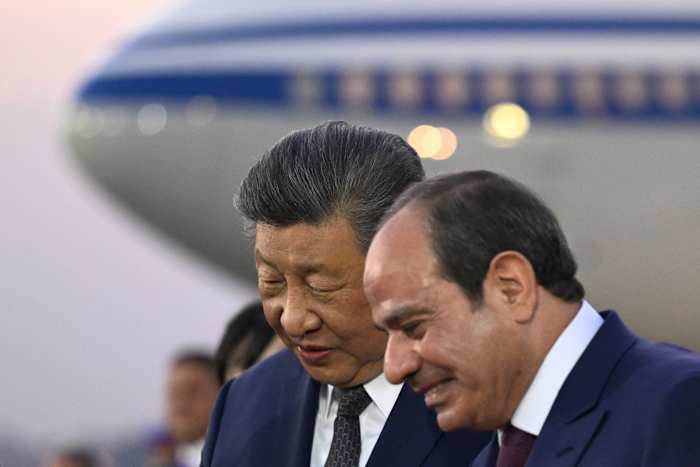
When Xi Jinping stepped off his plane onto the tarmac in Egypt, the headlines back home spoke the usual language of international relations. They used words like strategy, influence, and partnership. They framed it as a chess move in a global contest for the Middle East. As discussed in recent articles by The Guardian, the implications are notable.
Listen. That is the language of people who have never stood in a Cairo alleyway watching the sun turn the dust to gold.
The story of modern geopolitics is not just written in conference rooms. It is written in the asphalt of new administrative capitals rising from the sand, in the quiet hum of fiber-optic cables stretching beneath the Red Sea, and in the choices made by leaders who are tired of looking toward the West for permission to grow.
Consider what happens next: a nation of over one hundred million people needs to feed its cities, power its factories, and build a future for a generation that is overwhelmingly young, restless, and digitally connected. When traditional allies offer lectures on governance, other partners arrive with checkbooks, cement mixers, and very few questions asked.
This is the invisible architecture of a changing world.
To understand why this matters, you have to look at the geometry of modern ambition. Egypt occupies a position that geography has rendered both a blessing and a curse. It sits at the throat of global commerce, guarding the Suez Canal where a single stuck container ship can hold billions of dollars hostage to fortune. For decades, the flow through that narrow trench of water moved overwhelmingly in one direction: toward Western markets, western capital, western validation.
Now, the traffic turns eastward.
Walk through the sprawling expanse of Egypt's New Administrative Capital, a city conjured out of the emptiness east of Cairo like a mirage made of glass and steel. It is designed to project permanence, a monument to a country refusing to stay anchored to its past. Much of the heavy lifting, the literal concrete and scaffolding of this megaproject, bears the quiet footprint of Chinese engineering and finance.
To call this a simple business transaction is to miss the human core entirely.
For the Egyptian engineer managing a crew under the blistering desert sun, this partnership means a paycheck that feeds a family. For the policymakers in Beijing, securing access to the Suez is the arterial lifeline that keeps an industrial economy breathing. It is about oil, yes. It is about shipping lanes, absolutely. But at its most fundamental level, it is about a mutual desire to rewrite the rules of a game that both sides feel was rigged against them from the start.
We often misread these alignments because we look for ideological conversions where none exist. Egypt is not becoming Beijing. Beijing is not adopting the spiritual cadence of the Nile. This is an alliance of convenience born of necessity and ambition. It is a marriage of convenience between an ancient civilization seeking economic salvation and an ascending economic titan seeking strategic breathing room.
The stakes are staggering. When a superpower shifts its gaze toward the cradle of human history, the ripples touch everything. They touch the price of wheat in local markets. They touch the security architectures of the entire region. They touch the quiet calculations of diplomats in Washington and Brussels who suddenly realize they no longer hold the monopoly on salvation.
Stand on the banks of the Nile again, as the call to prayer echoes across the water, bouncing off the hulls of cargo ships and the glass towers of a transforming metropolis. The world is changing its center of gravity. It is happening not with a sudden explosion, but with the steady, rhythmic pounding of pile drivers in the desert sand, building a tomorrow that nobody saw coming.