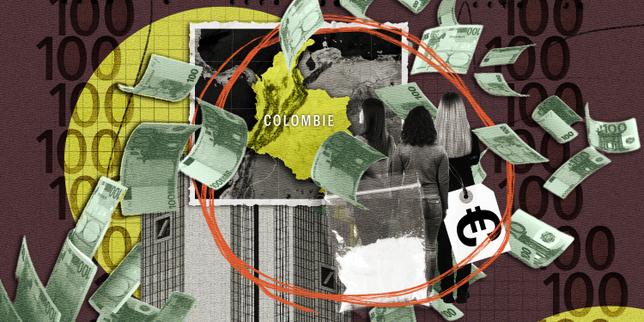
Everyone loves a good villain story. When investigative journalists drop a bombshell about bags of cash moving through Bogotá and correspondent banking lines running wide open at Deutsche Bank, the financial press immediately reaches for the same tired script. They call it a "compliance failure." They describe a "broken faucet" where money flowed unchecked because a few greedy bankers in Latin America looked the other way while Frankfurt slept at the wheel.
That narrative is comforting. It is also completely detached from how global banking actually functions.
If you believe the Deutsche Bank Colombia scandal was an isolated operational slip-up, you don't understand correspondent banking. You are looking at the smoke and pretending the arsonist didn't buy the matches, the gasoline, and the insurance policy. The truth is far less dramatic and infinitely more cynical. In international finance, high-risk liquidity isn't a bug in the system. It is the profit margin.
The Myth of the "Broken Faucet"
Mainstream reporting loves water metaphors. The "tap was left open." The "floodgates burst." These phrases imply passivity, as if compliance officers simply forgot to turn a handle before going home for the weekend.
I have sat in risk committees at Tier-1 institutions where every single red flag was visible on a dashboard in high definition. Nobody forgets to turn off a multi-billion-dollar liquidity tap. Correspondent banking—where a massive global bank like Deutsche Bank provides U.S. dollar clearing services to smaller local banks in emerging markets—is a razor-thin margin business at scale. To make the unit economics work, you need volume. Massive, relentless volume.
When you clear dollars for institutions in jurisdictions with heavy informal economies, strict compliance doesn't just slow down transactions. It kills the business line. Every time a compliance analyst freezes a wire transfer to ask for beneficial ownership documentation on a Colombian import-export firm, the local partner threatens to take their clearing volume to a competitor in Miami, Madrid, or Panama.
So, banks build what insiders quietly call "frictionless corridors." On paper, they have three lines of defense:
- Front-office relationship managers who bring in the fees.
- Middle-office compliance teams who review the alerts.
- Internal audit groups who check the reviewers.
In reality, those three lines bend toward the exact same quarterly revenue target. When the bonus pool depends on emerging market fee growth, the "tap" isn't broken. Someone welded it open.
Why Correspondent Banking Guarantees Illicit Flows
To understand why scandals like Colombia keep repeating at the exact same European and American banks, you have to strip away the moralizing and look at the plumbing.
Global trade runs on the U.S. dollar. If a legitimate coffee exporter in Medellín wants to pay a German machinery supplier, that money almost certainly touches a correspondent account in New York or Frankfurt. Because Deutsche Bank historically acted as one of the world’s premier dollar-clearing houses, it sat at the center of that web.
Here is the mechanics problem nobody wants to admit: at global clearing scale, legitimate trade money and laundered cartel cash look identical.
Trade-Based Money Laundering (TBML) doesn't happen with suitcases of bills anymore. It happens through over-invoicing and under-invoicing legitimate goods. A container of electronics leaves Asia, lands in a free-trade zone in Panama, gets re-invoiced at triple its value, and is paid for via a wire transfer cleared through a reputable European bank.
Compliance software looks for anomalies. TBML mimics normality.
When critics demand that banks "simply stop" illicit flows from high-risk regions, they are asking algorithms to read minds. If a bank tightens its automated filters enough to catch 99% of sophisticated laundering schemes, the false-positive rate explodes to 95%. Suddenly, thousands of legitimate payrolls, agricultural shipments, and medical supply orders get frozen. The bank gets sued by corporate clients, regulators complain about financial exclusion, and the compliance department collapses under a backlog of a million unreviewed alerts.
Banks know this. Regulators like FinCEN and the BaFin in Germany know this too. The entire Anti-Money Laundering (AML) regime operates on a quiet gentlemen's agreement: banks pretend to catch the bad guys by filing Suspicious Activity Reports (SARs), and regulators pretend the system works by levying massive fines every five years.
The Regulatory Fine Is Just a Licensing Fee
Let’s look at the math that boards of directors actually run.
Over the past decade, Deutsche Bank has paid billions in penalties for compliance failures—from the Russian mirror-trading scandal to Jeffrey Epstein, to Danske Bank’s Estonian branch, and straight into its Latin American operations. Every time a new scandal breaks, pundits predict the death of the bank or a total cultural overhaul.
Neither happens. Why? Because deferred prosecution agreements and billion-dollar fines are treated as a cost of doing business, amortizable over the multi-year lifespan of a profitable division.
Consider the timeline of a typical banking scandal:
- Years 1–4: The bank aggressively captures market share in a high-risk region. Revenue surges. Executives collect millions in vested stock and cash bonuses.
- Year 5: A whistleblower leaks documents or a journalist connects the dots. The bank announces an "internal investigation" and pledges "full cooperation."
- Year 7: The bank pays a fine equivalent to roughly 15% to 20% of the gross revenue generated during the boom years. The executives who built the machine have already retired to vineyards in Tuscany or moved on to private equity funds.
- Year 8: Shareholders absorb the hit, the bank hires a new Chief Risk Officer to give speeches about "rebuilding trust," and the cycle resets in a different geography.
Until regulators start putting senior managing directors in prison rather than fining shareholders, the financial incentives remain untouched. A corporate fine is just a retroactive tax on aggressive banking.
Are Regulators Asking the Wrong Question?
Whenever these investigations surface, the public asks: "How did Deutsche Bank’s compliance team miss this?"
That is the wrong question. Compliance didn't miss it. Compliance was structurally designed to look past it without leaving fingerprints.
In large multinational banks, risk management operates through a concept called plausible deniability via fragmentation. The banker in Bogotá knows the client is sketchy, so they keep the weird details off email and pass the onboarding file to a centralized KYC (Know Your Customer) hub in a low-cost jurisdiction like Manila or Jacksonville. The analyst in Jacksonville has 14 minutes to clear the ticket to hit their daily KPI. They check that the passport scan isn't blurry, verify the corporate registry exists, and click Approve.
Neither person committed a crime on paper. The banker didn't sign off on the risk, and the analyst didn't know the local context. The institution absorbs the fee, and nobody is legally culpable when the money turns out to belong to a sanctioned oligarch or a narcotics syndicate.
If you want to understand why this keeps happening, stop asking how compliance failed. Start asking who designed the KPIs for the people approving the accounts.
The De-Risking Trap Nobody Talks About
There is a dark irony to the public outrage over banks doing business in places like Colombia. Every time a scandal breaks, politicians demand that global banks cut ties with high-risk regions entirely.
Banks often comply. It’s called de-risking. Instead of spending hundreds of millions on boots-on-the-ground due diligence in Latin America, Africa, or Southeast Asia, Western banks simply close all correspondent relationships in those countries overnight.
Here is what happens the morning after a major bank pulls out of a developing market:
- Local entrepreneurs, charities, and legitimate exporters lose access to the global dollar system.
- Remittance costs for migrant workers skyrocket, pushing families toward unregulated hawala networks and crypto mixers.
- Legitimate financial activity gets driven underground, making it harder for intelligence agencies to track actual criminals.
By demanding zero tolerance for compliance failures while refusing to accept the high cost of genuine local verification, Western regulators have created a binary choice for banks: either do shady business quietly, or abandon entire nations to financial isolation. Deutsche Bank simply chose to keep the fees rolling until the journalists showed up.
How to Actually Fix Cross-Border Banking Risk
If you are an executive, an investor, or a policymaker who actually cares about stopping illicit financial flows rather than performing outrage for press releases, the current playbook is dead. Adding another 2,000 compliance analysts to read PDFs won't change a thing.
Real reform requires breaking the fundamental incentives of the banking industry:
1. Tie Executive Clawbacks to a 10-Year Tail
Right now, banking bonuses vest over three to five years. Financial crime investigations take seven to ten years to mature. If a managing director knows their deferred compensation can be seized a decade later when a correspondent account blows up, watch how fast they start personally auditing their clients' warehouses in Bogotá.
2. Abolish Self-Policing KYC
Asking a profit-driven bank to police its own clients is like asking a casino to check if the high roller’s cash is stolen. Know Your Customer verification should be stripped out of individual banks and centralized into utility-grade, sovereign-backed registries. If a company wants access to the U.S. dollar clearing system, it passes a standardized, transparent audit once—not fifty superficial checks at fifty competing banks.
3. Price Risk Explicitly Into Clearing Fees
Stop pretending emerging market clearing can be priced like domestic European transfers. If clearing a dollar through a high-corruption jurisdiction requires forensic accounting, charge the counterparty for the forensic accounting. When banks try to compete on low fees in high-risk zones, they always subsidize the discount by cutting corners on due diligence.
4. Accept the Downside of Transparency
We have to admit the uncomfortable trade-off of strict financial policing: if you actually shut the tap off, legitimate economies will bleed. Real AML enforcement means slower global trade, higher costs for consumers, and messy diplomatic fights when Western banks freeze accounts belonging to politically connected elites in allied nations. Until governments are willing to absorb that geopolitical friction, they will continue letting banks play both sides.
Stop Being Shocked by the Fire
The journalists who exposed the inner workings of Deutsche Bank’s Colombian operations did vital work. They pulled back the curtain on the gap between what banks preach in their glossy ESG reports and what they actually tolerate when nobody is watching.
But don't let the outrage fool you into thinking this was an aberration.
Deutsche Bank didn't lose control of its faucet in Colombia. The bank is a machine built to move money across borders at maximum velocity for maximum yield, and in Bogotá, the machine worked exactly as engineered. The scandal isn't that the money flowed without brakes. The scandal is that we still pretend banks ever installed brakes in the first place.