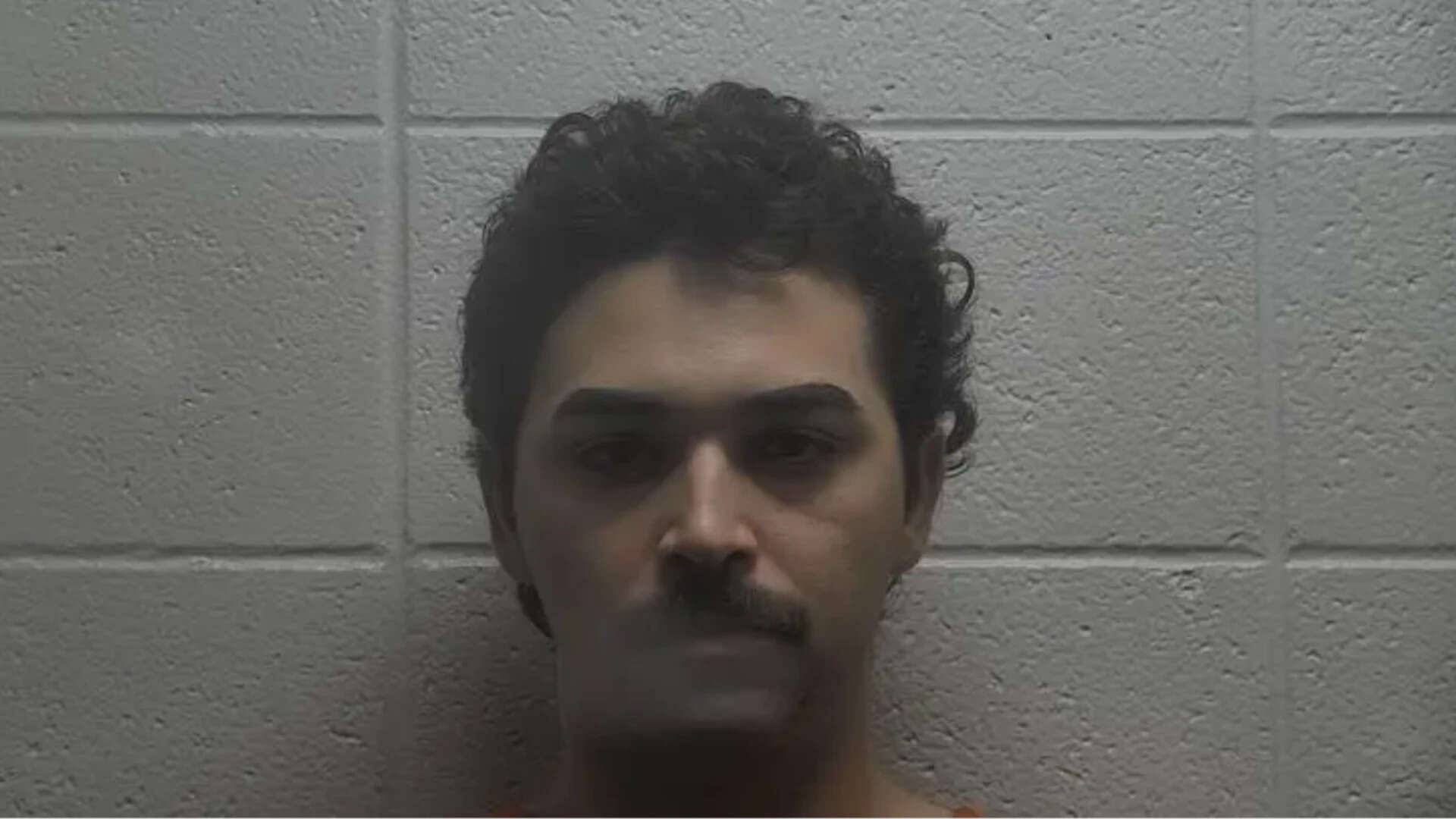
The screen glows with a pale, sickly light in the middle of a Kentucky night. It is a familiar hum, the electric heartbeat of a world that never sleeps, where the distance between a dark thought and a public declaration is only as long as a thumb’s reach to a glass screen. For most, this digital space is a place for cat videos or venting about the price of eggs. For others, it becomes a theater of the macabre.
In Whitley County, the air usually carries the scent of damp earth and woodsmoke. It is a place of quiet hills and long memories. But on a Tuesday that started like any other, that quiet was shattered by the heavy boots of the Secret Service. They weren't there for a local dispute or a routine check. They were there because of the words typed into the void by a man named Jordan Reed.
Reed is now a name etched into federal court records. He is a man who learned, in the harshest way possible, that the First Amendment is not a bulletproof vest against the consequences of violent imagination.
The Anatomy of a Threat
We often treat the internet like a shouting well. we scream into it, assuming our echoes stay at the bottom. But when Reed pulled up his social media account, his echoes didn't just fade. They curdled. According to the federal affidavit, the language used wasn't just angry. It was visceral. It was haunting.
He didn't just say he disliked a political figure. He didn't just voice a grievance against Donald Trump. He detailed a ritual of skinning. He spoke of feeding that skin to stray dogs.
Blood. Bone. The raw, primal imagery of the slaughterhouse.
When a person moves from "I disagree" to "I will flay you," the gears of the state begin to turn with a cold, mechanical precision. The Secret Service doesn't look for nuance in a threat that describes the physical deconstruction of a human being. They look for intent. They look for the capability to act. Most importantly, they look for the line where speech stops being a right and starts being a crime.
The Invisible Stakes of Our Public Square
Imagine a neighbor who stands on his porch and screams at the trees. You might find it odd. You might even feel a twinge of pity. Now, imagine that same neighbor looking directly at you and describing, in anatomical detail, how he would end your life. The air changes. The trees no longer matter. The only thing that exists is the threat hanging in the space between you.
This is the shift that occurred the moment Reed’s finger hit "Post."
Our modern world has collapsed the distance between the fringe and the center. In the past, a man with such dark impulses might have muttered them in a local tavern, or scribbled them in a notebook that never saw the light of day. Today, those impulses are broadcast to the entire world instantly. We are living through a massive, unplanned psychological experiment: what happens to the human brain when it is given a megaphone it was never evolved to handle?
The stakes are not just about one man in Kentucky or one former president. They are about the sanctity of our shared reality. If we allow the language of the butcher shop to become the standard dialect of our political discourse, we lose the ability to see one another as people. We become targets. We become trophies.
The Knock at the Door
There is a specific kind of silence that follows a federal arrest. It is heavy. It is the silence of realization.
When agents arrived at Reed’s door, they weren't just bringing handcuffs. They were bringing the weight of a legal system that has spent decades defining what "true threats" look like. Under 18 U.S. Code § 871, threatening a former president—especially one under active protection—is a felony that carries a potential five-year prison sentence.
It is easy to be brave behind a keyboard. The digital world offers a false sense of anonymity, a shimmering veil that makes us feel like ghosts haunting a machine. But we are not ghosts. We are flesh and blood, tied to physical addresses, bank accounts, and IP logs.
The Secret Service agents who interviewed Reed didn't see a digital warrior. They saw a man. They saw the environment he lived in. They assessed the risk. In their world, there is no such thing as "just a joke" when it involves the mutilation of a human being.
The Psychology of the Extreme
Why does a person reach for such horrific imagery?
Psychologists often speak of "online disinhibition." It is the phenomenon where the lack of eye contact and physical presence causes our social filters to dissolve. We say things online we would never dream of saying to a person's face. But Reed’s words went beyond mere venting. They tapped into something deeper—a dehumanization so complete that the subject of his ire was no longer a person, but a carcass to be fed to animals.
Consider the ripple effect.
When these threats are made, they don't exist in a vacuum. They require a massive mobilization of resources. Tactical teams are briefed. Security perimeters are tightened. Taxpayer dollars are funneled into investigating the validity of a post made in a moment of white-hot rage or profound isolation. Every "edgy" post is a pebble thrown into a pond, and the ripples eventually hit the shore in the form of a knock on the door at 6:00 AM.
The Mirror of Whitley County
Whitley County is a place where people generally want to be left alone to live their lives. It is a place of community and tradition. To have the national spotlight swing its harsh, blinding beam toward a local man for such a gruesome reason is a shock to the system.
It forces a community to look in the mirror.
How much of this vitriol is being brewed in the quiet corners of our own towns? We spend so much time looking at the "other side" across the country that we forget to look at the person sitting three stools down at the diner. We forget that the toxic rhetoric we consume in our feeds eventually leaks out into our physical reality.
Reed’s arrest isn't a victory for one political party over another. It is a sobering reminder that the guardrails of civilization are surprisingly thin. They are held together by a collective agreement that, regardless of how much we despise a leader or a policy, we do not cross the threshold into the language of the dark ages.
The Weight of the Word
Words have mass. They have gravity.
When you type a sentence that describes pulling the skin off a living being, you are creating a weight that you must eventually carry. Jordan Reed is now carrying that weight in a federal holding cell. His journey through the justice system will be long, expensive, and life-altering.
The digital age promised us a global village, a place where we could all connect and share ideas. Instead, we often find ourselves in a global coliseum, where the crowd roars for blood and the gladiators are often just confused men with high-speed internet and too much time to stew in their own grievances.
The Secret Service moved because they had to. They moved because in a world of "what ifs," they cannot afford to ignore the "when."
As the sun sets over the Kentucky hills, the pale glow of millions of screens continues to flicker. Each one is a portal. Each one is a choice. We can use them to build, to learn, and to connect. Or, we can use them to invite the dogs to the feast.
The man from Whitley County made his choice. Now, he sits in the silence of the consequences, while the rest of us are left to wonder just how many more are waiting in the shadows, fingers hovering over the "Post" button, ready to unleash their own nightmares into the light.
The gallows are no longer made of wood and rope; they are built of pixels and code, and we are all, in one way or another, standing on the trapdoor.


:strip_icc()/pic2513216.jpg)