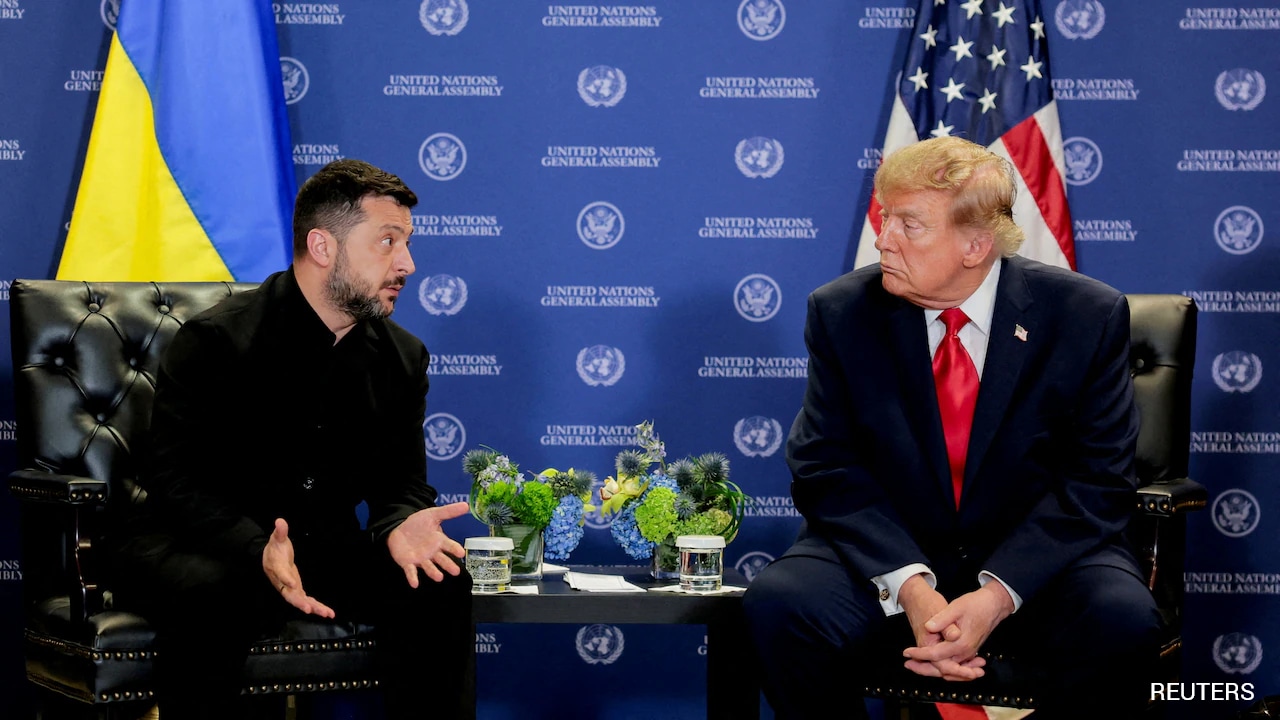
The Negotiator Myth: Why Changing Donald Trump or Volodymyr Zelensky Changes Nothing
The mainstream political commentary loves a simple theater: two men at a table, a handshake, and a signed document. So when Donald Trump suggests Volodymyr Zelensky step aside for "somebody else" to negotiate an end to the Russo-Ukrainian War, the predictable commentary machine instantly fires up. Pundits dissect personalities, analyze personal feuds, and debate whether a fresh diplomatic face could unlock a cease-fire.
It is a complete misdirection. For a different perspective, check out: this related article.
Focusing on the personal chemistry between heads of state ignores the brutal mechanics of statecraft, military capability, and structural incentives. Wars do not end because leaders like each other; they end when the real cost of fighting outstrips the projected benefit for both sides, or when one side loses the material capacity to continue.
Swapping out top diplomats or national leaders does not magically recalculate the math of artillery shell production, defensive depth, energy grids, or territorial defense strategies. Related coverage on this matter has been published by USA Today.
The Lazy Consensus on Diplomatic Breakthroughs
The dominant media narrative operates on three flawed assumptions:
- Diplomacy is a personality game. This view holds that personal friction between specific figures is the primary blocker to peace.
- A "fresh mediator" creates leverage. The assumption here is that replacing individuals changes the underlying structural interests of sovereign states.
- Cease-fires are born out of goodwill. In reality, cease-fires are born out of exhaustion or strategic reprioritization.
Having tracked geopolitics, risk assessment, and conflict economics for two decades, I have seen institutional observers fall into this trap repeatedly. They treat high-stakes geopolitical conflicts like corporate boardrooms where replacing the CEO resolves deep operational dysfunction.
It never works that way.
What the Analysts Miss About Structural Constraints
Imagine a scenario where Ukraine replaces its leadership tomorrow with a purely diplomatic cabinet. Does Russia's war aim—preventing NATO expansion and securing geopolitical leverage over its immediate border—evaporate? No. Does Ukraine's core requirement—sovereign independence, security guarantees, and economic viability—vanish? Absolutely not.
National interests are defined by geography, industrial capacity, alliance commitments, and domestic political survival. Leaders are custodians of these forces, not creators of them.
| Factor | Personal Leadership View | Structural Reality |
|---|---|---|
| Primary Driver | Relationships and rhetoric | Industrial output, ammunition, logistics |
| Leverage Source | Persuasion and negotiation skill | Battlefield position, economic resilience |
| Negotiation Trigger | Mutual respect or strategic diplomacy | High marginal cost of continued combat |
| Outcome Determinant | Agreement terms on paper | Enforceability and long-term deterrence |
Dismantling the Popular Questions Around War Negotiations
"Can a new Ukrainian negotiator break the stalemate?"
No. The stalemate is not a conceptual hurdle; it is a physical and material condition. It is driven by extensive minefields, layered air defenses, drone surveillance that eliminates tactical surprise, and the brutal reality of attritional warfare. Changing the person delivering a diplomat's speech does not supply additional artillery shells, replenish air defense interceptors, or fix severe power grid damage.
"Does Donald Trump's approach offer a faster resolution?"
Public statements about ending conflicts quickly serve political functions for domestic audiences, but rapid resolution in asymmetric high-intensity warfare requires one of two things: total capitulation by one party or a massive, sudden shift in external support.
Without altering the fundamental cost-benefit calculations of either Kyiv or Moscow, verbal demands for new negotiators remain purely symbolic.
"Isn't diplomatic flexibility better than ideological rigidity?"
Flexibility without strategic backing is merely concession. When a nation negotiates from a position where its core security mechanisms are ignored, any resulting contract is inherently unstable. History shows that prematurely forced settlements without explicit, verifiable enforcement mechanisms simply defer the next round of escalation.
The Harsh Reality of Conflict Economics
To understand how this conflict actually resolves, look at the supply chains rather than the press conferences.
- Ammunition and Industrial Capacity: Modern high-intensity warfare eats through munitions at a rate unseen since World War II. Peace terms become real only when one or both industrial bases cannot sustain the burn rate.
- Economic Endurance: Sanctions, defense budgets, energy markets, and sovereign debt levels set the hard boundary conditions for war.
- Domestic Political Costs: Neither government can accept a outcome that threatens its internal stability without risking domestic collapse.
I will be the first to admit the downsides of this cold, structural analysis: it offers no quick fixes, no dramatic diplomatic victories, and no easy political narratives. It forces observers to accept that some conflicts run on systemic momentum that individual personalities cannot simply turn off with a phone call or a change of personnel.
The Strategy Going Forward
Stop evaluating geopolitical strategy through the lens of political soundbites and personality conflicts.
If you want to track where the Russo-Ukrainian War is actually heading, ignore the calls for new negotiators. Track defense manufacturing targets in Europe and the US. Monitor Russian sovereign wealth reserves, energy export revenue, and military recruitment rates. Watch the development of autonomous battlefield systems and air defense supply chains.
That is where the conflict will be decided—not in room swaps at a diplomatic summit.


